𝘚𝘰𝘶𝘵𝘩𝘦𝘳𝘯 𝘈𝘧𝘳𝘪𝘤𝘢 𝘮𝘶𝘴𝘵 𝘯𝘰𝘵 𝘰𝘯𝘭𝘺 𝘤𝘰𝘯𝘴𝘶𝘮𝘦 𝘤𝘺𝘣𝘦𝘳 𝘵𝘩𝘳𝘦𝘢𝘵 𝘪𝘯𝘵𝘦𝘭𝘭𝘪𝘨𝘦𝘯𝘤𝘦. 𝘐𝘵 𝘮𝘶𝘴𝘵 𝘱𝘳𝘰𝘥𝘶𝘤𝘦 𝘪𝘵, 𝘰𝘸𝘯 𝘪𝘵, 𝘴𝘩𝘢𝘳𝘦 𝘪𝘵, 𝘢𝘯𝘥 𝘶𝘴𝘦 𝘪𝘵 𝘵𝘰 𝘥𝘦𝘧𝘦𝘯𝘥 𝘪𝘵𝘴 𝘥𝘪𝘨𝘪𝘵𝘢𝘭 𝘧𝘶𝘵𝘶𝘳𝘦.
Whenever I open my live threat map, I see the same picture. North America, Europe, Russia and East Asia are lit up. Southern Africa looks calm and dry. The same is true for any African Security Operations Centre, and my fellow cybersecurity professionals can attest to this reality.
So, here’s the problem. Last month, I was on a call with a SOC analyst friend of mine in Lusaka as he narrated a SIM swap fraud. He told me, “We had a customer lose their Airtel Money on a Tuesday around 02:30 PM. SIM swap happened instantly. The fraudster got the OTP, reset the PIN, and drained the wallet in 11 minutes. We blocked the number. We flagged the ID used to do the swap. Two days later, the same ID, same face on the CCTV, hit a MoMo agent in Ndola and did it again. So, we caught it. And it still spread. Because we caught it alone. What frustrates me is that we keep doing this. We keep investigating the same attack three times in three countries, like it’s new every time.
Those maps mostly show where the sensors are, not where the attacks are. The quiet is a gap in visibility, and our adversaries are perfectly comfortable working inside our systems.
I have spent the past four years feeding third-party threat intelligence. My biggest frustration has been simple: the global sources rarely describe what is actually hitting us. The picture is different: most organisations are being hit every millisecond. When you cannot see the campaigns aimed at your region, critical infrastructure stays exposed, and the consequences land on real operations.
Meanwhile, the region is digitising fast. Almost every African government is moving services online, banks are scaling digital channels, and telecom operators are connecting millions of people. That is a huge opportunity. But that also raises a hard strategic question we have not answered well as information security professionals: Who is developing the intelligence required to defend Africa’s digital infrastructure?
Our cybersecurity practice should move beyond deploying firewalls, endpoint agents, perimeter controls, or passing ISO/IEC certifications. It should be about understanding our adversaries, anticipating their behaviour, identifying emerging attack patterns, and sharing actionable intelligence before an attack becomes a crisis.
Most of the cyber threat intelligence consumed across Africa originates from international commercial vendors and global research communities. Those feeds are valuable because they provide us with visibility into global malware campaigns, ransomware operations, known vulnerabilities, and emerging threat actors at a global scale.
However, global feeds rarely carry the local African context needed to stop regionally tailored attacks.
Consider a phishing campaign targeting a Zambian financial institution. Security professionals have been discussing a phishing campaign that has been making rounds on the local scene for the past month, involving an adversary impersonating a GBS (telling users to download a receipt because they’ve made a payment by utilising government bus services). In this case, no international feeds flagged it, despite it coming in numbers. The possibility is that international feeds may eventually flag the technical indicators weeks later, and in some cases, when the damage is already done. Local analysts, by contrast, see the campaign unfolding in real time and understand its regional footprint.
Our cybersecurity community should not have to wait for overseas vendors to identify and contextualise threats that African analysts are already observing. We must become producers of intelligence, not merely consumers of it.
Cyber Threats Have No Respect for National Borders
A cyberattack on one SADC member state rarely stays contained within its borders. A compromised telecommunications operator, payment gateway, or cross-border bank can create risks extending beyond national jurisdictions.
We have seen this already in the not-so-distant past.
During Operation Serengeti 2.0, police dismantled a network in Zambia that had scammed about 65,000 people out of roughly $300 million. Sixty-five thousand. That wasn’t just a Zambian problem. It was run through local apps, social engineering, cross-border command-and-control, and 372 forged passports.
Then there was Operation Red Card. SIM-box farms taken down in South Africa were using the same SMS phishing setup to hit mobile money users in Zambia and next door. Same infrastructure. Different countries. Same victims, really.
And TransUnion in 2022. Attackers got in with stolen client credentials and took about 4 TB of data. Millions of people. Hundreds of businesses. That data didn’t stay in Johannesburg. It showed up in account takeovers, application fraud, and social engineering across the region. Because our banks talk to each other. Our telecoms talk to each other. Our supply chains cross borders every day.
So, the attackers are already regional. They already share infrastructure. They already coordinate.
Ransomware, business email compromise (BEC), mobile money fraud, credential theft and attacks on critical infrastructure are increasingly coordinated across jurisdictions. Yet our defensive intelligence remains trapped inside organisational and national silos.
Look at this: When one team in Lusaka blocks a malicious IP. A team in Johannesburg takes down a phishing domain. And a team in Gaborone isolates a banking trojan.
Individually, these observations may appear insignificant. But collectively, they may reveal an organised campaign targeting several Southern African countries.
The intelligence exists, but the ecosystem required to connect it is not sufficiently developed.
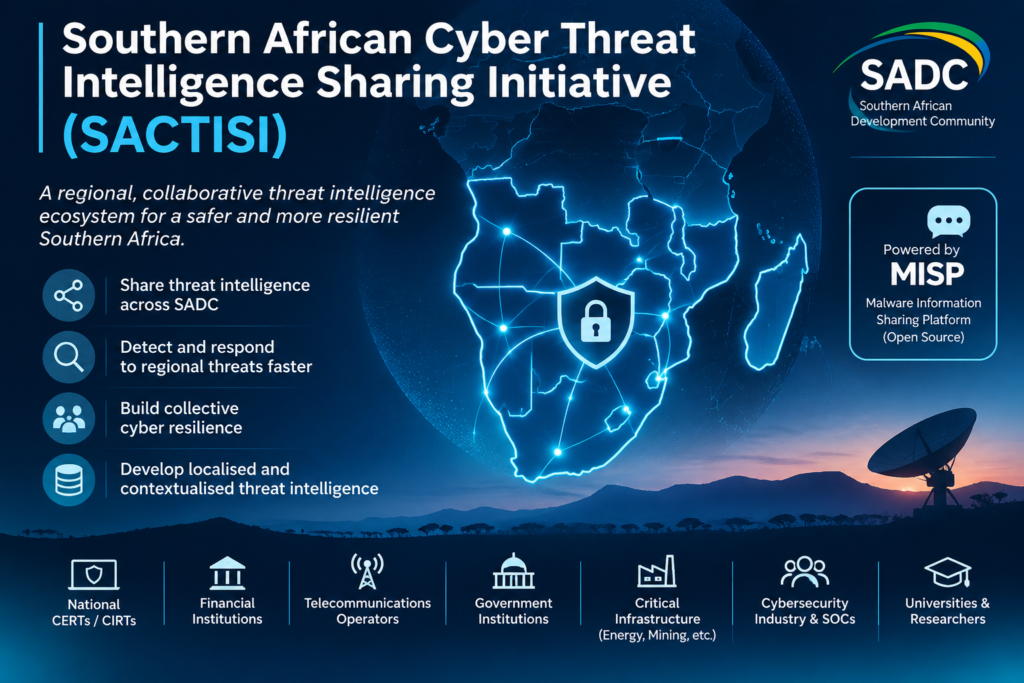
The case for a Southern African Cyber Threat Intelligence Sharing Initiative (SACTISI)
So, here’s what I’m proposing: a Southern African Cyber Threat Intelligence Sharing Initiative (SACTISI). Over the past few weeks, my mind has been crowded with all thoughts and questions, but one standing out that keeps bothering me is, “Why can’t we come up with our own threat intelligence platform (MISP) as Southern Africa?”
What frustrates me is this: The local bank can get an alert for a banking Trojan that had already been seen in South Africa two weeks earlier. Same hash. Same C2. But the SOC team at the bank will do the whole investigation again from scratch, like it was brand new. It wasn’t brand new. The team just hadn’t been told.
SACTISI should create a trusted, federated regional ecosystem through which national cybersecurity authorities, CERTs/CIRTs, financial institutions, telecommunications operators, critical infrastructure providers, cybersecurity companies, universities and independent researchers could contribute and exchange actionable cyber threat intelligence.
Technologically, we do not need to reinvent the wheel. SACTISI can be built on the open-source Malware Information Sharing Platform (MISP), which already supports structured threat correlation, controlled distribution, automated synchronisation between trusted instances, and direct integration with enterprise security technologies such as SIEM and SOAR platforms.
We can build this platform based on our regional cybersecurity requirements. My proposal is about much more than software. It is about building a regional cybersecurity community with the institutional trust, technical expertise and governance arrangements required to share intelligence responsibly.
Six Things We Actually Need To Share
To deliver immediate operational value, I would suggest the regional sharing should focus on six core areas:
- Financial cybercrime intelligence: This is what hits people the most on everyday basis. Mobile money fraud, SIM-swap syndicates, digital banking trojans, payment gateway compromises, regional BEC campaigns, and attacks on financial institutions.
- Telecommunications threat intelligence: Malicious ASN/IP infrastructure, signalling attacks, service disruptions, and threats targeting subscriber-related systems.
- Government and digital identity threats: Campaigns targeting e-government portals, national ID systems, public registries, and digital public infrastructure.
- Critical infrastructure intelligence: Threats affecting energy grids, mining operations, water utilities, transport corridors, healthcare, and industrial control systems (ICS/OT).
- Malware and ransomware intelligence: Localised malware samples, command-and-control (C2) infrastructure, indicators of compromise (IoCs), threat actor techniques and emerging attack campaigns.
- Vulnerability and exploitation intelligence: Active exploitation of technologies widely deployed across the region, particularly where legacy systems and unpatched infrastructure and misconfigurations create regional exposure.
That’s it. Start there. Don’t try to share everything. Share what stops an attack tomorrow
A federated model
I am not arguing for one big central database in one country. No one will trust that, and honestly, no one should. What I’m arguing for is federated. Each country keeps its own MISP. Each country decides what leaves the building. A federated architecture fits this cause.
Under a federated model:
- National control remains intact: each participating country maintains sovereignty over its domestic threat intelligence infrastructure and decides what is shared regionally and under what Traffic Light Protocol (TLP) conditions.
- A regional MISP exchange connects peers: a central exchange environment facilitates approved cross-border correlation without forcing institutions to surrender sensitive operational data.
- Sectoral communities drive speed: Dedicated sharing communities allow banks, telecom operators, energy providers, and other critical infrastructure to exchange sector-specific indicators rapidly. Banks could share the malware and fraud patterns aimed at financial systems, telecom operators could share intelligence on SIM-swap syndicates and signalling abuse, and energy utilities could share threats to their control systems.
Digital sovereignty does not mean digital isolation. It means building the institutional capacity to collaborate across borders without relinquishing control over strategic national interests.
This proposal is not starting from an institutional vacuum. SADC has already made measurable progress in regional cyber cooperation. In October 2026, Luanda hosted the AfricaCERT and SADC Cyber Drill and Cybercrime Cooperation exercise, the seventh SADC cyber drill, which drew 282 delegates from across the region. At the same event, the SADC Secretariat noted that the number of operational national CIRTs in the region had grown from four in 2018 to thirteen in 2026.
SACTISI should reinforce, not duplicate, the SADC Regional CIRT coordination structures and national cybersecurity agencies. Rather than creating another bureaucratic layer, it would provide the technical backbone through which trusted intelligence is generated, validated, and operationalised across the region.
The Cybersecurity Community Must Take Ownership
Governments cannot build this ecosystem alone. The private sector sits on the front lines every day; as a result, they also own the responsibility. Banks, fintechs, telecom operators, managed security service providers (MSSPs), and enterprise security teams see first signs of new attacks every day. Universities and independent researchers contribute valuable technical knowledge, including malware analysis, vulnerability research and emerging threat investigations. The opportunity is to bring these capabilities together.
Imagine a workflow where a threat analyst in Lusaka publishes verified indicators from an attempted payment intrusion, and within minutes, SOC teams in Johannesburg, Gaborone, Harare, Maputo, Dar es Salaam, and Windhoek automatically ingest those rules into their security defences.
Over time, that kind of collaboration would let us track threat actors regionally, build shared malware repositories, and publish an annual Southern African Cyber Threat Landscape Report based on our own telemetry rather than outside estimates.
The Bigger Question: Intelligence Sovereignty
On a daily basis, as cybersecurity professionals, we are always debating digital sovereignty in terms of data localisation, cloud infrastructure, national payment switches, and digital identity. Yet one critical pillar is too often overlooked: intelligence sovereignty.
- Who owns the knowledge about the adversaries targeting our economies?
- Who has the capability to detect multi-country campaigns before they scale?
- Who is building the institutional memory and training the next generation of African threat intelligence analysts?
If our digital infrastructure is increasingly becoming the foundation of our economies, then the intelligence required to defend it must become a strategic regional asset.
A Call To Action
Well, getting SACTISI off the ground needs leadership from:
- SADC cybersecurity coordination structures and national CERTs/CIRTs.
- Central banks, commercial financial institutions, and fintech operators.
- Telecommunications providers and critical infrastructure operators.
- MSSPs, cybersecurity practitioners, universities, and independent researchers.
The first practical step we should take is to conduct a regional feasibility assessment. The second is to pilot an MISP-based sharing environment among willing Member States and sector partners. We can start small, prove the value, and grow as trust grows.
We cannot outsource our cyber resilience forever. We need to see our own threat landscape clearly, investigate our own adversaries, and defend our own digital future.
One Region. Shared Intelligence. Collective Cyber Resilience.
Share your perspective in the comments. #Cybersecurity #DigitalSovereignty #SADC #ThreatIntelligence #MISP #CyberResilience #Africa #Info