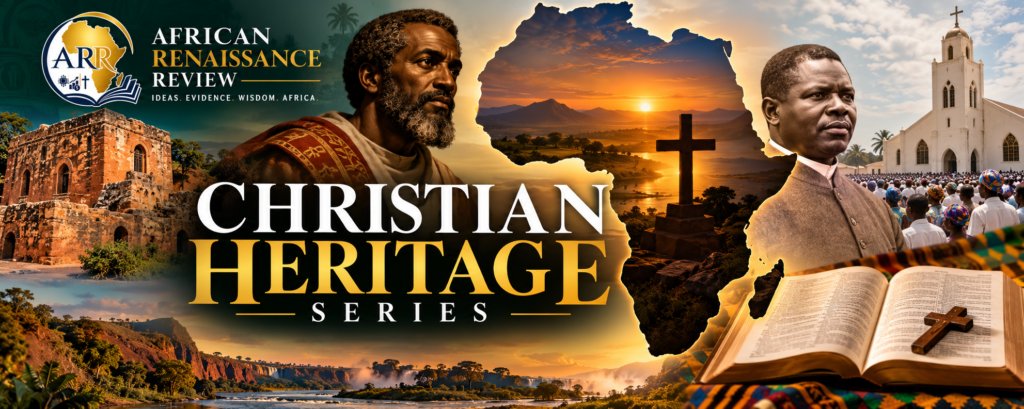
Christians in Alexandria, Carthage, and Aksum wrote theology, established monasteries, and built churches long before any missionary societies reached the continent’s interior. This essay examines that history and why it’s so often absent from the story Africans are told about their own religion.
Introduction
Standard histories of Christianity follow the same pattern. They start in Jerusalem, go through Rome and then to Constantinople, pause at Wittenberg, and end in Africa in the 19th century. Africa is presented as a destination rather than a place where Christianity actually developed.
The historical record doesn’t bear that out. There were Christian communities of some significance in Egypt and in the Roman provinces of North Africa by the close of the 2nd century, and some of the earliest Christian texts in Latin are from Carthage (the record of the martyrs of Scillium, executed in 180 CE, and the prison narrative of Perpetua, who died in the arena at Carthage in 203 CE) (Burns and Jensen 2014). Alexandria was one of the great centres of Christian learning in the ancient world. The monastic life, which was to so profoundly influence mediaeval Europe, originated in the Egyptian desert. By the 4th century, the Kingdom of Aksum (in modern-day northern Ethiopia and Eritrea) had adopted Christianity as the state religion, and the church that developed from it has continued without break to the present day (Isichei 1995).
None of this makes Christianity an African invention, and nothing in what follows depends on that claim. The movement began among Jews in Roman Judaea and spread along the roads and sea lanes that bound Africa, western Asia and southern Europe into a single Mediterranean world. The argument here is narrower and, I think, harder to dismiss. Africa entered the Christian story early, and African communities did much of the work of turning a Palestinian movement into an intellectual and institutional tradition. They interpreted its scriptures, fought over its doctrines, organised its religious life, and, in the Ethiopian highlands, built a Christian civilisation that owed very little to Europe.
The question is far more than one of mere antiquarian interest. Africa is now the continent with the most Christians, yet the version of Christian history that most African Christians are exposed to begins with the arrival of the European missionaries. How much of the earlier history is actually taught in the seminaries, preached from the pulpits and known in the congregations is an open question, and the answer to that question is going to have a profound effect on how African Christians see themselves in a faith which is, demographically at least, more theirs than anyone else’s.
Alexandria and Egyptian Christianity
By the Roman period, Alexandria, founded by Alexander the Great in 331 BCE, had become the Mediterranean’s second city: a port where Greek philosophy, Jewish learning, and Egyptian religion had lived side by side for centuries. Tradition locates the making of the Septuagint, the Greek translation of the Hebrew scriptures that became the Old Testament of the early church, here, and it was here that the Jewish philosopher Philo developed the allegorical reading of scripture that Christian interpreters later adopted.
How Christianity first reached Egypt is unclear. Coptic tradition attributes the founding of the Alexandrian church to Mark the Evangelist, a tradition Eusebius recorded in the fourth century, but the first decades of Egyptian Christianity are almost undocumented. Papyrus fragments of second-century New Testament writings, preserved in the dry Egyptian soil, show that Christian texts were copying and reading texts in the province early on. By the 180s, Alexandria had a school of Christian instruction associated with Pantaenus and, soon afterwards, with Clement.
Clement (c. 150–c. 215 CE) wrote for educated readers trained in Greek philosophy who wanted to know whether the new faith required them to abandon it. Broadly, he answered that philosophy had prepared the Greeks for Christ much as the Law had prepared the Jews. Origen (c. 185–253/254) went further than any Christian before him in treating the Bible as an object of systematic scholarship. His Hexapla set the Hebrew text of the Old Testament beside several Greek versions in parallel columns; his commentaries and homilies covered most of the biblical books; and On First Principles was the first attempt to set out Christian teaching as a coherent body of doctrine. Some of his speculations, notably on the pre-existence of souls, were condemned in the sixth century, long after his death, and he remains a contested figure. Nonetheless, much later exegesis in the Greek East and the Latin West alike is unimaginable without him.
Alexandria also hosted the fourth century’s most consequential doctrinal dispute. The controversy that led to the Council of Nicaea in 325 started as a quarrel within the Alexandrian church between the presbyter Arius and his bishop, Alexander, over whether the Son was eternal or created. Alexander’s successor, Athanasius, bishop from 328 to 373, spent five periods in exile defending the Nicene position, and his Easter letter of 367 contains the earliest surviving list of the twenty-seven books that now make up the New Testament.
The Coptic Tradition
After the Council of Chalcedon in 451, most Egyptian Christians rejected the council’s definition of Christ’s two natures and followed their own patriarchs. The division hardened into a separate church, the Coptic Orthodox Church of today, whose liturgy preserved the Coptic language long after it had ceased to be spoken in daily life. Arab armies conquered Egypt between 639 and 642. Christianity did not disappear; over several centuries of conversion, taxation and periodic pressure, it became a minority faith, and the Coptic church remains the largest Christian community in the Middle East. Its survival, under rulers who were neither Christian nor European, is among the clearest refutations of the idea that African Christianity depended on European protection.
Roman North Africa
West of Egypt, in provinces roughly corresponding to modern Tunisia, eastern Algeria, and coastal Libya, a different Christianity took shape: Latin-speaking, legally minded, and preoccupied with the church’s purity. Rome refounded Carthage as the capital of the province of Africa, making it the second city of the Latin West. Its church produced the first substantial body of Christian literature in Latin, and much of the vocabulary Western theology still uses (Tilley 2006; Burns and Jensen 2014).
Tertullian
Tertullian (c. 155–after 220) was a Carthaginian, probably trained in rhetoric and possibly in law, whose prose is hard to forget: abrasive, epigrammatic and fond of paradox. He wrote apologies defending Christians against the charges brought against them, treatises on Christian conduct and polemics against rival teachers. In Against Praxeas, he is the earliest surviving writer to use the Latin trinitas, describing God as one substance in three persons, a formula later councils refined but did not abandon. Later in life, he associated himself with the New Prophecy, the rigourist movement usually called Montanism, which helps explain why the Latin church remembered him with some ambivalence.
Cyprian of Carthage
Cyprian, a wealthy convert who became bishop of Carthage around 248, faced a different problem. The persecution ordered by the emperor Decius in 250 required citizens to sacrifice to the gods and to obtain a certificate proving that they had done so, and many Christians complied. When the persecution ended, the church had to decide what to do with the lapsed: whether they could be readmitted, on what terms and on whose authority. Cyprian’s answer, set out in On the Lapsed and On the Unity of the Catholic Church, tied reconciliation to penance under the bishop and tied the unity of the church to the unity of its bishops. He was beheaded in 258 under Valerian. His conviction that no one is saved outside the church and his view that baptism given by schismatics was invalid shaped North African Christianity for the next century and a half and eventually set the terms of the Donatist conflict.
Augustine of Hippo
Augustine (354–430) belongs to this tradition and is the subject of the next essay in this series. He was born in Thagaste (modern Souk Ahras, Algeria), educated at Madauros and Carthage, spent most of his adult life as bishop of a provincial African port, and wrote much of his work in response to African controversies. Western philosophy has tended to remember him as a European. That reflects how he was later read, not how he lived (Brown 2013).
The Egyptian Desert and the Beginnings of Monasticism
Christian asceticism did not begin in Egypt, but organised monasticism largely did. In the late third century, some Egyptian Christians began withdrawing from village life to pursue prayer, fasting, and manual labour on the desert’s edge. The most famous was Antony (traditionally c. 251–356), whose reputation spread through the Life of Antony that Athanasius wrote shortly after his death. The book circulated across the Mediterranean in Greek and soon in Latin, and it fixed the desert holy man in the imagination of the whole church. Augustine records in the Confessions that hearing Antony’s story in Milan in 386 helped bring him to conversion.
Pachomius (c. 292–348) gave the movement a communal form. Around 320, he founded a community at Tabennisi in Upper Egypt, where monks lived under a common rule, shared labour and worship, and obeyed a superior. By his death there were several such houses, for women as well as men. The sayings of the Desert Fathers and Mothers, collected and circulated from the fifth century onwards, became a classic of Christian spiritual writing.
The route by which all this reached Western Europe can be traced with some precision. John Cassian lived among Egyptian monks before settling near Marseille early in the fifth century, where he wrote the Institutes and the Conferences to introduce Egyptian monastic teaching to Latin readers. A century later, the Rule of Saint Benedict commended Cassian’s works to its monks. Thus, the Benedictine houses of mediaeval Europe, which preserved so much classical learning, stood in a line of descent from the Egyptian desert. In this case, Africa gave the wider church not a doctrine but a way of organising religious life.
Aksum and Nubia
Aksum was a major power in late antiquity. From its highland capital, it controlled trade between the Red Sea, the Nile Valley and the Indian Ocean through the port of Adulis, minted its own gold coinage and at times ruled across the water in southern Arabia (Phillipson 2009). The third-century prophet Mani is reported to have counted it among the world’s four great kingdoms, alongside Rome, Persia, and China.
The Latin historian Rufinus describes the conversion of its rulers in a work written around 400. In his account, two young Syrian Christians, Frumentius and Aedesius, were seized on the Red Sea coast and brought to the Aksumite court, where Frumentius rose to a position of trust. He later travelled to Alexandria, where Athanasius consecrated him bishop and sent him back. The independent evidence fits the story well. Inscriptions of King Ezana from the middle of the fourth century move from invoking traditional deities to invoking the God of heaven and, in one Greek text, the Father, Son and Holy Spirit, while the crescent and disc on Aksumite coins give way to the cross (Phillipson 2009; Rukuni and Oliver 2019).
The link with Alexandria proved durable. Until 1959, an Egyptian monk appointed by the Coptic patriarch headed the Ethiopian church. Yet the church that grew in the highlands was, in most respects, its own creation. It was worshipped in Ge’ez; it kept a biblical canon broader than that of other churches, including books such as 1 Enoch and Jubilees that survive complete only in Ge’ez; and in the rock-hewn churches of Lalibela it produced one of the great architectural achievements of mediaeval Christianity.
Nubia
Further down the Nile, the Nubian kingdoms of Nobadia, Makuria and Alodia accepted Christianity in the sixth century through missions sent from Constantinople and Alexandria. Christian Nubia lasted nearly a thousand years. When a Polish team excavated the cathedral at Faras in the early 1960s, during the salvage campaign that preceded the flooding of Lake Nasser, it recovered more than a hundred wall paintings that reveal a confident local tradition of Christian art (Welsby 2002). Nubian Christianity declined from the thirteenth century under military pressure from Mamluk Egypt and the southward migration of Arab groups, and by around 1500 it had largely disappeared.
Nubia matters to this argument partly because of how it ended. Its church left buildings, paintings and manuscripts in Greek, Coptic and Old Nubian, but no surviving community of believers. The contrast with Egypt and Ethiopia has prompted a long debate among historians of mission, which we now turn to.
How the African Story Receded
Why, if so much actually happened in Africa, is it so neglected in the way the history of Christianity is normally presented? Part of the answer is simply that the churches themselves didn’t all survive. The Latin church in North Africa didn’t survive into the modern period. It had been weakened by the Vandal invasion in the 5th century and by its own long periods of schism, and it had been slowly eroding after the Arab conquest in the late 7th century and was pretty much gone by the 12th. Calvin Shenk, looking at the four ancient African churches, asked if the key difference was contextual: the churches of Egypt and Ethiopia had been so embedded in the local languages and the local peoples, whereas the Latin church in North Africa had remained so much the church of the Romanised urban population and Nubian Christianity had been so much the church of the royal courts (Shenk 1993). That’s a fairly sharp formulation of the issue, and the thesis has its detractors.
A second part of the answer lies in where historians later wrote the history. Andrew Walls observed that Christian expansion has been serial rather than progressive: the faith has repeatedly declined in its old heartlands while taking root in new ones (Walls 1996). By the time church history became an academic discipline in nineteenth-century Germany and Britain, the old African centres were Coptic, Ethiopian, or extinct, and scholars writing that history saw themselves as heirs of a Latin and Protestant West. Scholars read Augustine as a father of that West, and his African world receded into the background. The colonial period added its own distortion, since the missionary societies that carried Christianity into much of sub-Saharan Africa from the nineteenth century onwards often presented it, without much reflection, as part of a European civilising mission (Hastings 1994).
Since the 1990s, scholarship has pushed back. Kwame Bediako argued that African Christianity should be understood as the renewal of a non-Western religion rather than as a provincial extension of European church history (Bediako 1995), and Thomas Oden made a forceful, at times overstated, case for North Africa as the seedbed of Western Christian thought (Oden 2007). One need not accept every claim in that literature to grant its central complaint. Africans were not latecomers to Christianity; they were present at its formation.
Correcting the record should not produce a new myth in which missionaries figure only as agents of empire. Modern missions built schools, clinics, and printing presses and translated the Bible into hundreds of African languages; Lamin Sanneh argued that vernacular translation strengthened African cultures more than it erased them (Sanneh 1989). African converts, for their part, read the translated scriptures for themselves and drew their own conclusions, sometimes against the missionaries who had given them the text. The third essay in this series examines one such case.
Conclusion
The history surveyed here is uneven. Some of it is well documented; much rests on traditions written down long after the events or on the patient work of archaeologists at sites such as Faras and Aksum. The communities involved also differed greatly. Alexandrian scholars, Carthaginian bishops, Coptic monks, Aksumite kings, and Nubian painters did not share a single African identity, and giving them one would misrepresent them.
What they have in common is that they belong to the history of Christianity as participants rather than recipients. African Christians produced the church’s first great biblical scholar, much of the theological vocabulary of the Latin West, the monastic forms that shaped mediaeval Europe, and one of the world’s oldest continuously surviving churches. A history of Christianity that treats these as a prelude to the real story in Europe is simply a poor history. For African readers, recovering it is less a matter of pride than of accuracy, and accuracy is the only sound foundation for a renaissance worth the name.
References
- Bediako, K. (1995). Christianity in Africa: The Renewal of a Non-Western Religion. Edinburgh: Edinburgh University Press.
- Brown, P. (2013). Augustine of Hippo: A Biography. 45th anniversary edn. Berkeley: University of California Press.
- Burns, J.P. and Jensen, R.M. (2014). Christianity in Roman Africa: The Development of Its Practices and Beliefs. Grand Rapids: Eerdmans.
- Hastings, A. (1994). The Church in Africa, 1450–1950. Oxford: Clarendon Press.
- Isichei, E. (1995). A History of Christianity in Africa: From Antiquity to the Present. London: SPCK; Grand Rapids: Eerdmans.
- Oden, T.C. (2007). How Africa Shaped the Christian Mind: Rediscovering the African Seedbed of Western Christianity. Downers Grove: IVP Academic.
- Phillipson, D.W. (2009). Ancient Churches of Ethiopia: Fourth–Fourteenth Centuries. New Haven: Yale University Press.
- Rukuni, R. and Oliver, E. (2019). ‘Ethiopian Christianity: A continuum of African Early Christian polities’, HTS Teologiese Studies/Theological Studies, 75(1), a5335. doi:10.4102/hts.v75i1.5335.
- Sanneh, L. (1989). Translating the Message: The Missionary Impact on Culture. Maryknoll: Orbis Books.
- Shenk, C.E. (1993). ‘The Demise of the Church in North Africa and Nubia and Its Survival in Egypt and Ethiopia: A Question of Contextualisation?’, Missiology: An International Review, 21(2), pp. 133-154. doi:10.1177/009182969302100201.
- Tilley, M.A. (2006). ‘North Africa’, in Mitchell, M.M. and Young, F.M. (eds) The Cambridge History of Christianity, Volume 1: Origins to Constantine. Cambridge: Cambridge University Press.
- Walls, A.F. (1996). The Missionary Movement in Christian History: Studies in the Transmission of Faith. Maryknoll: Orbis Books.
- Welsby, D.A. (2002). The Mediaeval Kingdoms of Nubia: Pagans, Christians and Muslims along the Middle Nile. London: British Museum Press.