
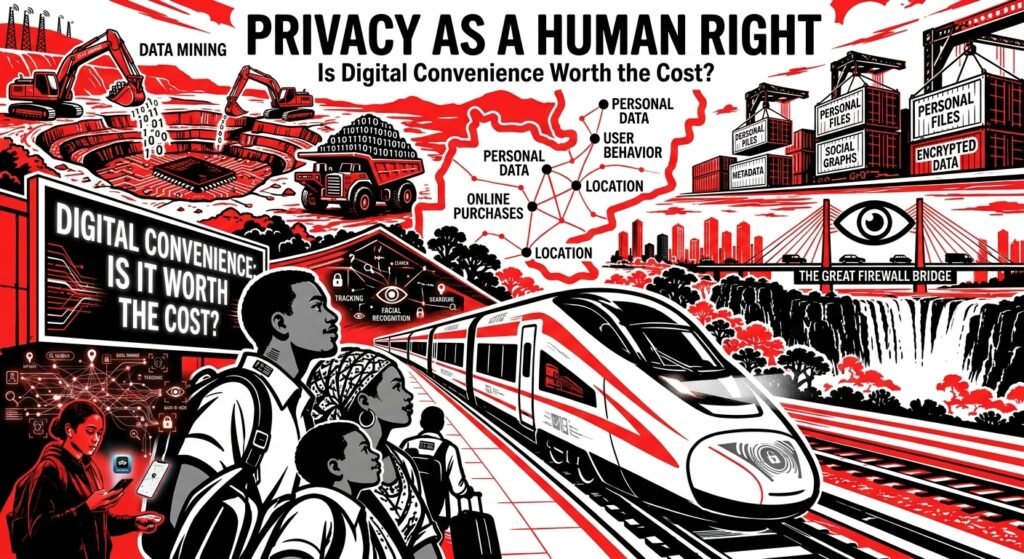
Every digital interaction leaves a trace. Technology makes life easier, but how much of our personal lives should we hand over in return?
A mobile payment takes seconds. An online application spares us a trip to a government office. A digital platform remembers what we like, suggests what we might buy next and makes staying in touch feel almost effortless.
These conveniences have reshaped modern life, and nowhere more visibly than in Africa, where mobile technology has opened the door to financial services and information for millions of people.
Yet there is a trade-off we rarely see. Much of that convenience runs on the collection and processing of our personal information.
Our phones can reveal where we go, what we buy, who we talk to, what we search for and which services we rely on. Many apps also track our location. Depending on the technology and the permissions we grant, these scattered details can be stitched together into a strikingly intimate picture of our lives.
Which raises a question worth sitting with: at what point does the ease of digital life start to wear away our right to privacy?
Privacy is not about hiding wrongdoing. In his book Ethics in Computing, Science and Engineering, Professor Barry G. Blundell links privacy to personal autonomy, dignity, freedom of association and our ability to decide when information about us is collected, used or shared.
The United Nations has come back to this issue again and again, insisting that human rights must hold firm even as technology changes the way we live.
Digital convenience can genuinely improve lives. But convenience alone is not a good enough reason to collect every piece of data that can be collected.
Is Privacy More Than Secrecy?
We often hear that if you have nothing to hide, you have nothing to fear. That argument misses the point of privacy entirely.
Everyone needs private space to work through ideas, build relationships, explore beliefs, ask for help and make decisions without feeling watched. A person can be entirely blameless and still be hurt when sensitive information about them is exposed, misread or used in ways they never anticipated.
Medical records, financial histories, biometric data, location data and private messages can all become tools for discrimination, fraud, embarrassment or coercion when they fall into the wrong hands or are carelessly handled. Privacy protects freedom, too. People who believe their every move is being monitored think twice before voicing an unpopular opinion, joining a lawful association or searching for sensitive information.
Nor is this only about government surveillance. Businesses, data brokers, criminals and a host of other organisations can collect, infer, trade or misuse personal information. Seen this way, privacy is really a question of power: how much control individuals keep, and how much passes to the institutions that hold information about them.
The Hidden Cost of Convenience
Many digital services offer us what looks like a simple choice: accept the terms or walk away. But genuine consent is more than a rushed click on “I agree”.
Those terms are usually long, technical and hard to follow. Few users can tell what information is being collected, how long it will be kept, whether it will be shared with third parties or how it might be combined with other data. Some of that information is genuinely needed for the service to work. Some is gathered for advertising, analytics, profiling or product development. These are very different purposes, and they should not be lumped together.
A bank, for instance, may need certain details to verify a transaction or meet its legal obligations. That does not entitle it to use the same information for every other purpose it can dream up. Likewise, an app may need access to one feature on your phone to do a particular job. That need should not become an excuse to reach into unrelated corners of your digital life.
This is where the principle of data minimisation earns its keep. Collect only what you need for a clear purpose, keep it only for as long as that purpose lasts, and protect it properly. The GDPR, Kenya’s Data Protection Act, South Africa’s POPIA and Zambia’s Data Protection Act all reflect this principle.
Put plainly, convenience should never be a blank cheque to harvest whatever the technology makes possible.
None of this is to deny what digital services offer African societies. Mobile money, digital identity systems, electronic health records and online public services can cut red tape and widen access in very real ways. But these same systems carry risks when personal information is gathered without proper safeguards, or when people have little choice but to take part.
A few everyday examples make the risks easier to see.
Consider a digital identity system. It can help people reach public services and curb some kinds of fraud. Yet weak access controls, excessive data sharing or poor ways of correcting mistakes can leave individuals exposed to real harm.
Or consider mobile banking. Transaction histories are useful for spotting fraud and improving service, but they can also reveal a remarkable amount about how people live, and they deserve protection.
The same goes for digital health. Electronic records can improve continuity of care, but health information needs especially strong safeguards, because an unauthorised disclosure can do serious and lasting damage.
The lesson from all three is that digital inclusion and privacy protection have to be built side by side. A service is not truly inclusive if people must accept outsized privacy risks just to reach opportunities they cannot do without.
Zambia’s Data Protection Act No. 3 of 2021 provides a legal framework for protecting personal data and regulating how it is processed. The real test is whether those protections show up in how institutions behave day to day.
Organisations need to know what personal data they hold, why they hold it, who can access it, where it is stored and how long it should be kept. They must put proper technical and organisational safeguards in place, train their people, manage the risks that come with third parties, and have clear procedures for handling data breaches and requests from individuals.
Privacy also has to be designed into digital systems from the start, not bolted on once a product is already built.
Public institutions need to take particular care here, especially where services reach large populations or handle sensitive information. Clear purposes, proportionate collection, access controls, accountability and complaint mechanisms that actually work are all essential.
Citizens have a part to play as well. Checking app permissions, using strong authentication, recognising phishing and scam attempts, and not oversharing all reduce risk. But individuals cannot carry this burden alone. Organisations must design and run their systems responsibly, and bodies such as ZICTA, ZCSA and the Data Protection Commission should help citizens understand the risks that come with an increasingly digital way of life.
Can Privacy and Innovation Coexist?
Privacy protection is sometimes cast as a brake on innovation. In practice, responsible data governance builds trust and makes digital services more secure and more sustainable.
Organisations can use privacy-enhancing technologies, encryption, access controls, carefully designed analytics and, where appropriate, de-identification techniques. They can draw a clear line between the information they need to provide a service and the information that is merely commercially tempting to collect.
They should also be honest about what these measures cannot do. Stripping names from a dataset does not always prevent re-identification, and encryption will not save you from poor access management or deliberate misuse.
The aim is not to stop data processing altogether but to make sure it is lawful, proportionate, secure and accountable.
There will, of course, be times when personal information is processed without a person’s prior consent, for example, to meet a legal duty or carry out a public-interest function. Even then, there must be a valid legal basis and appropriate safeguards. A socially useful purpose should never be treated as an automatic licence to override privacy.
Reclaiming Control in a Digital World
So how do we take back control of our digital lives? We need to move beyond asking whether people are willing to trade privacy for convenience and start asking whether that trade is necessary, transparent and fair.
People should be able to understand what happens to their information and exercise meaningful rights over it. Organisations should be able to explain why they collect each piece of data. Regulators, particularly on the African continent, must make sure existing safeguards are not watered down, and governments must make sure that digital transformation does not come at the expense of rights.
Convenience matters. But it is not the only thing that matters.
A society can make every interaction faster and still lose something important along the way. If speed and efficiency are bought at the cost of personal autonomy, technological progress may leave us less humane, not more.
Privacy is not the price we must inevitably pay for digital progress. It is one of the conditions that makes digital progress compatible with human dignity, freedom and trust.