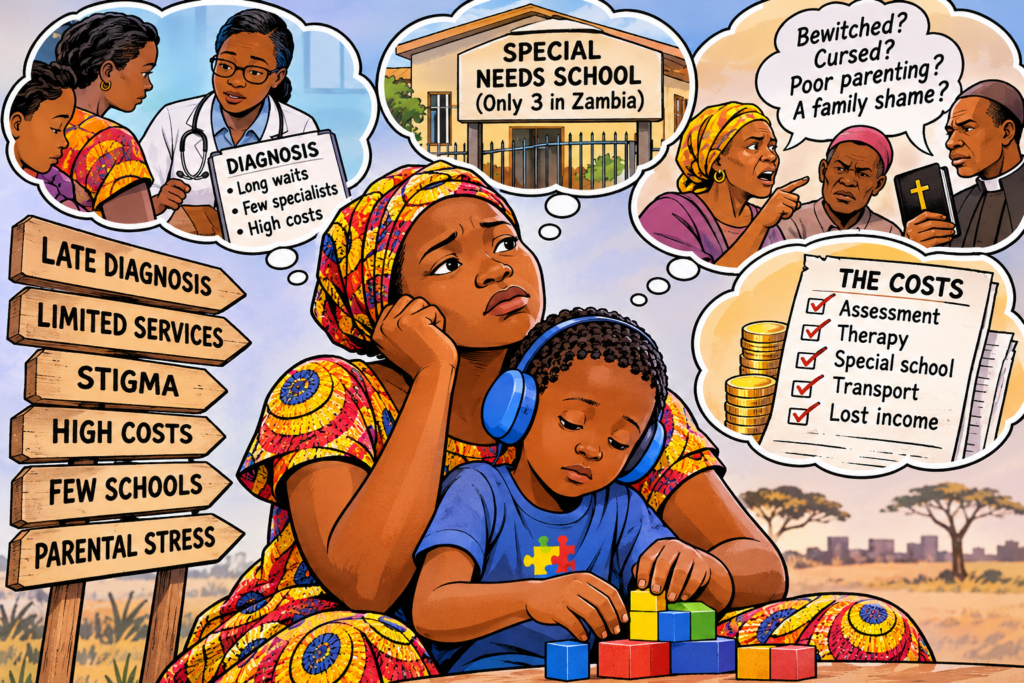
Diagnosis often comes late, support is thin, and stigma can be crushing. Across Africa, families raising autistic children are carrying a load that health systems, schools and governments have largely left to them. That has to change.
This week, I asked our editor, Septimius Severus, for special permission to take off my cybersecurity hat and put on a father’s hat to raise awareness about autism. I believe there isn’t much awareness regarding autism spectrum in Zambia and Africa at large. Therefore, as someone who is raising two autistic boys, I feel mandated to advocate and encourage those who are going through this.
Our boy’s story began with a small worry that never went away. At one year and three months old, he was very active and could say words such as Dad and Mum, but then he suddenly stopped saying any of them. Later, our child would not look into your eyes, failed to regulate whether he was tired, kept doing the same things for very long hours, and eventually developed difficulties sleeping. The boy lost his sense of awareness, and that came with low risk tolerance. As parents, we noticed and asked, “Why is our boy not like any other?” “Is our boy fine?” “Should we give him enough time to develop the necessary milestones?” Many times, my wife became suspicious and argued that we needed to take the boy to the hospital for assessment, but I kept refusing until one morning I decided we would take him to one of the private hospitals.
We took our boy to a certain private hospital on two occasions; on one, we were attended to by a female paediatrician who argued that the boy would talk and give him time. We asked her to check if the boy has a tongue-tie (akalimba); unfortunately, she brushed off the idea. Over a few weeks, we switched hospitals for a second opinion in search of answers; this time around we met a male general doctor. After diagnosing him, he asked us to take him to either Beit Cure or UTH for a hearing checkup. My wife and I decided to take him to UTH ENT Surgery Department. The boy was found to have no hearing problem. From there, the Doctor recommended that we take him to the Children’s Department. It was at the Children’s Hospital that, after several sessions, we were told that “your child is showing signs of autism.” Further, the boy was assigned some American University students who were interning at UTH. Those students helped us learn about autism and explained what it is. They shared autism literature and many videos on different autism therapies. From that moment, I started reading all the literature on autism that I could find, and whether there is a possibility of a cure. I am talking about months!
In our African setup, the answer or acceptance of having ASD can take months, sometimes years, to arrive. Parents ask relatives. They pray and ask their pastor to pray. Sometimes parents have gone the extra mile to consult traditional healers. Many parents move from clinic to clinic like we did, collecting reassurances (“boys talk late”) and contradictory opinions along the way.
But when a diagnosis of autism spectrum disorder (ASD) finally comes as it did to us, some families feel relief: at last, there is a name for what they have been living with. For others, the diagnosis opens a second struggle: the search for therapy they can afford, a school that will take their child, professionals who understand and neighbours who will not stare.
So the burden of raising an autistic child in Africa is not only about parenting. It is about health care, education, money, culture and what the state owes its citizens. It is also a test of who we are. How we treat children whose development does not follow the expected script says a great deal about the kind of society we have built.
Are More Children Being Born Autistic?
Autism is attracting more attention worldwide, and more children are being identified as autistic. The World Health Organisation (WHO), drawing on the Global Burden of Disease study, estimates that about one in 127 people worldwide was autistic in 2021. The same research programme’s previous estimate, for 2019, was one in 271. The number of autistic people did not more than double in two years; the researchers changed and improved the way they counted. The WHO itself cautions that estimates vary widely from study to study, and that prevalence in many low- and middle-income countries is simply unknown. And that is true in our society, where medical professionals are only catching up now, and where children like that are sometimes termed demon-possessed, and parents tend to reject them.
I should mention that recorded diagnoses could rise for many reasons. Parents and teachers need to know more; screening and assessment are improving. More families are opening up and seeking help. Eventually, children who once slipped through unnoticed are finally being seen. None of this proves that the underlying rate of autism is climbing at the same pace.
Africa and Zambia’s particular problem is that most of its countries have never carried out the large, representative studies that would tell us how many children are autistic, where they live and what support they need. Without that data, governments are guessing when they plan for assessment services, specialist teachers, speech and communication support or help for families. The first step, then, is to make autistic children visible: in our statistics, our budgets, and our policies.
A Race Against Time: Bridging Zambia’s Early Detection Gap
Zambia offers a clear example of how issues arise when the structure for diagnosing autism is inadequate. This problem matters because the lack of early diagnosis not only causes administrative delays but also limits opportunities for life.
Between May 2016 and January 2017, Lisa Kafula Nkole studied 560 children aged one to 15 attending the paediatric outpatient department of the University Teaching Hospital (UTH) in Lusaka. Fifteen showed at least one red-flag sign of autism, and eight met the DSM-5 diagnostic criteria for ASD. That works out to 1.4% of the children assessed.
The finding needs careful handling. It came from a single hospital clinic, not a national survey, so it cannot tell us how common autism is across Zambia. Nkole herself called for large population studies. What the study showed is that autism was present and identifiable among children already passing through Zambian health services, and that health workers and the public needed to know far more about the early warning signs.
Another area is too costly: late identification. A lot of parents come to learn about their child being autistic late. A child can spend years being punished for behaviour that no adult around them understands. In most cases, the teachers read communication difficulties as defiance. Parents keep searching for explanations while in the early years, when support can make the greatest difference, it slips past.
The WHO notes that signs of autism can often be spotted in early childhood, yet diagnosis frequently comes much later, especially in Zambia. Evidence-based developmental and psychosocial interventions can improve communication, social skills and quality of life.
A diagnosis does not define a child’s worth, and every child deserves to be treated with dignity. But a timely assessment can help families and teachers understand what a child needs and plan accordingly.
Zambia needs more trained professionals, assessment services that people can actually reach, referral pathways that work, and screening tools that fit our languages and cultures. A family in Kaputa or Kalabo should not have to make repeated trips to Lusaka to begin understanding their child.
Three special schools for an entire country
Now, let’s flip the page and look at the state of our special needs school infrastructure. Few statistics highlight the severity of Zambia’s predicament as vividly as the shortage of educational facilities designed specifically for autism.
In November 2024, the then Minister of Education, Douglas Syakalima, told the National Assembly that, as of March 2024, the country had only three special schools specifically dedicated to autistic children, namely:
- Bauleni Special School — Lusaka Province.
- University Teaching Hospital (UTH) Special School — Lusaka Province.
- St. Mulumba Special School — Choma, Southern Province.
The minister added that autistic children with milder needs are integrated into mainstream schools, while those with more severe needs attend separate schools such as these. These three are not the only places where autistic children can learn. Some children attend mainstream classes, special units, or other institutions that accept learners with developmental disabilities. Remember, this figure reflects the position in March 2024, not necessarily today’s.
However, progress has been made since then. In November 2024, First Lady Mutinta Hichilema officially handed over the newly established Mutinta Hichilema Autism and Special Needs Centre in Kabwe to the Ministry of Education. The centre was built for autistic children and other learners with special needs. This is a welcome addition, and we commend our First Lady for this initiative. But one centre in Central Province does not close the national gap.
Lately, especially in Lusaka, a few private schools have been opened, but their infrastructure is inadequate, including human resources and incentives. These private special needs schools are also too expensive for an ordinary Zambian to afford.
But these numbers don’t tell us how many children the schools can take. They do raise an urgent question: where does a child go when the schools in their own community cannot meet their needs?
For a family in a rural district, a specialist school far from home can mean bus fares, rented rooms and a parent giving up work. A parent who cannot afford all that may have no real choice but to keep the child at home. Take, for example, urban areas like the Copperbelt, where parents of autistic children find it hard to find a school that offers special-needs classes. A childhood friend in Chingola has a 12-year-old son who has ended up at home because no school offers special-needs classes. The boy was integrated into the mainstream school, but teachers thought he was stubborn. They simply couldn’t comprehend how he views the world.
And school is only the beginning. Autistic children become adolescents and then adults. They need routes into secondary education, vocational training and supported employment, independent living where possible, and a place in community life.
As a country, we need a serious national response that looks beyond school headcount to capacity, location, teacher qualifications, affordability, support services, and how learners progress through the system.
I want to talk about ZAMISE. The Zambia Institute of Special Education (ZAMISE) plays a central role. Established in 1971, the institute trains special education teachers and has expanded its programmes to include diploma- and degree-level training. Its mission encompasses training, research and outreach.
That makes ZAMISE a natural foundation for a more autism-friendly education system. To be clear, though, we need to separate the institute’s overall role from what individual studies show. But that raises a critical question: if ZAMISE is constantly training special education teachers while the government only runs three public special needs schools, where are all these teachers going? Are they actually being hired into mainstream classrooms?
ZAMISE can help link these priorities through specialist teacher training, research partnerships, professional development and outreach to schools and communities. To do that well, it needs adequate funding and close collaboration with the Ministry of Education, health professionals, universities, parents and organisations representing autistic people.
The aim is not simply more teachers. It is teachers who can recognise developmental differences, adapt their teaching, support communication and help every learner take a real part in class.
When culture turns a developmental difference into a family crisis
In many African communities, autism is not understood as a neurodevelopmental condition. Instead, it is explained through religious, spiritual, or cultural frameworks, which can place a heavy and unnecessary burden on the child and the parents.
Families may be told that their child is bewitched, possessed by demons, as we were told, or under spiritual attack. Parents may also be blamed for neglect, poor parenting or failing to discipline their child.
In our Zambian and African context more broadly, not everyone holds these beliefs, of course. But for many families, faith communities and traditional networks offer real comfort and practical support. The problem arises when these explanations turn into blame, rejection, or harmful practices, or when they prevent someone from receiving a proper diagnosis and the medical care they need.
Imagine a child who struggles to speak, avoids certain social situations, or stims (becomes uncomfortable) in public. Without understanding autism, adults may see stubbornness, defiance, or bad manners and respond with punishment. Eventually, the child is then punished for a difficulty that punishment cannot fix.
Parents suffer differently too. Their marriage is questioned. Some are accused of hiding a family problem (e.g., a generational curse). They become the subject of whispers at funerals and kitchen parties. Mothers, in particular, are blamed, even though autism is not caused by any failure of a mother’s love, discipline or care. And basically, relatives with little understanding of autism tend to distance themselves from the parents raising an autistic child. In fact, parents walk a lonely journey. Very few relatives even call in to check how the parents are coping or how the child is doing.
Some families hide the diagnosis for fear of rejection in society. Others delay seeking help, hoping the child will grow out of it or dreading the label. Others think the child can’t speak because of tongue-ties. Either way, support comes later, and isolation deepens.
We do not need to abandon our cultural identity as Africans to respond well to autism. What we need is our cultural and religious traditions to sit alongside sound science, compassion and respect for human dignity.
Churches, mosques, traditional leaders, community health workers and local authorities can be strong allies, helping families access support and challenging the belief that a child’s differences bring shame. They must recognise autism as a neurodevelopmental condition and part of human neurodiversity; not a curse, a sin or demonic possession. No family should face social punishment because their child is autistic.
The Financial Burden: Love Does Not Pay Every Bill
Every child costs money. But a child who needs specialised developmental, educational or communication support can bring costs that many ordinary Zambian households are not prepared for. Those costs vary enormously. Some autistic people need substantial support throughout life; others need more targeted help and go on to live with considerable independence. Autism is a spectrum, and no single story covers every family.
Still, many families in our communities face several costs at once, such as:
- Assessment and diagnosis: specialist consultations and repeat appointments are expensive, especially where services are concentrated in the big cities like Lusaka. Normally, a medical consultation at private hospitals around Lusaka costs at least ZMW 500. I am not sure whether public hospitals offer these services apart from the University Teaching Hospital.
- Communication and developmental support: some children benefit from speech and language therapy, occupational therapy or other individualised interventions. For example, we have engaged a home-schooling teacher to supplement what our child is learning at school. In truth, regression is a significant issue for many children on the autism spectrum.
- Education: specialised schools, adapted materials, transport and extra classroom support can add costs well beyond ordinary school fees. Most special needs schools within Lusaka cost no less than ZMW 5000; some high-end schools even cost as much as ZMW 20,000.
- Transport and accommodation: families from rural districts may pay for repeated journeys and overnight stays. The question is: Can an ordinary family from rural Zambia afford these costs? We all know the poverty levels in our rural areas. Maybe we should also extend that question to urban areas.
- Lost income: a parent may cut working hours, turn down a job or leave work altogether to provide care.
- Emotional strain: constant uncertainty, social isolation and the demands of caregiving wear down parents and siblings alike. As I noted earlier, raising and caring for an autistic child can be a lonely journey, one my wife and I continue to navigate.
In reality, these pressures feed one another. For example, the parent who leaves work to care for a child loses income just as household spending rises.
Where public services are scarce, access to support follows income. Wealthier families have options; poorer families are often shut out of the very services their children need. That makes this a social protection issue, not just a household one. The government should look at how disability-related support, affordable assessment, inclusive education and help for caregivers can stop a child’s developmental needs from pushing a family into hardship.
The Invisible Burden On Parents
Public conversation about autism tends to focus on the child. Far less attention goes to the wellbeing of the people who provide care every single day.
Parents often describe exhaustion, anxiety, uncertainty and loneliness. They worry about whether their child will be accepted at school and whether others will understand how their child communicates. For many of us, one question keeps us awake at night: who will care for my child when I no longer can?
A 2026 study by Munshya Mushingwa of the University of Zambia interviewed twelve parents in Kitwe and Ndola about what shapes their mental health. They described cultural misconceptions about autism, stigma and social isolation, financial strain, scarce specialised services and weak institutional support. Many also showed real resilience, drawing strength from religious faith and family. Although twelve voices cannot give a population-wide picture, they offer a rare look at the lives of parents on the Copperbelt. Their experiences deserve to be taken seriously. Parents should not be expected to show endless patience without support. They need accurate information, counselling where they want it, peer-support groups, a chance to rest, and professionals who understand their reality.
Fathers need to be part of this journey too. When a father does not understand autism and leaves daily care to his wife, she can feel exhausted, overwhelmed and alone. Mothers should not have to carry that responsibility almost entirely on their own, and no child should be rejected for having needs their parents did not anticipate. Fathers, let us learn about our children, be present and share the care.
Creating Spaces Where Autistic Learners Can Truly Thrive
Zambia is committed in law and policy to inclusive education; the Persons with Disabilities Act of 2012 guarantees the right to quality inclusive education at all levels. Yet inclusion is not achieved simply by enrolling a child in a mainstream school.
A school can formally admit an autistic learner and still offer no teacher trained in their communication needs, no suitable learning materials and no practical plan for sensory difficulties. That is enrolment without participation. We can achieve real inclusion only with teachers who understand autism, manageable class sizes, sensible adaptations to learning, partnership with parents, and referral routes to specialist help.
This also means recognising that autistic learners are not all alike. Some do well in mainstream classrooms with modest adjustments; others need substantial individual support or a specialist setting. I mean, the goal is to fit the support to the child, not to force every child into a single model.
ZAMISE, teacher-training colleges, universities and NGOs such as STS Zambia (RISE Project) should work with the Ministry of Education to strengthen autism-related content in teacher preparation and ongoing professional development. Schools should be supported to spot developmental concerns, talk respectfully with parents and make reasonable adjustments to their teaching.
The government should also publish better data on special schools, special education units and mainstream schools equipped to support autistic learners, so that parents can see their options and policymakers can see where the needs are greatest.
What Must We Do?
I strongly believe awareness campaigns alone will not lift this burden. It needs a coordinated response across health, education, social protection and community institutions. The following are some of the practical suggestions that I think can work well:
1. Build accessible diagnostic services. Integrate early developmental screening into routine child-health services, train frontline health workers to recognise developmental concerns, and establish clear referral pathways to qualified professionals. Screening must lead to proper assessment, not replace it.
2. Expand educational capacity. Increase specialist provision and strengthen mainstream inclusion. Invest in teacher training, classroom support, communication resources and pathways into secondary and vocational education. Additionally, governments must equip mainstream classrooms with sensory-friendly learning spaces, low-stimulation resource rooms, visual communication tools, and modified curricula that accommodate neurodivergent learning profiles
3. Support families and caregivers. Promote parent-led support groups, caregiver education, counselling and practical assistance. Family-support programmes must reach rural communities, not only the towns.
4. Fund African research. Support locally relevant studies on prevalence, diagnostic pathways, educational outcomes, family needs and what interventions actually work here. African researchers must help shape the evidence used to design African services.
5. Challenge stigma and discrimination. Work with community leaders, faith institutions, the media and organisations representing autistic people to replace blame and misinformation with knowledge, acceptance and respect. We need to demystify conditions like autism and intellectual disabilities as Africans.
6. Make the data visible. As Africans, let us build reliable systems for monitoring developmental disabilities and service provision, with proper privacy protections. We also need to publish regular statistics on assessments, school enrolment, teacher capacity, geographic coverage and unmet need.
Looking Beyond Childhood
There is a question we cannot afford to leave unanswered: what happens when our autistic children grow up?
We talk a great deal about diagnosis and schooling. But childhood does not last forever, and the need for support does not end when a young person leaves school.
Some will go to university, find work, build relationships and live independently. Others will continue to need help with communication, everyday tasks, decisions or finding their place in community life.
As parents, we need to know that our children will not be left without support when they turn eighteen. That concern follows them into the workplace too. How will an HR officer or manager who knows little about autism understand and support an autistic employee?
Across Africa, we need to prepare for adult life long before school ends. That means making room for vocational training, inclusive employment, accessible public services, social protection and supported living for those who need it.
This is about more than services. It is about how we see one another. An autistic person’s worth does not depend on exam results, how much they earn or whether they can live alone. Everyone deserves dignity, safety from abuse and a place in society, with support that respects their abilities and needs.
In the end, the question is not just whether we can raise our autistic children. It is whether our society will keep standing beside them throughout their lives.
In Conclusion
When we talk about Zambia and Africa’s future at large, we often talk about growth, technology, industrialisation and our young, growing population. These ambitions are essential. But progress also means knowing that families have someone to turn to when raising their children brings challenges they cannot manage alone.
For those of us raising autistic children, late diagnosis, limited school options, financial worries and cultural misunderstanding can make an already demanding journey much harder. The fact that Zambia had just three dedicated public special schools for autistic children as of March 2024 brings the challenge into sharp focus. Research across families echoes the need for clearer information, consistent diagnosis, well-trained professionals and support that puts families at its heart.
Yet autism is not a tragedy, and our children are not burdens; they are God’s given gifts. What weighs families down is the lack of support: institutions that fail them, communities that shame difference, and the exhausting fight for services they should be able to count on.
Our autistic children are not broken. They are children with their own unique personalities, abilities, struggles and possibilities. Like every child, they deserve opportunities to learn, communicate, make friends and feel that they belong.
As Africans, we need to do more than feel sympathy. We need to stand beside families in practical ways, replace blame with understanding, and make inclusion something children and parents can experience in everyday life, not just a promise.
Raising an autistic child should not mean fighting an entire society. It should mean raising a child within a society willing to stand beside the family.
References
- World Health Organisation (2025). Autism [fact sheet]. https://www.who.int/news-room/fact-sheets/detail/autism-spectrum-disorders
- GBD 2021 Autism Spectrum Collaborators (2024). The global epidemiology and health burden of the autism spectrum: findings from the Global Burden of Disease Study 2021. The Lancet Psychiatry. https://pmc.ncbi.nlm.nih.gov/articles/PMC11750762
- National Assembly of Zambia (2024). Debates, Wednesday 6 November 2024: Number of Schools for Autistic Children Countrywide. https://www.parliament.gov.zm/node/12101
- Nkole, L.K. (2017). The prevalence and clinical characteristics of autism spectrum disorder in children aged 1–15 years seen at the University Teaching Hospital in Lusaka, Zambia. Master’s dissertation, University of Zambia. https://dspace.unza.zm/handle/123456789/5666
- Nyoni, J. (2022). A Participatory Action Research Project on Family Needs: Experiences of Formal and Informal Support Services Available among Zambian Families of Children with Autism Spectrum Disorders. PhD thesis, University of Cape Town. https://open.uct.ac.za/items/d86b486e-47af-455a-be6e-5c18c66a3c27
- Chalwe, H.K., Muzata, K.K. and Mandyata, J.M. (2024). Coping with Stressful Behaviour of Autism: Voices of Lusaka Parents, Zambia. Journal of General Education and Humanities, 3(1). https://doi.org/10.58421/gehu.v3i1.148
- Mushingwa, M. (2026). Social, Cultural and Systemic Influences on the Mental Health of Parents Raising Children with Autism Spectrum Disorder in Zambia. Journal of Arts, Humanities and Social Science, 3(2), 667–676. https://doi.org/10.69739/jahss.v3i2.2123
- Zambia Monitor (2024). President Hichilema’s wife, Mutinta, launches national Autism centre in Kabwe. https://www.zambiamonitor.com/?p=52887
Zambia Institute of Special Education (ZAMISE). About Us. https://zamiseistp.edu.zm/about-us/