A Tribute to Cheikh Hamidou Kane (2 April 1928 – October 2026)
9 October 2026
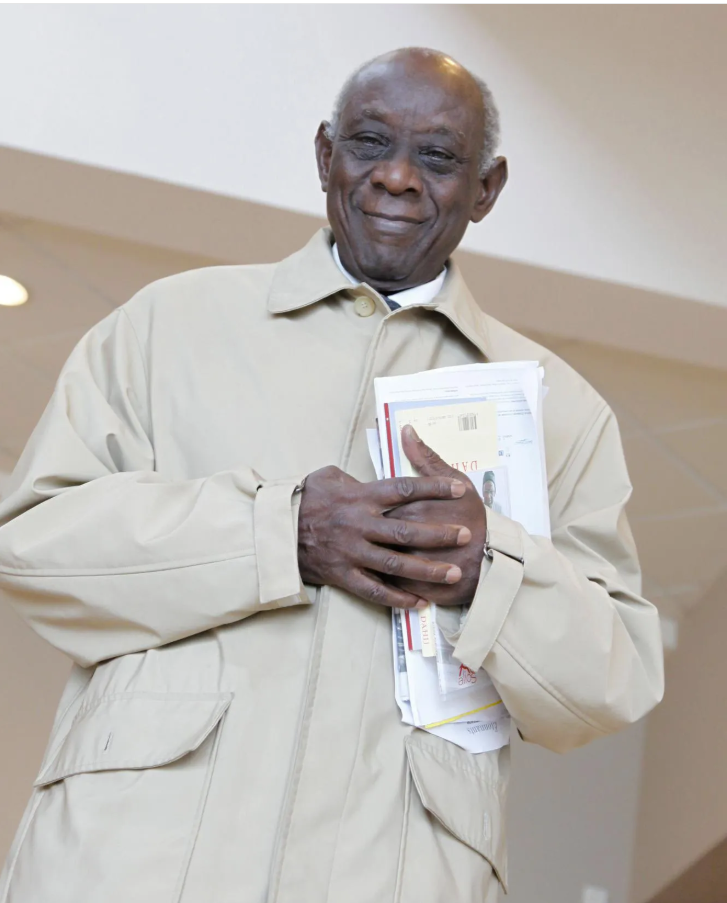
Cheikh Hamidou Kane – Metro/KolaKing
Cheikh Hamidou Kane has died in Dakar at the age of 98. The announcement came on Sunday, 4 October 2026, from the Université Cheikh Anta Diop and was later confirmed by Senegal’s national press agency. He will be laid to rest at Yoff cemetery.
For many readers, Kane was the author of a single book. But what a book it was. Published in 1961, while the flags of independence were still being raised, L’Aventure ambiguë gave a continent words for one of its oldest modern dilemmas: how do we enter the school of the world without forgetting who we are?
Today, The African Renaissance Review pauses to remember him because his question did not die with the age of empire. It follows us whenever we take up an imported system, a borrowed curriculum or a foreign platform. Kane asked it early, and few have asked it with such clarity.
Kane was born on 2 April 1928 in Matam, in northern Senegal’s Fouta Toro, into a prominent Fulani family. His education began in a Qur’anic school, where knowledge was memorised, recited and lived. At about ten, he entered the French colonial school. That passage from one world of learning to another became the central tension of his life’s work.
He later studied law and philosophy at the Sorbonne, then trained at the École nationale de la France d’Outre-Mer, an institution created to produce colonial administrators. The irony is hard to miss: the empire trained him to operate its machinery, and he used that training to imagine a way beyond it.
He began writing the novel in Paris in the 1950s. It draws closely on his own experience and carries the loneliness of a young man who has learned to reason in the master’s language, only to discover that reason alone cannot make him feel at home.
Ambiguous Adventure follows Samba Diallo, a gifted boy from the Diallobé country. His first teacher is Thierno, a Qur’anic master whose discipline can be severe and whose devotion approaches the sublime. Then the community makes a painful choice: it will send its children to the foreigners’ school.
The decision is voiced by the Grande Royale, the formidable matriarch of the Diallobé. She is unsentimental: the newcomers have prevailed not because they were right, but because they knew how to build and command. Her people must learn that art as well, whatever the cost. The question she leaves with the assembly (and with every reader) is simple and devastating: will what we gain be worth what we lose?
Samba Diallo goes, and he excels. In Paris, he reads philosophy and debates brilliant Europeans, yet gradually finds that he can no longer pray as he once did. He has gained the West’s tools without gaining its certainties, and lost his old certainties without finding anything to replace them. When he returns home, he is suspended between two worlds; the novel’s ending is tragic and mystical rather than neatly resolved.
The novel won the Grand Prix littéraire d’Afrique noire in 1962. Since then, it has been translated widely, taught across Africa and the diaspora, and placed in the canon beside Achebe’s Things Fall Apart. Achebe showed a world breaking under colonial pressure; Kane showed what that break felt like inside a single mind.
Kane did not remain on the sidelines as an anguished artist. He returned to Senegal in 1959 and went to work. He served as Governor of the Thiès region and as Commissioner of Planning in Mamadou Dia’s government, just as a new state was deciding what kind of country it would become.
His public service later took him to UNICEF posts in Lagos and Abidjan, and eventually into ministerial office in Senegal. In his tribute this weekend, President Bassirou Diomaye Faye remembered both sides of the man: the writer who found words for Africa’s dilemma and the public servant who gave himself to the Republic.
That part of Kane’s life deserves more attention, especially from those who build institutions. For him, the pull between heritage and modernity was never just something to discuss in a lecture hall. He carried it into planning offices and budget meetings, where big ideas become hard choices, and those choices shape people’s lives.
After 1961, Kane published no new novel for more than three decades. The long silence became part of his legend. Perhaps, readers wondered, a man who had already said the essential thing saw no reason to keep saying it again.
Then, in 1995, came Les Gardiens du Temple. The first book had been a metaphysical fable about one soul; the second looked outward, towards the life of a nation. Set in an imagined African country that is recognisably Senegal, it unfolds a few years after independence, amid the unfinished argument between tradition and progress. Its guardians are Farba Mâri, a griot who carries the people’s memory, and Daba Mbaye, a young revolutionary intellectual.
Their pairing is the point. Kane had moved beyond Samba Diallo’s private anguish towards a public answer: memory and modernity must sit at the same table and learn to govern together. In 2019, the Grand Prix des Mécènes honoured the whole of his work, a fitting recognition for a writer whose output was small, but whose reach was immense.
If the Grande Royale called her assembly today, the foreign school would look very different. It might be a cloud region hosted in another hemisphere, a payment rail controlled from elsewhere or an AI model trained on data in which Africans barely appear.
Even so, her reasoning would remain familiar. Africa cannot simply turn away from this new school. Computing, cryptography and artificial intelligence increasingly determine who builds, who trades and whose voice is heard. If the continent refuses these tools, it risks being governed by those who do not. Our children (and our institutions) have to learn.
Yet Kane’s warning should stay with us. Think of a bank built entirely on platforms it cannot inspect, a regulator borrowing frameworks it had no hand in shaping or a university whose students know every foreign model but have never worked with a local dataset. Each faces Samba Diallo’s danger: becoming highly capable while quietly losing the ability to say whose values the system serves.
Kane’s own life offers a model. He mastered the coloniser’s disciplines, then put them to work in service of his own people’s state. African technologists, regulators and security leaders need the same posture: fluent in global standards but accountable to the local good.
At its heart, Ambiguous Adventure is a religious novel. What Samba Diallo truly loses in Paris is not simply a culture but a sense of closeness to God. Kane, a devout Muslim, understood that modernity’s deepest challenge to Africa was not technical but spiritual: the temptation to believe that only what can be measured is real.
That insight reaches beyond Islam. Many Christians in Zambia know a version of the same tension. Mission schools brought the Gospel, but they also carried the assumptions of a colonial order. We have had to learn how to cherish the faith without remaining captive to the culture that delivered it.
Kane never pretended that this tension could be neatly resolved. That honesty is part of his gift. He trusted readers to stay with the question instead of rushing towards a slogan, and he trusted that the sacred would continue to speak to those willing to listen.
Farewell to a Guardian
Cheikh Hamidou Kane lived for ninety-eight years. He saw colonial rule, independence and the dawn of the digital age, yet the question at the centre of his work never left him: were Africa’s gains worth what they cost? He wrote only a little, but he served for decades. He leaves behind a novel that still unsettles students, a granddaughter, Ndèye Fatou Kane, who carries the family’s pen into another generation, and a question that no African institution can afford to ignore.
One of the temple’s oldest guardians is gone. What he guarded (and what he asked us to protect) is now in our hands.
Rest in peace, Cheikh Hamidou Kane, 1928–2026.