Some scholars study history. Others make us question the stories we have inherited. Cheikh Anta Diop was one of the latter.
Born on 29 December 1923 in Thieytou, a village in Senegal’s Diourbel region, Diop grew into one of Africa’s most influential thinkers of the twentieth century. He moved with unusual ease across history, anthropology, physics, linguistics and politics, but one urgent question tied all of his work together:
Who has the right to tell Africa’s story?
For generations, much of Africa’s history was told through European intellectual frameworks. The result was a distorted picture: African societies were often presented as if they had no complex institutions, scientific traditions or civilisations of their own. Ancient Egypt was separated from the rest of the continent, while African achievements were routinely credited to outside influence.
Diop wanted to take that story apart. His point was not simply that Africans had a history; to him, that was obvious. He argued that Africa’s ancient civilisations had been repeatedly misread, downplayed or disconnected from the continent that produced them. He was also willing to make that case in the very institutions that had long resisted it.
Diop is best known for his work on ancient Egypt. He argued that Egyptian civilisation made little sense when lifted out of its African setting, and that the ancient Egyptians belonged within the wider story of African peoples. That view challenged a powerful strand of nineteenth- and twentieth-century scholarship that treated Egypt as culturally separate from sub-Saharan Africa. The resistance he met was not abstract. The University of Paris rejected his doctoral thesis in 1951, and he did not receive his doctorate until 1960, after years of further work.
In 1974 he took the argument to the international stage. At a UNESCO symposium in Cairo on the peopling of ancient Egypt, convened for UNESCO’s General History of Africa, Diop and the Congolese scholar Théophile Obenga presented their case before leading Egyptologists. Diop went on to write the chapter on the origin of the ancient Egyptians in volume II of that history.
His method was deliberately multidisciplinary. He drew on physical anthropology; historical linguistics; archaeology; classical and historical sources; religious traditions and cultural; practices; social and political organisation; and laboratory science.
This wide lens mattered because, as Diop understood, civilisations do not exist as isolated facts. They emerge from places, languages, migrations and long continuities. To understand them properly, he believed, those connections had to be studied together.
The African Origin of Civilization
Diop’s ideas first appeared in French, above all in Nations nègres et culture (1954) and Antériorité des civilisations nègres: mythe ou vérité historique? (1967). The English-speaking readers came to know them through The African Origin of Civilization: Myth or Reality, a 1974 translation by Mercer Cook drawn from those two books.
The importance of this work reached far beyond Egypt. It challenged a stubborn assumption that Africa’s greatest historical achievements must somehow have arrived from elsewhere.
Diop turned that assumption on its head. Instead of asking “What did others bring to Africa?”, he asked “What did Africa create, and how did it shape the wider world?”
That was a profound intellectual shift.
Diop grasped something that still matters: history is never only about the past. The story a society tells about where it came from shapes what it believes it can become.
When generations of Africans are taught that their ancestors contributed little to world of civilisation, the harm does not end in the classroom. It can chip away at confidence, shrink political imagination, weaken cultural identity and lower expectations of what a society is capable of building.
Diop therefore treated the reconstruction of African history as part of Africa’s intellectual liberation. That is a large part of why his work became so influential among Pan-African thinkers.
Diop’s vision reached well beyond ancient history. In Les fondements économiques et culturels d’un État fédéral d’Afrique noire (1960), published in English as Black Africa: The Economic and Cultural Basis for a Federated State, he argued that African states were too fragmented to fulfil their potential on their own. In his view, political independence meant little if the continent remained divided and economically dependent.
He called for continental cooperation in industrialisation, scientific research, education, infrastructure, energy and economic planning, and ultimately for a federal political structure.
He also acted on these convictions at home. Diop founded several opposition parties in Senegal, including the Bloc des Masses Sénégalaises in 1961 and the Rassemblement National Démocratique in 1976, and was a leading critic of President Léopold Sédar Senghor’s government.
The same questions are still with us. The African Continental Free Trade Area, major infrastructure programmes and the push for African technological sovereignty all echo debates Diop was raising more than six decades ago.
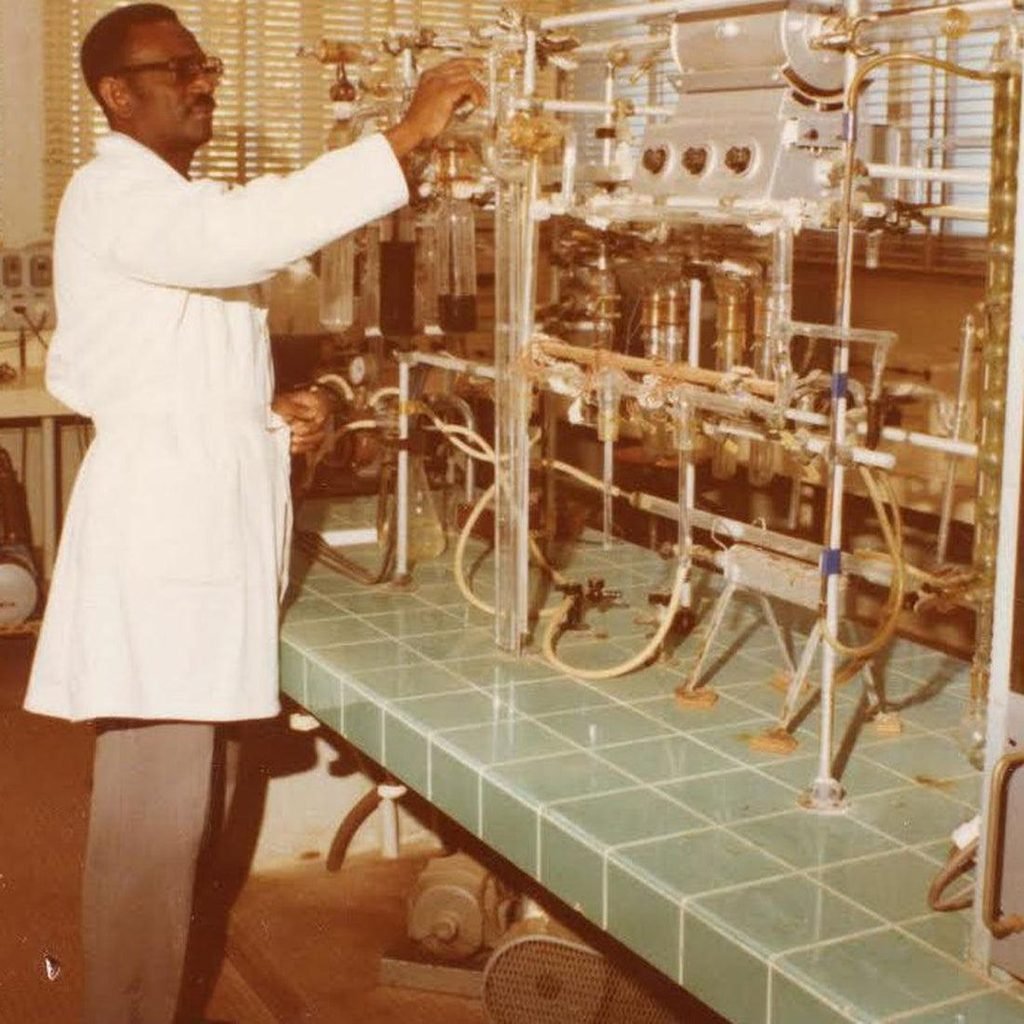
What makes Diop’s career especially striking is its range. While studying history and the humanities in Paris, he also trained in physics and chemistry, including nuclear physics in Frédéric Joliot-Curie’s laboratory.
He did not leave that scientific training in Europe. In 1966, he established a radiocarbon dating laboratory at the Institut Fondamental d’Afrique Noire (IFAN) in Dakar, one of the first of its kind on the continent. For African researchers, it meant archaeological material from Africa could be dated in Africa.
Diop believed African scholarship could not be confined to the humanities. Africa needed historians and linguists, but also physicists, chemists, engineers and economists, and those communities needed to talk to one another. His career embodied a principle Africa still urgently needs: African problems require interdisciplinary African knowledge.
To Diop, language was not simply a tool for communication. It carried the memory of a people.
He compared ancient Egyptian with African languages, especially his native Wolof, and set out his case in Parenté génétique de l’égyptien pharaonique et des langues négro-africaines (1977). He also argued that African languages could carry modern science, and demonstrated it by rendering scientific material, including concepts from physics, into Wolof.
The idea still resonates. When written records are scarce, language itself can become an archive. Names, grammar, concepts, oral traditions and inherited vocabulary may preserve traces of journeys and relationships that no document ever recorded.
Respecting Diop’s legacy does not mean pretending every conclusion he reached is settled. Some remain contested, and any honest account should say so. Most linguists classify ancient Egyptian within the Afroasiatic family, not alongside Wolof and the Niger-Congo languages, so his proposed genetic link between them has not won general acceptance. His melanin-dosage tests on mummy skin samples were criticised on methodological grounds. The genetic studies of ancient Egyptian remains have since reported a mix of North African and Near Eastern ancestry, a picture that fits neither the old “Egypt apart from Africa” model nor a simple version of Diop’s thesis.
Even so, much of what Diop fought for now sits closer to the mainstream. Few serious scholars would today remove Egypt from its African context, dismiss African historical agency or deny the ties between Nile Valley civilisations and their African neighbours. The debate changed because he refused to let it stand still.
Diop insisted that Africa should not merely consume knowledge produced elsewhere. It should produce knowledge of its own.
Look, a country may have universities yet still lack intellectual sovereignty. It may have laboratories without control over its research agenda, or imported technology without the ability to build its own. This is why Diop’s thinking speaks so clearly to today’s debates about technology sovereignty, data sovereignty, scientific independence and digital colonialism.
Can Africa be genuinely independent if it depends on others for the production of knowledge?
The question has only grown sharper. Africa holds vast reserves of critical minerals and the world’s youngest population. Its cities and digital economies are expanding, and artificial intelligence is beginning to reshape education, finance, government and industry.
Yet much of the technology Africa uses is imported. Much of its capital comes from outside, much of its research infrastructure sits elsewhere, and a great deal of knowledge about the continent is still produced beyond its borders. Diop would have recognised the pattern immediately.
The task is no longer only to reclaim African history. It is to build African capacity to produce knowledge about Africa, and for Africa.
Diop’s Greatest Lesson
It is easy to reduce Cheikh Anta Diop to a single argument about the ancestry of the ancient Egyptians. But doing so misses the larger point. His deepest contribution was not just a conclusion; it was a way of working.
Diop showed that Africans could question the historical record for themselves. They could challenge old assumptions, bring different disciplines into conversation, develop new interpretations and enter debates long dominated by European scholars. Above all, they could demand that African history receive the same serious attention given to Europe, Asia and the Americas.
His message can be distilled into one principle: Africa must be the subject of its own intellectual inquiry, not merely the object of somebody else’s research.
Diop died in Dakar on 7 February 1986. The following year, the University of Dakar was renamed Université Cheikh Anta Diop in his honour. But the questions he raised remain open:
- Who writes Africa’s history?
- Who owns Africa’s archives?
- Who controls African scientific research?
- Who builds Africa’s technologies?
- And what happens when Africa stops asking others to explain Africa?
An African Renaissance cannot be measured only in economic growth, political independence or new technology. It must also be an intellectual renaissance: one in which African universities generate original scholarship, African languages are preserved and studied, African archives are digitised, and African scientists tackle African problems.
It must be a renaissance in which young Africans understand that their continent has never been merely a recipient of civilisation. It has been, and can again be, a producer of civilisation.
That is the challenge Diop left us: not only to remember Africa’s past, but to recover the intellectual confidence needed to build Africa’s future.
Cheikh Anta Diop’s legacy should not be kept as a museum piece. It is an intellectual project still in progress, and engaging with it seriously means testing his ideas, not just repeating them.