
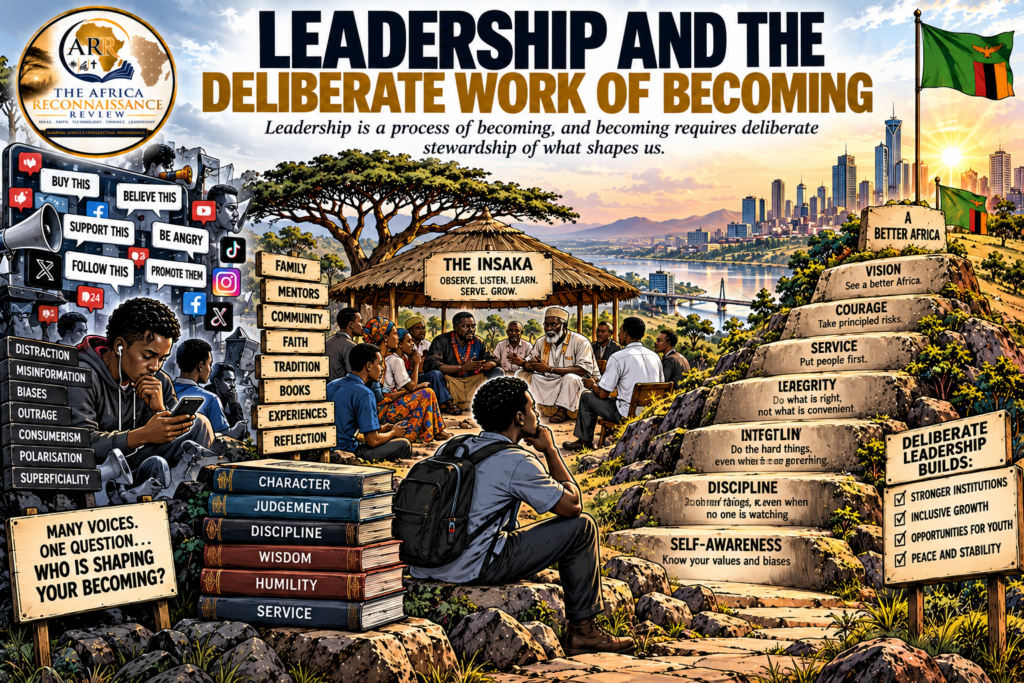
(Leadership is a process of becoming, and becoming requires deliberate stewardship of what shapes us.)
There has probably never been a time when so many people, platforms, and institutions have competed so aggressively for our attention.
Someone wants you to buy something.
Someone wants you to believe something.
Someone wants you to support something.
Someone wants you to become angry about something.
Someone wants you to adopt their interpretation of the world.
And, increasingly, someone wants you to promote them.
The struggle for our attention is no longer merely about advertising. It is a struggle for influence over how we understand the world and, ultimately, over who we are becoming. This should concern all of us. But it should especially concern anyone who aspires to lead.
Leadership does not begin when somebody gives you a title. It begins much earlier, in the slow formation of the person who will eventually occupy that position. The leader who walks into the boardroom did not suddenly become that person that morning. They arrived carrying years of accumulated influences: books, conversations, mentors, wounds, ambitions, prejudices, successes, failures, social media feeds, and private reflections.
Some of these influences were deliberately chosen. Many were not. And therein lies one of the great leadership challenges of our time—who, and what, is participating in your becoming?
The Ancient Work of Forming Leaders
Leadership is not a modern invention. Long before leadership programmes, executive coaching and MBAs, faith traditions, families and communities wrestled with how those entrusted with responsibility should conduct themselves. Our own Zambian traditions did this too.
They may not have called it “leadership development,” but much of what they practised was precisely that: the deliberate formation of human beings capable of exercising judgement, responsibility, restraint, and wisdom.
The biblical instruction in Proverbs 4:23 remains remarkably relevant: “Above all else, guard your heart, for everything you do flows from it” (NIV).
It is easy to read this only as religious instruction. But there is also a profound leadership principle within it: be careful about what enters the inner person from which your decisions, attitudes, motivations, and behaviours eventually emerge. Guard the source, because what resides within us eventually finds expression in what we do.
Our traditions understood something similar, transmitting lessons about life through stories, songs, proverbs, ceremonies, and everyday observation.
There was the insaka, the open, thatched shelter where elders gathered to deliberate on matters affecting families and communities. You did not simply arrive one morning and declare yourself an elder because you had reached a particular age. There was a process of becoming. Your conduct, your judgement, your ability to listen, your restraint and how you treated others all mattered. You gradually earned the privilege of being numbered among those whose voices carried weight.
Modern leadership has something to relearn here. We have become very good at appointing people into positions, and less deliberate about forming the people who eventually occupy them.
Becoming Was Never Accidental
The formation process started early. You observed, you listened, you were corrected and you were mentored. You were taught to choose your company carefully, because the people around you eventually leave something of themselves in you.
Even participation was sometimes carefully staged. When elders went to negotiate matters such as marriage and dowry, they would sometimes beckon a promising young person to come along. The young person was not necessarily invited to speak. Their assignment was simply to sit, watch and listen: to observe how experienced people handled disagreement, how difficult messages were communicated without humiliating others, when somebody remained silent, and how humour could lower the temperature of a tense discussion.
That young person was being prepared for a future table.
Today we might call it mentoring, apprenticeship, or succession planning. The language has changed. The principle has not.
Do Not Outsource Your Becoming
That principle becomes even more important in the modern environment. Our ancestors worried about the company you kept. We must now worry about the company we keep and the algorithms we keep.
The voices surrounding us have multiplied dramatically. Your phone wakes up with you and travels with you. Platforms learn what excites you, frightens you, angers you, and keeps you scrolling. Commercial organisations want you to purchase, political actors want you to interpret events through particular lenses, and movements want your allegiance. Algorithms discover that outrage can sometimes keep you engaged longer than simple truths.
Not every influence is malicious. But neither is every influence neutral. Repeated exposure gradually becomes familiarity, familiarity can become normalisation, normalisation can become belief, and belief eventually influences behaviour.
You therefore cannot afford to be passive about the architecture of your mind. Read widely, and listen beyond the voices that already agree with you. Talk to people whose experiences are different from yours. Study history. Interrogate your assumptions, and allow yourself to change your mind when better evidence appears.
The danger is not merely ignorance, but ignorance accompanied by a closed mind. A leader who speaks forcefully about matters they have never taken time to understand can cause tremendous damage.
An old saying captures this: Ichishikala kumuuba tachumfwa nshintu.
One who cannot understand deep, layered speech does not belong at the forge.
At the forge, raw metal was patiently shaped into something useful, and the work demanded attention to what lay beneath the surface. Leadership is no different. Some understanding requires study, some requires listening and humility, and some wisdom simply requires time.
We reveal the quality of our inner formation when we speak. People eventually see the limits of our thinking through our inability to accommodate complexity, our refusal to acknowledge other perspectives, and our tendency to reduce complicated realities into convenient absolutes.
Leadership therefore requires intellectual humility. Before asking people to listen to you, ask yourself whether you have done enough listening.
The Way of the Hyena Is Not the Way of the Hunter
There is another proverb that speaks powerfully to becoming:
Ifikala chimbwi tefikala ina iyikata.
The way of the hyena is not the way of the hunter.
The hyena lingers nearby, hoping to feed on what others have done. The hunter cannot simply sit and hope. The hunter prepares, studies, develops skill and enters the terrain. There is agency involved.
So it is with leadership. Do not sit on the sidelines of your own development waiting to discover the person that life will eventually turn you into. Make deliberate choices about the person you are becoming. What must you learn, and what must you unlearn? Whose counsel should you seek, and which habits must you abandon?
Ambition asks, “Where do I want to go?” Becoming asks the harder question—“Who must I become to carry that responsibility well?”
What Am I Like, Really?
An important dimension of becoming that cannot be outsourced to mentors, books, traditions or leadership programmes is self-knowledge.
As leaders, we must all periodically confront the deceptively simple question—What am I like, really?
Not what my CV or LinkedIn profile says, but what I am actually like to experience. What happens to people around me when I am under pressure, when someone disagrees with me, or when someone else receives the recognition I wanted? What happens when I have power?
Remember, we carry ourselves everywhere: our strengths and perspectives, but also our insecurity, ego, wounds and old disappointments. An unresolved experience can quietly become a leadership philosophy.
One betrayal can become “People cannot be trusted.”
One disappointing employee can become “Young people do not want to work.”
One failed delegation can become “If you want something done properly, do it yourself.”
If we do not interrogate ourselves, yesterday’s wounds can become tomorrow’s management practices. That is why self-awareness is not a soft leadership skill. It is governance. The leader who has not examined themselves can eventually make an entire organisation live inside their unresolved issues.
Leadership amplifies the person. Power rarely leaves our inner condition private.
Our impatience becomes somebody else’s working environment.
Our insecurity becomes somebody else’s silence.
Our prejudice becomes somebody else’s ceiling.
Our need for control becomes somebody else’s inability to grow.
Our lack of preparation becomes somebody else’s crisis.
Our ego becomes the culture of the organisation.
This is why those entrusted with leadership must be particularly deliberate about their own formation. You can bring fear into a room, or possibility; suspicion, or trust; intellectual arrogance, or curiosity. You can make people smaller, or you can create conditions in which they discover capacities they did not know they possessed.
Leadership is never merely about what the leader accomplishes. It is also about what happens to other human beings in the presence of their leadership.
Guard Your Heart
Perhaps this brings us back to that ancient instruction: Guard your heart.
Guard what enters you and the voices you allow to become authorities in your life. Guard yourself against environments that constantly feed your ego, against success that slowly makes you unteachable, and against the temptation to perform leadership instead of living it.
It is possible today to appear thoughtful without thinking deeply, to appear successful while privately disintegrating, and to speak endlessly about leadership while treating people poorly. But leadership eventually encounters reality. Our families, our colleagues and those who report to us experience us beyond our speeches. And over time, they discover whether the person and the persona are the same.
Mentor Generously
Becoming, however, should never become an entirely private project. If life has given you years of professional experience, access, mistakes, successes, and lessons, some of that knowledge should become useful to somebody else.
Mentor generously. Mentoring does not mean manufacturing copies of yourself. It means helping others navigate terrain you have already travelled.
Unfortunately, we sometimes do the opposite. We say, “I struggled, so let them struggle. No one helped me. They must learn the hard way.”
But why must unnecessary difficulty become an inheritance? Some difficulties build character. Others simply waste human potential.
Isaac Newton famously acknowledged that if he had seen further, it was because he stood “on the shoulders of giants.” None of us is entirely self-made.
Somebody opened a door.
Somebody corrected us.
Somebody tolerated our early mistakes.
Somebody gave us an opportunity before we were completely ready.
Somebody mentioned our name in a room we had not yet entered.
Leadership should eventually turn gratitude into responsibility. If somebody helped you see further, perhaps part of your responsibility is to lower your shoulders so somebody else can see further too.
Who Are You Bringing to the Table?
We speak frequently today about having a “seat at the table.” It is an important conversation. But leadership eventually requires us to ask another question—who are you bringing with you?
When somebody asks, “What do you bring to the table?” perhaps one of our answers should occasionally be:
I bring Chanda.
I bring Lungowe.
I bring Mutinta.
I bring someone who is capable but has not yet been seen, whose voice belongs in rooms like this but who has not yet accumulated the networks necessary to enter them.
There is something limiting about celebrating endlessly that we were the first, the youngest or the only. Those achievements matter. But leadership should eventually make “the only one” uncomfortable.
If you have occupied important spaces for years and remain the only person from your community, organisation or background who has entered them, perhaps another question needs to be asked—Who came through because you were there?
Remember the young person accompanying the elders. They did not need the microphone. They needed the room, and the chance to see excellence close enough to understand it.
Perhaps one of leadership’s quiet responsibilities is simply to say, “Come with me.”
Becoming Never Ends
We attend programmes, collect qualifications and learn frameworks. All of these matter. But underneath them sits something more fundamental: the human being exercising them. And that human being is never finished. The elders, our faith traditions and our proverbs all understood this, so becoming must remain deliberate.
Keep learning, keep inviting correction, and keep bringing others into rooms. And every so often, step away from the noise long enough to ask yourself:
“Who am I becoming?”
“What am I repeatedly allowing into my mind?”
“Which of my convictions have I genuinely examined, and which have I merely inherited or absorbed?”
“Who am I preparing for tables I currently occupy?”
“If people followed not my words but my actual way of living, where would I lead them?”
These are not questions we answer once.
They are questions we grow into.
Because leadership is not simply about reaching a position from which we can influence others.
It is about becoming the kind of person whose influence is worth following.
And in an age when countless voices are competing to shape us, one of the most important acts of leadership is to refuse to leave our own becoming to chance.