
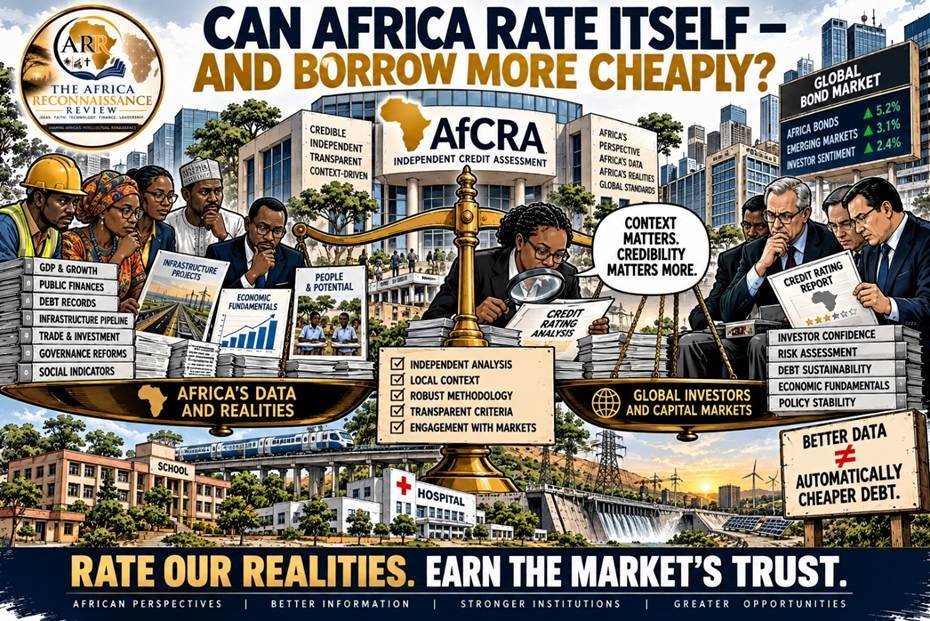
Illustration: The African Reconnaissance Review (ARR). AI-generated for editorial purposes.
On 7 October 2026, the African Union officially launched the Africa Credit Rating Agency (AfCRA) in Mauritius, where the agency is headquartered in Port Louis. First mandated by African leaders in 2017, developed under the African Peer Review Mechanism (APRM), and delayed from an original September 2025 launch, AfCRA is designed to provide independent, evidence-based and Africa-focused credit assessments of sovereigns, sub-sovereigns, corporates and public and private institutions. For decades, Africa was written off as a high-risk market. Now, the continent is stepping up to define and measure that risk on its own terms.
Yet the real question is not whether Africa needs its own rating agency. It is this:
Can AfCRA help change the price Africa pays for capital?
If it can, better-informed risk assessment could translate into cheaper borrowing, more investment, and more fiscal room for African governments to finance the much-needed infrastructure, industrialisation, energy, healthcare and education.
The answer is a cautious yes, but only if AfCRA becomes something far harder to build than an African version of Moody’s, S&P or Fitch. It must become a credible alternative way of understanding African risk. To be fair and accurate, Africa’s risk must be viewed in its true context and measured by frameworks built on the continent. The foreign credit rating agencies have never depicted risk through our African lens.
Credit ratings matter because investors do not simply ask whether a country can borrow. They ask, ‘At what price?’
A sovereign country with a weaker rating must generally offer investors a higher return to compensate for perceived default risk. That premium feeds directly into the cost of issuing bonds and, ultimately, the cost of financing public investment.
For Africa, the stakes are huge. According to African Development Bank estimates, African governments’ debt-service payments rose from roughly US$61 billion in 2010 to about US$163 billion in 2024. Debt pressure is no longer an accounting problem; it directly constrains governments’ ability to invest in development.
Africa therefore faces a paradox. The continent needs vast amounts of capital to finance its transformation, yet the risk attached to African borrowers often makes that capital more expensive. The result can be a vicious cycle:
Breaking that cycle requires more than better public relations. It requires better information.
The AfCRA proposition: context matters
AfCRA’s central proposition is not that African countries should receive better ratings because they are African. That would undermine the very purpose of a credit rating. The argument is rather that African economies should be assessed using more complete information about the environments in which they operate. The African Union has been explicit on this point: AfCRA is not intended to replace existing international agencies, shield borrowers from scrutiny, or guarantee favourable ratings. Its stated purpose is to add an independent perspective grounded in African data, expertise and economic realities. The UN Economic Commission for Africa (ECA) likewise argues that AfCRA’s comparative advantage lies in its proximity to African markets, its understanding of local institutions, and its ability to factor reform trajectories into risk assessment.
This is why the idea of a “context-intelligent” rating matters. A context-intelligent rating is not a softer rating. It is a better-informed one.
What does “context-intelligent” actually mean?
Consider two countries with similar debt-to-GDP ratios. A conventional model might see comparable fiscal risk.
Now suppose Country A has a large but measurable informal economy, substantial domestic savings, deepening pension-fund participation, predominantly local-currency debt, a credible central bank, a stable banking sector, improving tax collection, major infrastructure investment underway, and a demonstrable record of implementing reforms.
Country B has the same headline debt ratio but weak institutions, limited domestic savings, shallow financial markets, poor fiscal transparency, heavy foreign-currency debt, weak revenue mobilisation, political instability, and a history of policy reversals.
The numbers look similar. The risks are not.
AfCRA’s opportunity is to capture that difference more intelligently by incorporating local knowledge, higher-resolution data, institutional realities, reform momentum, domestic financial structures and economic trajectories into credit analysis.
The ECA and APRM’s latest Africa Sovereign Credit Rating Outlook (12th edition, February 2026) makes the same call: global rating methodologies should be adapted to African structural realities, including informal sectors, development priorities and reform momentum. That is a fundamentally different demand from simply asking for higher ratings.
Data could become AfCRA’s Greatest Asset
The future of credit assessment will belong to whoever has the best data. AfCRA has the chance to build what the traditional rating architecture has historically lacked: a genuinely continental data ecosystem. Imagine an African credit intelligence platform drawing on:
- Public finance data such as tax revenues, expenditure patterns, fiscal balances, debt maturity profiles and contingent liabilities.
- Domestic financial-market data, such as banking-sector liquidity, pension and insurance assets, domestic bond markets and local investor participation.
- Macroeconomic data in terms of inflation, exchange rates, trade balances, commodity exposure, reserves and growth patterns.
- Institutional data, such as procurement performance, public financial management, regulatory quality, judicial effectiveness and governance indicators.
- Development data, i.e., infrastructure pipelines, energy capacity, logistics performance, industrial output and human-capital investment.
- Reform data, i.e., not whether a government has announced a reform, but whether it is implementing it.
That last category may matter most. Markets react to events; credit analysis should also understand trajectories. A country moving steadily from weak to stronger institutions should not be analysed in exactly the same way as one moving in the opposite direction.
Context Is Key – Not An Excuse
Here lies AfCRA’s greatest danger.
If “African context” becomes a euphemism for giving African governments the benefit of the doubt, AfCRA will fail. Investors will quickly recognise an institution that produces politically convenient ratings; and once credibility is lost, it is extraordinarily hard to recover.
AfCRA must therefore be willing to tell African governments uncomfortable truths. If Zambia’s fiscal position deteriorates, AfCRA must say so. If Ghana’s debt dynamics turn unsustainable, AfCRA must say so. If Nigeria’s fiscal transparency falls short, or South Africa’s institutional weaknesses raise credit risk, AfCRA must say so. And when an African government’s reforms genuinely improve its creditworthiness, AfCRA should say that too.
The purpose of African ownership is not to produce African-friendly ratings. It is to produce better African ratings.
That distinction may decide whether AfCRA becomes a serious global institution or merely a political project. The AU itself has stressed that the agency’s credibility will rest on independence, professionalism, transparency, internationally recognised standards and freedom from political influence.
Can AfCRA Make Borrowing Cheaper?
Potentially it can make borrowing cheaper, but there is no automatic link between creating a rating agency and lowering interest rates. AfCRA could reduce the cost of capital through four channels.
1. Reducing information asymmetry
Normally, investors demand higher returns when they do not fully understand a market. Better, more granular and more credible information reduces that uncertainty. If AfCRA produces analysis global investors trust, part of the premium attached to the unknown could fall.
2. Introducing competition
The global rating market is dominated by three agencies. A credible newcomer introduces competition in analysis, methodology and information. AfCRA is explicitly positioned as a complement to the existing agencies, not a replacement, and rightly so. Africa does not need to dismantle the existing rating architecture. It needs to diversify it.
3. Expanding coverage
According to the AU, 23 of Africa’s 55 states have no rating from any of the three major global agencies (i.e., S&P, Moody’s, and Fitch). For smaller economies, the absence of a recognised rating is itself a barrier to international capital market. If AfCRA can credibly rate previously unrated countries, municipalities, corporates and financial institutions, it could widen the universe of investable African assets.
4. Strengthening local-currency markets
Perhaps the most strategic opportunity is not helping African governments issue more Eurobonds. But helping Africa build deeper local-currency capital markets, an area where AfCRA is expected to concentrate its early ratings. That could reduce dependence on foreign-currency borrowing and help African pension funds, insurers, banks and asset managers finance African development with African savings.
That would be a far deeper form of financial sovereignty.
Unpacking the “African Risk Premium”
And now this is where the debate gets serious and interesting.
Supporters of AfCRA argue that African countries are penalised by methodologies that fail to capture local realities. In November 2025, an Africa Expert Panel convened under South Africa’s G20 presidency and chaired by former finance minister Trevor Manuel reported that rating agencies exhibit “perception biases”, often assessing African risk as higher than that of other regions with comparable fundamentals.
Critics counter that Africa’s higher spreads are not simply the product of Western bias. They point to genuine structural weaknesses: fiscal opacity, weak regulation, large informal economies, shallow financial systems and limited domestic revenue mobilisation. Chatham House analysis in late 2025 argued that evidence of systematic anti-African rating bias is weak and that much of the continent’s higher borrowing cost reflects underlying risk. The agencies themselves dispute the charge; Moody’s has cited historical default data showing African countries behave in line with similarly rated borrowers elsewhere.
This criticism should not be dismissed. If anything, it strengthens the case for AfCRA, because the objective should not be to prove that the Big Three are “wrong”. It should be to establish what the risk actually is.
If AfCRA reaches the same rating as Moody’s, Fitch or S&P but demonstrates it with deeper African data, it adds value. If it reaches a different rating, it must show precisely why. That is how an alternative institution earns credibility.
Challenging the Rating Oligopoly
Strictly speaking, the global rating industry is an oligopoly rather than a monopoly. But the practical concern stands: a handful of institutions exert enormous influence over how sovereign and corporate risk is read by international capital markets.
Whoever controls the methodology shapes how risk is perceived. And whoever shapes perceived risk influences the price of capital.
AfCRA’s strongest challenge to that architecture will be methodological. It must ask: what does African creditworthiness actually look like? Not through a New York, London or Frankfurt lens. Not through an African political lens. But according to the evidence available.
That means building models able to recognise realities that generic global assumptions can miss: the economic weight of informal markets; the role of traditional and local institutions; regional trade networks; commodity-linked fiscal cycles; domestic pension and insurance pools; regional monetary arrangements; development expenditure; infrastructure bottlenecks; demographic dynamics; political settlements; and the actual pace of institutional reform.
These are not reasons to ignore risk. They are reasons to understand it better.
Governance will determine everything.
AfCRA’s most important asset will not be its Mauritian headquarters, its technology, or even its analysts. It will be trust.
The agency is structured as a private-sector-driven institution funded through shareholder capital and its own operations, and (under the AU framework) governments may not own shares. That design is intended to protect analytical independence. It will be tested with time.
Imagine AfCRA downgrading a powerful African government shortly before an election. Does the government cry economic sabotage? Does the board protect the analysts? Does the methodology survive the pressure?
Or imagine the reverse: AfCRA upgrading a politically influential government despite deteriorating fiscal indicators. Investors will ask the same questions.
The moment AfCRA is seen as a political tool rather than an independent authority, then its value will vanish.
Can AfCRA say no? That will be the real test. Building that local credibility is only half the battle; defending it is the rest.
On the flip side, AfCRA should be shielded from both foreign investors and political actors who might be quick to dismiss its objectivity.
Africa Needs Credibility, Not Flattery
I should state that there is a dangerous temptation in this debate: to interpret financial sovereignty as the right to control the narrative. But financial sovereignty does not mean controlling the narrative. It means having the capacity to produce, interrogate and defend the evidence behind it.
A credible African rating agency must be able to deliver bad news. It must downgrade the economic outlook based on reality. It must challenge governments, expose poor fiscal management, identify institutional weakness, and distinguish genuine reform from reform theatre. At times it must disagree with investors, too.
Only then will investors believe it when it reaches a positive conclusion. As the ECA has framed it, the goal is not preferential treatment for African countries but greater accuracy, transparency and contextual relevance in assessing credit risk.
That is the standard Africa should set and demand.
The Ultimate Test: Will Markets Listen?
Launching AfCRA was the easy part. Earning investor trust is much harder.
Credit ratings run on reputation. Investors need confidence that an agency’s methodology is transparent, its data reliable, its analysts independent, and its governance resistant to political pressure. AfCRA has signalled that it will publish its methodology, rating scale and timeline for issuing assessments shortly after launch. That is a necessary first step, and one that will be closely scrutinised.
Beyond that, it will need clear rating criteria, transparent appeals and review procedures, strict conflict-of-interest rules, protected analyst independence, and regulatory recognition. That will result in pension funds, insurers and central banks being able to actually reference its ratings in their mandates and rules. Above all, a published track record showing whether its ratings predict credit outcomes over time.
The ultimate test will not be whether African governments praise AfCRA. It will be whether global investors price African securities differently because they trust its analysis.
Africa’s opportunity is bigger than a rating.
AfCRA arrives as the global financial order shifts. The world is becoming more multipolar, and African economies matter more than ever in critical minerals, energy, agriculture, digital services and consumer markets. However, the continent still depends heavily on analytical systems designed elsewhere.
AfCRA challenges that imbalance. But Africa should resist framing it as “Africa versus the West”. The stronger argument is simpler:
Africa needs a seat at the table where risk is defined.
AfCRA does not have to prove that Western agencies are always wrong. It has to prove that African data can make global credit analysis better. That is a far more ambitious and potentially far more transformative proposition.
Credit ratings are a metric, not a destiny. While reforming risk assessment is crucial for fair borrowing costs, Africa’s true opportunity lies far beyond financial scores. It sits in building integrated markets, unlocking intra-African trade, powering industrial capacity, and financing its own growth. A fairer rating opens doors, but what Africa builds once inside is what truly changes the future.
Conclusion
Ultimately, AfCRA is about who gets to define value. Who defines risk? Who controls financial information? Who decides whether a country’s future is investable, and how much that future costs?
For generations, African economies have been evaluated largely from outside. AfCRA offers the possibility of something different: Africa evaluating itself (rigorously, independently and transparently) and presenting that evidence to the world.
If it is politically captured, it will fail. If it becomes a propaganda instrument, it will fail. If it merely copies existing methodologies, it will add little value.
But if AfCRA can combine African data, global standards, contextual intelligence, technological sophistication and uncompromising independence, it could become part of the infrastructure of African economic sovereignty and help answer one of the continent’s most expensive questions:
Why should Africa keep paying a premium for being misunderstood?
The answer is not that Africa deserves cheaper money. It is that better information should produce better pricing. That is the promise AfCRA must now prove.