The Pacific is warming, and Southern Africa is watching. The real question is whether Africa will prepare before the crisis arrives.
The warning is becoming harder to ignore. El Niño is strengthening, and the World Meteorological Organization (WMO) expects it to intensify further before peaking towards the end of 2026, with near-certainty that it will persist into early 2027. Forecasters now speak of an event that could rank among the strongest observed since reliable records began in 1950.
This is not merely a story about an unusually warm patch of the Pacific Ocean. For Africa, El Niño becomes a story about food, water, electricity, livelihoods, inflation, public finances and human security. For Southern Africa, the timing could hardly be worse: the 2026/27 agricultural season is beginning at precisely the moment climate models are pointing to heightened rainfall risk across much of the region.
At this particular point, Sub-Saharan Africa needs to ask an important question:
What will we do with the warning?
El Niño is a naturally occurring climate pattern marked by unusually warm sea-surface temperatures in the central and eastern tropical Pacific. Its reach, however, is global. By shifting atmospheric weather patterns, it rewrites local climates—leaving some regions parched by intense heat and drought, while drowning others under unseasonable downpours and sudden floods.
Current forecasts point to sea-surface temperature anomalies well beyond those seen at the peak of the 2015/16 event, which until now served as the modern benchmark for a “super” El Niño. But an important qualification applies. As the World Meteorological Organisation (WMO) itself stresses, a very strong El Niño does not produce identical impacts everywhere. Local outcomes depend on geography, seasonality and other climate drivers, including the Indian Ocean Dipole, which is also forecast to be in a positive phase this year.
The Southern African Development Community (SADC) has forecast an increased likelihood of below-normal rainfall across much of central and Southern Africa during the 2026/27 rainy season. From October to December, drier conditions are favoured across southern Zambia, Zimbabwe, much of Mozambique, Botswana, Namibia, much of South Africa, Eswatini, Lesotho and parts of Angola.
The picture is not uniform. Northern Zambia, Tanzania and the eastern Democratic Republic of Congo are expected to be comparatively wetter. Africa’s response therefore cannot be a blanket, continent-wide declaration of “drought”. It must rest on localised climate intelligence.
For Zambia, El Niño 2026 deserves particular attention. The country is coming off a markedly improved 2025/26 season, with the Famine Early Warning Systems Network (FEWS NET) estimating a record maize harvest of roughly 5 million tonnes. That is a genuine buffer. But a good harvest today does not guarantee food security tomorrow.
FEWS NET expects the 2026/27 season to bring delayed and below-average rainfall, especially in southern and western Zambia, together with above-average temperatures. Prolonged dry spells during the critical crop-development window could reduce planting, yields, agricultural labour opportunities and rural incomes. A new report from the Integrated Food Security Phase Classification (IPC) warns of a growing hunger crisis. Between October 2026 and March 2027, conditions are expected to worsen, leaving more than 1.2 million people facing severe, life-threatening food shortages.
Zambians do not need to be reminded what this looks like. In February 2024, the drought was declared a national disaster. Crops failed across the south, and as Lake Kariba fell, the country endured some of the most severe load-shedding in its history. The memory is recent, and it should shape the response now.
At this point, the El Niño conversation becomes an economic conversation. A rainfall shock does not stop at the farm gate. It moves through the economy, and it tends to move in a predictable sequence.
The first domino: agriculture
Millions of African households depend directly or indirectly on rain-fed agriculture. A delayed season travels down a familiar chain: planting, crop establishment, yields, farm income, food supply, prices and, finally, household purchasing power.
The damage is not confined to smaller harvests. A poor season erodes agricultural employment, livestock pasture, water availability, rural demand, transport activity, agro-processing, government revenue and foreign-exchange earnings. This is why climate resilience cannot be filed under environmental policy alone. It is an economic policy.
The second domino: food prices
One of the clearest lessons from past El Niño events is that the worst economic consequences often arrive after the weather itself. FEWS NET notes that the most severe food-security effects of El Niño rainfall anomalies typically emerge in the following lean season, not during the rains.
That time lag is dangerous. The skies may clear while household food stocks keep falling. As local supplies tighten, households turn to markets just as prices begin to climb. Poorer families then face a triple squeeze: less food, higher prices and lower income. Governments cannot afford to wait for food inflation to accelerate before acting.
The third domino: electricity
For Zambia, there is a vulnerability that cannot be ignored: hydropower. The IMF reported that hydropower made up roughly 81 per cent of installed generation capacity as of October 2025, much of it tied to the Zambezi basin. The 2024 drought showed exactly how that dependency works in practice. Water scarcity became electricity scarcity, and electricity scarcity became economic disruption for households, mines, manufacturers and small businesses alike.
Lake Kariba stood at about 38 per cent usable storage on 5 October 2026. That is considerably better than a year earlier, but it remains a critical indicator to watch as the season unfolds. El Niño is therefore simultaneously an agricultural risk, a water risk and an energy risk.
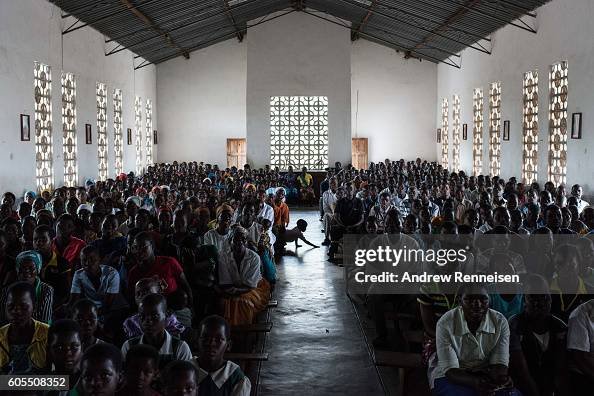
While Southern Africa braces for severe dry spells, the east faces the exact opposite danger. Weather experts warn that from October to December, heavy rains are far more likely across large parts of the Greater Horn of Africa, including Kenya, Somalia, Ethiopia, Tanzania, Uganda, Rwanda, and Burundi.
For families in these regions, the threat isn’t drought but rising waters. Heavy rain could trigger sudden flash floods that sweep away crops, wash out vital roads and bridges, and force communities from their homes. Worse still, standing water brings a spike in waterborne and insect-borne diseases, all while damaging critical infrastructure and cutting off access to healthcare when people need it most.
One climate phenomenon can bring drought to one part of Africa and floods to another.
Africa, therefore, needs a continental climate-intelligence architecture capable of turning global forecasts into local decisions.
Moving from Crisis Response to Early Action
There are encouraging signs that the continent is moving in this direction. The African Union has been working with meteorological and climate institutions to strengthen preparedness for the 2026/27 season, including an AU-supported workshop in Lusaka that brought together meteorologists, regional climate centres, national meteorological services and representatives of climate-sensitive sectors. The emphasis was explicitly on anticipation, preparedness and coordinated early action. This is precisely the shift Africa needs.
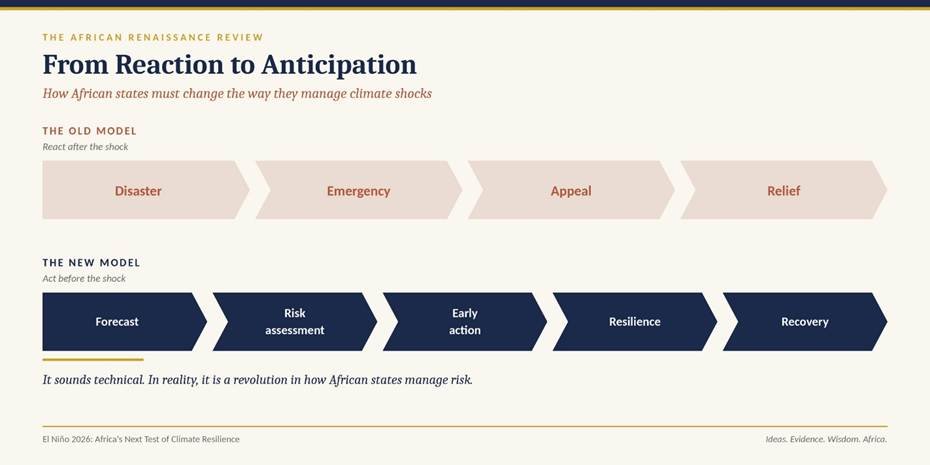
Building Resilience: Key Actions for African Governments
1. Protect the agricultural season: The forecasts should guide the targeting of drought-tolerant and early-maturing seed varieties, irrigation, conservation agriculture, extension services, water harvesting, livestock support and farmer finance. The aim is not to distribute relief after crops fail, but to reduce the probability and scale of failure before it happens. In Zambia, this means aligning the Farmer Input Support Programme and extension messaging with Zambia Meteorological Department advisories, region by region.
2. Build strategic food buffers: Where harvests have been strong, governments should decide deliberately how much surplus to hold in reserve. Food reserves are not just emergency stockpiles; they are national resilience infrastructure. For Zambia, the Food Reserve Agency’s stock position after a record harvest is a strategic asset, and decisions on exports and releases should be taken with the 2027 lean season firmly in view.
3. Accelerate energy diversification: The goal is not to abandon hydropower but to ensure that one failed rainy season never again becomes a national electricity crisis. Solar, wind, geothermal where feasible, battery storage and deeper regional interconnection through the Southern African Power Pool all belong in the national resilience portfolio.
4. Treat water as strategic infrastructure: Dams, reservoirs, irrigation schemes, groundwater management, rainwater harvesting and urban water systems are strategic assets. The guiding question should be: how much of Africa’s rainfall can we capture, store and use intelligently? A continent that suffers floods and drought in the same year is not facing a contradiction; it is revealing a gap in water infrastructure.
5. Turn climate information into climate intelligence: A smallholder farmer does not need a paper on ENSO dynamics. She needs to know when to plant, which seed to use, how much rain to expect, when to move livestock and where to find drought-tolerant inputs. A utility needs to know what the rainfall outlook means for reservoir inflows. A finance ministry needs to know what a poor season means for inflation, imports, subsidies and the budget. That translation, from forecast to decision, is the difference between information and intelligence.
6. Build integrated national risk dashboards: Instead of managing climate, farming, water, and public finance in silos, governments should view them through a unified lens. Picture a real-time dashboard connecting these pieces: when lower rainfall threatens the maize harvest, the system automatically tracks how that ripple effect drives up grocery bills, squeezes household income, and triggers the need for government assistance. That is what a modern African climate-security system should look like, and it is well within reach of the data and digital capabilities African states already possess.
7. Make early warning financially actionable: Africa has become increasingly good at producing warnings. The next challenge is financing action on them. If a credible warning arrives six months before a drought, governments need mechanisms to release funds before crops fail: contingency funds, sovereign disaster-risk financing, agricultural and parametric insurance, climate-resilience bonds, pre-arranged credit lines and regional risk pools such as the African Risk Capacity. A warning without money to act on it is only half a warning.
Africa cannot control ocean temperatures in the Pacific, nor can it stop global climate change on its own. But it can control its own vulnerability. That means investing in irrigation instead of waiting on rainfall, tapping into diverse energy sources rather than relying on just one, and stocking strategic reserves instead of scrambling for emergency imports. It means choosing foresight over sudden shocks and standing together as a region rather than standing alone. Above all, it means acting before a crisis strikes, not after.