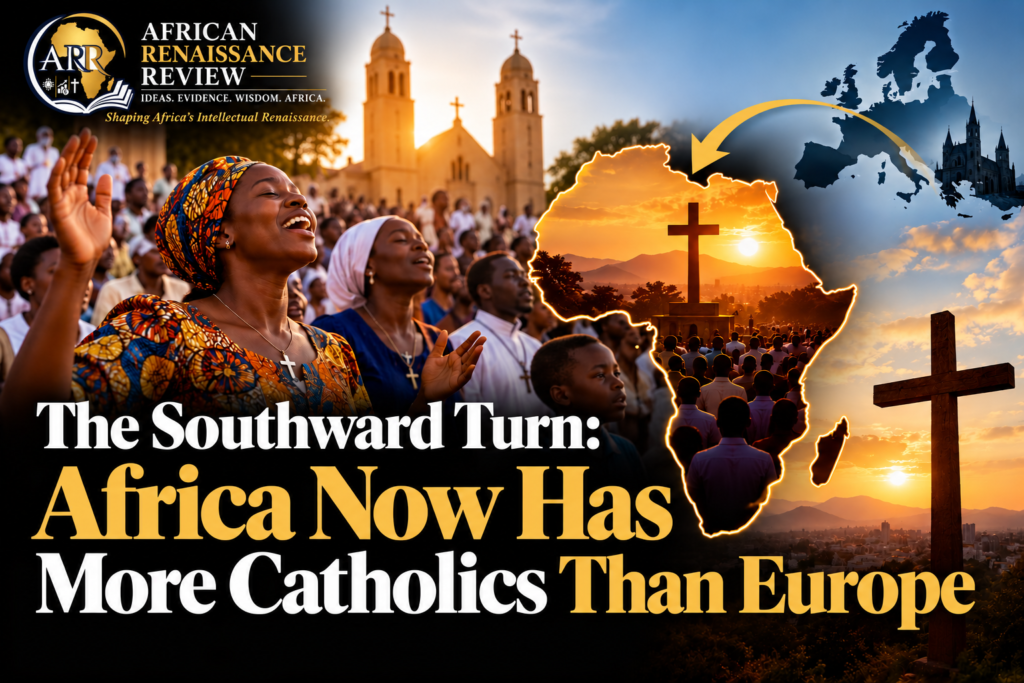
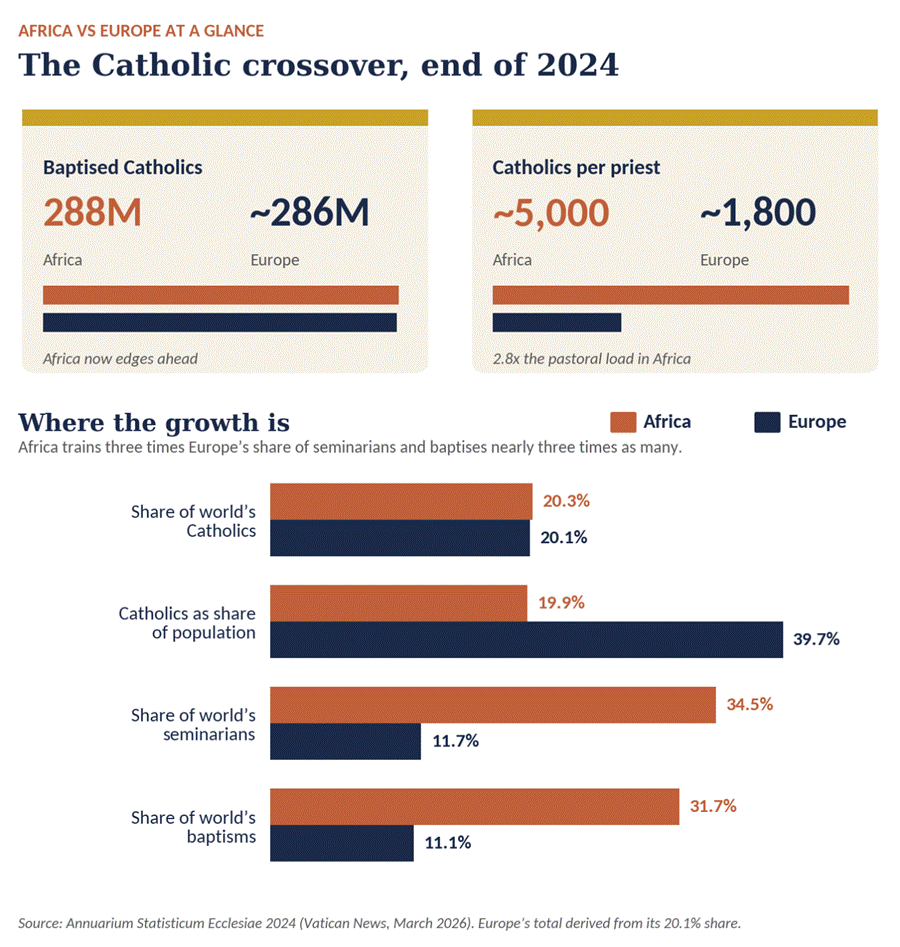
Africa’s overtaking of Europe as the home of more Catholics marks a transfer of the Church’s centre of gravity, not merely a statistical milestone: African believers, clergy and priorities will increasingly shape global Catholicism. For the first time since the Vatican began keeping global statistics, Africa is home to more Catholics than Europe. The Vatican’s own statistics, published in March 2026 and covering the year 2024, put Africa’s share of the world’s Catholics at 20.3 per cent against Europe’s 20.1 per cent.
The margin is thin, but the direction is not in doubt. Africa added roughly seven million baptised Catholics in a single year. Europe, by contrast, has been close to flat for a decade.
There was no ceremony to mark the moment. Yet the crossover may come to be recognised as a defining marker in Christianity’s long southward shift. The continent, once treated primarily as the Church’s mission field, is now its largest home outside the Americas. This is a quiet milestone with loud implications.
At the end of 2024, Africa counted just over 288 million Catholics, up from about 281 million a year earlier. Europe held roughly 286 million, growing by under one per cent. The world total stood at about 1.422 billion.
The longer arc is starker. In 2000 Africa held about 12 per cent of the world’s Catholics, and Europe nearly 27 per cent (RNS via Baptist News Global). In under a quarter century the two lines have crossed.
The continent’s weight is concentrated. The Democratic Republic of Congo alone has almost 55 million baptised Catholics, and Nigeria about 35 million. Uganda, Tanzania and Kenya follow (CathNews).
Two cautions keep the headline honest. These are baptismal counts, not attendance figures; Europe’s practising Catholics are far fewer than its registered ones. And only one in five Africans is Catholic, so the Church’s growth here sits within a crowded religious landscape of Protestant, Pentecostal, Muslim and traditional communities.
This hasn’t happened by chance. Africa’s Christianity is older than Europe’s in many places. Augustine of Hippo, Tertullian and Cyprian were North Africans, and Ethiopia’s church predates most of Europe’s conversions. The Kingdom of Kongo had a Catholic king in the early 1500s.
The modern surge, however, is mostly a twentieth-century story. Missionary orders arrived alongside colonial rule, and the association left real scars. The schools and clinics came with the catechism, but so did a faith often dressed in foreign clothes.
What changed the trajectory was African agency. After independence, African bishops, priests and catechists took over the work. Liturgy moved into local languages after the Second Vatican Council. Drums, dance and indigenous hymnody entered the Mass. The faith stopped being something done to Africans and became something Africans did.
Demography amplified that shift. Africa is the world’s youngest continent, and its families remain larger than Europe’s. Because baptismal totals rise partly with the number of births, the crossover reflects population momentum as well as evangelisation, retention and conversion. Africa now accounts for nearly a third of all Catholic baptisms worldwide; Europe for about a tenth.
Africa has the Catholics, but Europe still has the clergy. Each African priest serves about 5,000 Catholics; each European priest about 1,800. African bishops oversee roughly 365,000 faithful each, more than double Europe’s 170,000.
The gap is narrowing in one important respect. Africa was the only region where the number of students for the priesthood increased in 2024, and it now trains about a third of the world’s seminarians. It also posted the strongest growth in permanent deacons and women religious. These gains strengthen the continent’s future capacity, although they do not yet erase its severe shortage of clergy.
The pull runs in both directions. Many African priests now serve parishes in Italy, Ireland, Germany and the United States, where local vocations have collapsed. This “reverse mission” is a striking inversion of the colonial-era flow. It also raises a fair question: should Africa export priests while its own rural parishes wait weeks for Mass?
Much of the African Church is held together by laypeople. Catechists lead prayer, prepare sacraments and run small Christian communities between a priest’s visits. Clerics make up only about 9 per cent of Africa’s pastoral workforce, against over 20 per cent in Europe. Africa may be quietly modelling a less clerical Church out of necessity.
Numbers alone do not move power in Rome. Europe and the Americas still account for about two-thirds of all bishops, and the Curia and College of Cardinals remain weighted toward the old heartland. Representation lags demography.
Africa’s voice is nonetheless growing louder. In January 2024, the continent’s bishops, through their symposium SECAM, collectively declined to apply the Vatican’s guidance on blessing same-sex couples, citing pastoral and cultural context. Supporters saw a confident African church speaking for itself. Critics saw resistance to Rome and to minorities. Either way, it showed that African bishops can now shape global debates rather than merely receive them.
The deeper influence may be theological and pastoral. African Catholicism tends to be communal, youthful, charismatic in worship and close to questions of poverty, healing and governance. Its synodal habits, built in small Christian communities, predate Rome’s recent synod on synodality. As the Church’s centre shifts, these instincts will increasingly set its tone.
Zambia offers a clear window onto this shift. The country declared itself a Christian nation in 1991, a commitment later written into the preamble of its constitution. The Catholic Church is among its largest denominations and one of its most consequential institutions.
That influence reaches far beyond the pew. Catholic mission hospitals and rural health centres, working through the Churches Health Association of Zambia, carry a large share of care in remote districts. Catholic schools have educated generations of the country’s leaders. On the Copperbelt, Radio Icengelo in Kitwe has long carried both liturgy and public debate.
The Church has also been a civic conscience. The Zambia Conference of Catholic Bishops and the Catholic Commission for Justice and Peace speak regularly on elections, debt, poverty and the cost of living. Their pastoral letters are read as political events, and governments of every party have felt their weight. In 2010, Medardo Mazombwe became Zambia’s first cardinal, a symbolic recognition of that standing.
Zambia’s experience reflects the wider African pattern. The Church here is not an import sitting atop society. It is woven into how Zambians heal, learn, organise and hold power to account.
Africa’s overtaking of Europe is more than a statistical curiosity. It marks the end of an era in which the continent was described mainly as a receiver of faith, ideas and institutions. In the Catholic world, at least, Africa is now a primary bearer of them.
That status brings responsibility as well as recognition. A church this large must train enough priests without stripping its own parishes to fill Europe’s. It must finance itself rather than depend on foreign donors. It must keep speaking truth to African governments, not only to Rome. And it must keep its witness credible on corruption, abuse and accountability, where trust is easily lost.
There is a parallel here with ARR’s recurring theme of sovereignty. Just as Africa is asserting control over its data, its payments and its digital infrastructure, its believers are asserting ownership of their faith. Sovereignty in the spiritual sphere means African theology, African leadership and African priorities taking their rightful place at the table.
The Church’s future will be written, increasingly, in Kinshasa, Lagos, Kampala, Nairobi and Lusaka. Rome should respond by giving African leaders greater influence, investing more seriously in the continent’s pastoral capacity and listening when African Catholics describe the realities shaping their faith. Africa no longer needs to prove that it matters to global Catholicism; global Catholicism must show that it is ready to share authority with Africa.