By Harrison Simumba
When Quickmart’s owners announced they would sell half the company on the Nairobi Securities Exchange, the number that made the headlines was KSh 15 billion (US$115 million). The number I kept coming back to was smaller. The Kinuthia family’s share of that sale comes to roughly KSh 4.77 billion (about US$36.6 million). For an African family business, getting paid like that, on your own terms and while you are still around to see it, is rarer than it ought to be.
The business started in Nakuru as Kids Supermarket, run by the late John Kinuthia and his wife Zipporah. Nothing about it suggested a national chain. It was their son Duncan who took it to Nairobi, opening a branch in Ruai at a time when, as he tells it, suppliers would not even give the family credit.
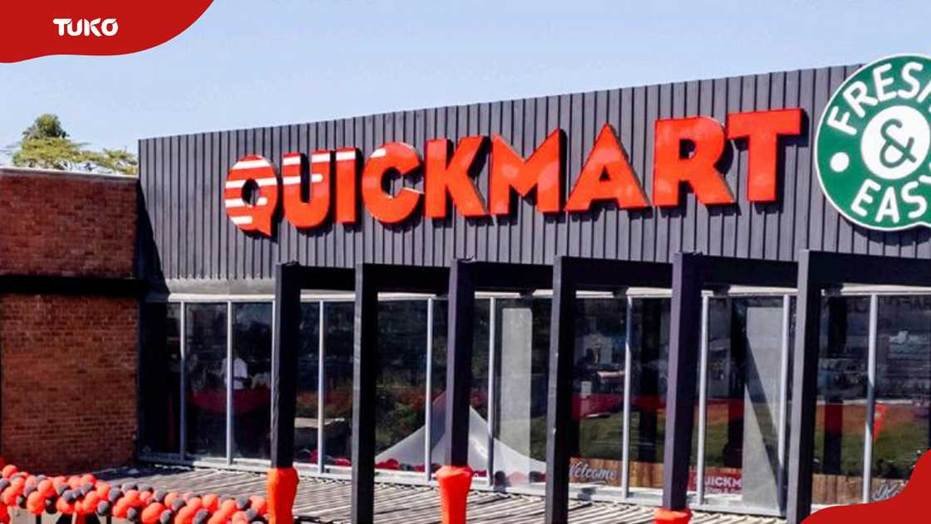
Two decades after the 2006 founding, Quickmart has 72 stores in 16 counties. It handles about five million customer transactions a month and booked KSh 50.4 billion (about US$386 million) in revenue last year. The offer opened on 5 October and closes on 30 October, and the shares are due to start trading on 12 November.
What struck me most at the announcement was Zipporah Kinuthia admitting she never thought the family would get this far. I believe her. Most founders on this continent never see the day their business grows beyond them and still pays them for having built it.
So I want to look at three things here: what made this exit possible, what the public is really buying, and what we in Zambia should take from it.
The structure is simple. Every shareholder group is selling exactly half of what it owns. That is 2 billion of Quickmart’s 4 billion shares, at a fixed KSh 7.50 (about US 5.8 cents) each, which values the whole company at KSh 30 billion (about US$230 million).
The owners hold their shares through a vehicle called Sokoni Retail Kenya Limited (SRKL). Here is how the money splits if the offer is fully taken up.
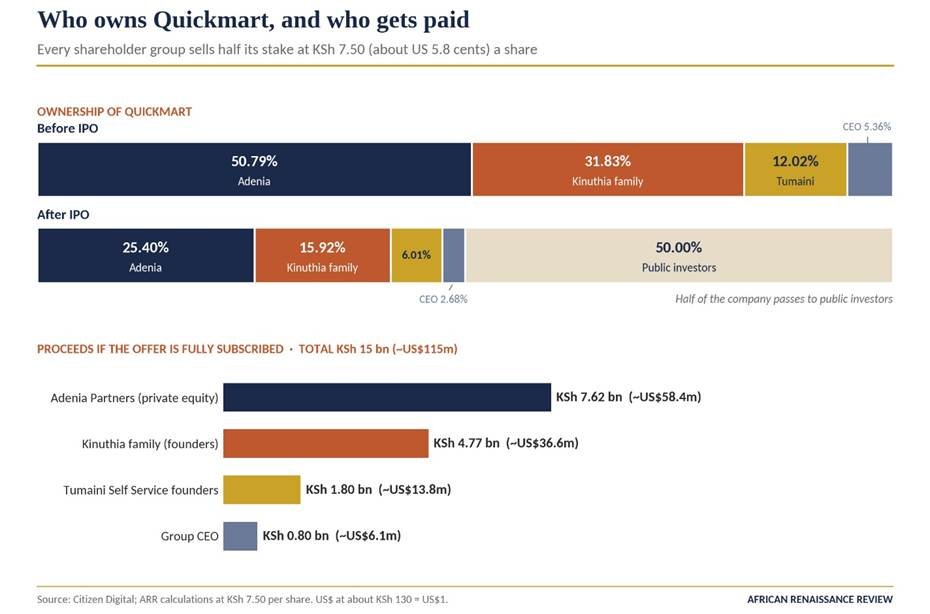
Stakes before the IPO, and the Adenia and Kinuthia proceeds, are from Citizen Digital. The other figures are my own calculations at KSh 7.50 (about US 5.8 cents) per share.
A few details in the fine print deserve more attention than the headline. There is no underwriter and no over-allotment option, so the deal only goes ahead if investors apply for at least 1.5 billion shares, three-quarters of what is on offer. SRKL is also locked in: it cannot sell 60% of its remaining shares for two years after listing, which keeps the sellers tied to the outcome they are asking everyone else to back. And the IFC has made a conditional commitment of about KSh 1.9 billion (US$14.6 million), roughly 13% of the offer, which would leave it holding about 6.5% of the company.
The minimum application is 500 shares, or KSh 3,750 (about US$29). I like that detail. In principle, a shop assistant in Nairobi and a development bank in Washington are buying the same thing at the same price.
Here is the part that is easy to miss: Quickmart itself receives nothing. Not a shilling of the KSh 15 billion (US$115 million) goes into the company. This is an offer for sale, so the money passes from new investors to the existing owners, and the balance sheet stays exactly as it was.
There is nothing wrong with that. It is simply what cashing out looks like. But it should change the question investors ask. Forget “what will Quickmart do with the money?” The real question is whether half of this business’s future cash flow is worth KSh 15 billion (US$115 million).
On the numbers, it looks like a fair price rather than a cheap one. Quickmart made an adjusted profit after tax of KSh 1.7 billion (about US$13 million) in 2025, so the KSh 30 billion (US$230 million) valuation works out at about 17.6 times earnings. That profit is only about 3.4% of KSh 50.4 billion (US$386 million) in revenue. That is normal for groceries, but it leaves little cushion if costs jump or shoppers tighten their belts.
The board says it will pay out at least 80% of profit after tax as dividends, twice a year, starting with the second half of 2026. Market commentators expect roughly KSh 0.50 (about US $0.40) a share for 2026, a yield of around 6.7% at the offer price. Management also wants to pass 100 stores. With most of the profit going out as dividends, that growth will have to be paid for from cash flow and borrowing. So what is on the table is a mature, dividend-paying retailer with thin margins, not a growth gamble. The founders are being paid for twenty years of risk they have already carried.
Anyone who has followed Kenyan retail knows the names that went before Quickmart. Nakumatt, Tuskys and Uchumi were once bigger and better known. Each of them faded or collapsed within about fifteen years.
Their stories differ, but they rhyme. Nakumatt grew on borrowed money and supplier credit until the creditors ran out of patience. Tuskys was pulled apart by fights among the founder’s heirs. Uchumi, the last supermarket to list on the NSE back in 1992, proved that a listing on its own does not fix weak governance.
The Kinuthias took a different road in 2019. That year they let an outsider take control. Adenia bought 51% and merged Quickmart with Tumaini, a rival chain it also controlled. The family gave up the majority and got professional management, a proper board, audited discipline and scale in return.
It is an uncomfortable lesson, and I think it is the main one: the family kept its wealth by giving up control. Too many of our founders see the business as an heirloom that must pass to the children whole. The Kinuthias seem to have seen it as an asset to grow, share and, in time, partly sell.
Put the survivors and the casualties side by side, and a few things stand out. Here, the family and the firm were kept apart, with ownership in a holding company and decisions made by a board rather than around the dinner table. Dilution was accepted early: giving up 51% of a smaller business opened the door to the capital and management that built a KSh 30 billion (US$230 million) company. And the exit was planned before anything forced it, instead of arriving as a fire sale after a death or a creditor’s petition.
The biggest cheque from this IPO does not go to the Kinuthias. It goes to Adenia: about KSh 7.62 billion (US$58.4 million), against the family’s KSh 4.77 billion (US$36.6 million). In money terms, this Kenyan success story is first of all a private equity success story.
You could call that extraction. I think it is closer to a fair price. Adenia took a family-run business and a rival chain, put them together, professionalised them and carried the risk. Without that money, Quickmart might still be a solid regional grocer. It might also have joined the list above.
So the sovereignty question, as I see it, is not whether foreign investors should make money. It is whether African savers get in before all the value has been taken. This IPO answers that only in part.
Half the company will now be in public hands, and for the first time ordinary Kenyans, pension funds and SACCOs can own a piece of the supermarket where they buy their groceries. At KSh 3,750 (about US$29), the entry ticket is within reach of a salaried worker, and you can apply online. But the anchor investor is once again foreign. The IFC’s commitment steadies the deal, yet it also means the first big name in the order book is a development financier, not a Kenyan institution.
Earlier this year, the Kenya Pipeline Company listing ended an IPO drought that had lasted more than a decade. Quickmart is the first real test of whether a private, family-founded company can use that window too. If Kenyan investors fill the book, Nairobi gets a deeper market. If foreign and development money has to carry it, the bell will still ring, but the renaissance will be borrowed.
What Zambia should take from this
We have not had our Quickmart moment yet, and it is worth being honest about why. Modern grocery retail here is dominated by regional chains headquartered elsewhere, and the Lusaka Securities Exchange is still small and thinly traded. We have no shortage of family businesses. What we lack are family businesses with a planned way out.
For founders, the Kinuthia story points to a path taken in steps, not one leap:
- Set the business up as a company that stands apart from the family, and get its accounts audited early.
- Build a board that can tell the founder no, and write down a succession plan long before anyone needs it.
- See outside equity as a tool rather than a defeat. A smaller share of a much bigger company is usually worth more.
- Plan how the family will get paid, so it is rewarded for its risk instead of fighting over the business after a funeral.
For policymakers and market institutions, the job is to build the bridge from private success to public ownership. NAPSA and our other pension and insurance funds could play the anchor role that the IFC is playing in Nairobi, so that Zambian savers are first in line rather than last. Listing rules, costs and disclosure requirements for growth companies should fit the size of the mid-sized family firms the LuSE needs to attract. And Kenya’s KSh 3,750 (about US$29) minimum, with applications made online, shows how ordinary people can be brought in. Our payment rails can already do the same.
The goal is not one listing. It is a steady stream of Zambian-built companies that Zambians can own a part of.
The Kinuthia exit deserves to be celebrated, and it deserves to be studied. A family that started with one grocery in Nakuru is being paid nearly KSh 5 billion (about US$37 million) for what it built, and it still owns a meaningful share of whatever comes next.
But the founders’ payday is not the real story. The real story is the public moving from customer to owner. We will know whether that has actually happened on 6 November, when the allocations show who filled the book.
Africa has never been short of builders. What we are short of are institutions that let builders hand over, sell up and still come out whole. Quickmart has shown that the path exists. Our work now is to make it ordinary, in Nairobi and in Lusaka.