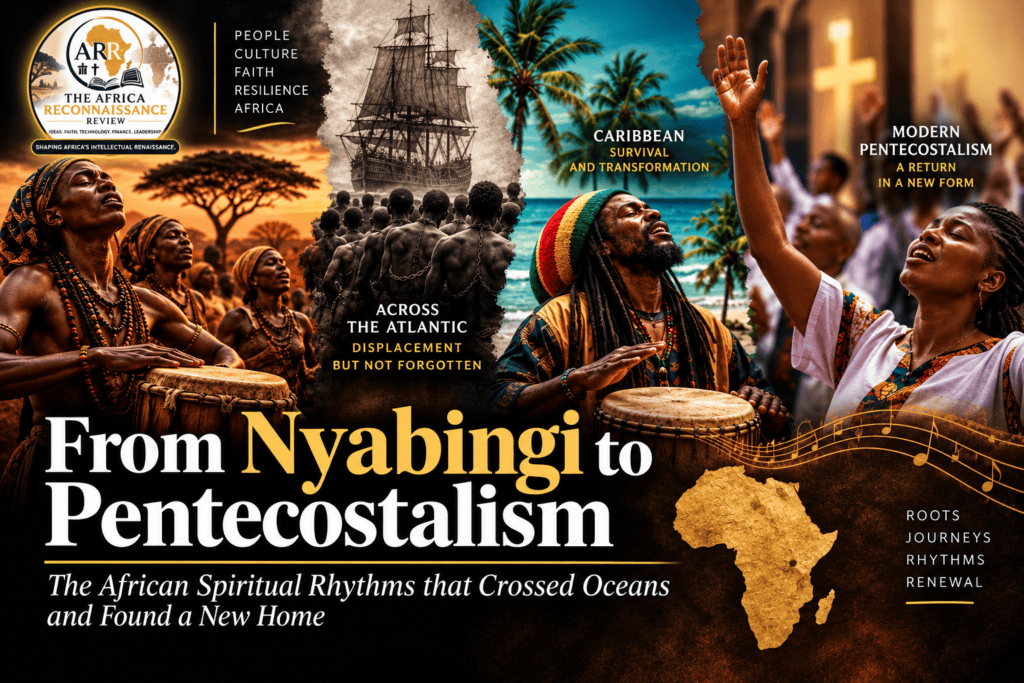
History has a way of coming back around. The traditions that were once condemned, suppressed, or nearly forgotten often reappear in new forms, still carrying the imprint of where they began. The Nyabinghi chant and drumming tradition of East and Central Africa is one powerful example. Born as a sacred spiritual practice within African communities, it was carried across the Atlantic through the violence of slavery. There, it evolved within Afro-Caribbean religions and Rastafarianism, helped shape music around the world, and today can be heard in unexpected ways in modern Pentecostal worship across Africa and beyond.
The story of Nyabinghi, then, is about much more than music. It is about memory that refuses to die, resilience in the face of oppression, the search for identity, and the enduring strength of African spirituality.
I. The Spirit Before the Sound: East African Origins
Every beat carries a story. The story of the Nyabinghi chant begins not in a recording studio or church hall, but in the mist-covered highlands of East Africa’s Great Lakes region, in what is now Rwanda, south-western Uganda, and north-western Tanzania. It was here that people believed a powerful female spirit lived among them.
The name “Nyabinghi” carries deep meaning. In Runyankole, the language of the Ankole kingdom in western Uganda, it is said to mean “abundance”. Oral tradition traces the spirit back to the 18th century and to Queen Kitami, ruler of the Bgeishekatwa people in the ancient kingdom of Karagwe, in present-day Tanzania. After she was murdered by her husband, Murari, the region was struck by drought, disease, and upheaval—the calamities people linked to the queen’s vengeful spirit. Out of this tragedy grew a religious tradition led by mediums known as abagirwa, who communicated with Nyabinghi on behalf of the living and sought her protection and intercession.
These mediums, most of them women, became channels of spiritual power. Communities brought offerings, and the spirit was believed to speak through them. Chanting, drumming, and ecstatic possession stood at the centre of these encounters. Over time, reverence for a murdered queen grew into one of the most politically powerful spiritual movements East Africa had known.
By the 19th century, Nyabinghi had become far more than a religious movement. It had also become a force for organised resistance.
II. Muhumusa: The Queen Who Defied Empires
No one captures the political force of the Nyabinghi spirit more vividly than Queen Muhumusa, whose name is also spelled Muhumuza. A Rwandan queen mother, she became one of the most remarkable figures of resistance in African colonial history.
In the early 1900s, Muhumusa fled with the heir to the Rwandan throne to Ndorwa, in present-day south-western Uganda. She refused to recognise the authority of the usurper King Musinga, an ally of the German colonial administration. Declaring herself a medium of the Nyabinghi spirit, she gathered supporters across the region and promised to drive out the Europeans, proclaiming that “the bullets of the Wazungu would turn to water against her.” Her armed resistance was crushed within months. She was captured first by the Germans and later by the British, who kept her in detention from 1912 until her death in Kampala in 1945.
British authorities were so unsettled by Nyabinghi’s political influence that they passed the Witchcraft Ordinance of 1912 to outlaw the movement. The law gave them a convenient means of crushing what they correctly recognised as organised anti-colonial resistance. Nyabinghi-inspired uprisings continued in the years that followed, although less frequently. The last major revolt, led by a medium named Ndungutsi, was suppressed in 1928.
However, the spirit could not be imprisoned. The chant, the drums, and the cry for freedom travelled beyond East Africa (across generations and across the ocean), carried first in the bodies of enslaved Africans and later in the consciousness of descendants who refused to forget.
III. The Middle Passage: Rhythm as Survival
The transatlantic slave trade carried more than people across the ocean. It also carried whole worlds of knowledge—languages, medicine, kinship systems, beliefs, and, crucially, sacred music. Enslaved Africans came from many parts of the continent, including large numbers of Kongo, Ashanti, Igbo, and Yoruba people from West and Central Africa. Each community brought its own rhythms and spiritual traditions.
In African spiritual life, the drum was never just an instrument. It was a voice, a sacred vessel, and a way of communicating with ancestors and the divine. Slaveholders in the Americas and the Caribbean understood its power and banned drums in many places. But they could not silence rhythms already held in the body: the beat of the heart, the call-and-response of communal song, and the shared movement of collective praise.
In Jamaica, several African musical traditions survived and blended. The Burru tradition, brought by enslaved Ashanti people from present-day Ghana, used three drums much like those later heard in Nyabinghi ceremonies. Kumina, carried by Kongo-speaking Central Africans who arrived as indentured workers after slavery was formally abolished, contributed the distinctive “heartbeat” rhythm: a deep, steady pulse that became central to Nyabinghi drumming and, eventually, reggae. Kumina ceremonies brought together drumming, chanting, ancestral worship, and spirit possession—a pattern strikingly similar to the Nyabinghi groundation gatherings that Rastafari later formalised.
A similar act of cultural preservation was unfolding in the American South. Enslaved Africans gathered secretly at night in wooded spaces known as “brush arbors.” There, they brought Christian scripture together with African rhythms, chanted preaching, intense emotion, and drumming. These gatherings helped lay the spiritual foundations of the Black Church and, later, American Pentecostalism.
Across these displaced communities, the chant remained the common thread: repetitive, communal, hypnotic, and spiritually charged. Whether it was called Kumina, brush-arbor worship, or simply “making a joyful noise”, the pattern echoed what had long taken place in the East African highlands—the voice and drum calling the sacred near, and the body becoming an instrument of the divine.
IV. Jamaica: Where the Chant Found Its Name
The word “Nyabinghi” reached Jamaica by an indirect route. In 1934, Italian journalist Frederico Philos published an article describing a secret African organisation called the “Nya-Binghi,” said to be spreading the message “Death to all White and Black oppressors.” When the Jamaica Times reprinted the article in 1935, Rastafari elders recognised in it the same call for African liberation that shaped their own movement. They adopted the name not simply as an imitation, but as an act of recognition: the spirit of resistance that had stirred the Ugandan highlands now spoke to the African diaspora in the Caribbean.
Rastafari emerged in Jamaica in the early 1930s, inspired by the coronation of Ethiopian Emperor Haile Selassie I, whom Rastafari revere as divine. The movement drew together many African spiritual currents and shaped them into a distinct ceremonial tradition. The Nyabinghi Order became the oldest and most orthodox of the Rastafari “mansions”, or branches. It emphasised biblical devotion, reverence for Selassie, African repatriation, and rejection of the Western colonial order known collectively as Babylon.
At the centre of Nyabinghi worship is the groundation, a communal gathering that can last for several days. Three sacred drums shape its sound: the bass drum, which lays the foundation; the funde, which keeps the heartbeat pattern; and the repeater, which leads with improvisation. Together, they create what Rastafari calls the heartbeat of Jah (God), a pulse that connects worshippers to life itself. The drumming is joined by chants drawn from biblical psalms, Rastafari hymns, and the Holy Piby, often called the “Black Man’s Bible.” Rhythm, scripture, ganja used as a sacrament, and a shared spiritual purpose sustain the gathering.
The legendary drummer Count Ossie, based in Kingston’s Wareika Hills, played a decisive role in carrying Nyabinghi rhythms beyond the ceremonial space and into Jamaican popular music. During the 1950s and 1960s, he blended the Nyabinghi heartbeat with jazz and early ska, recording with influential groups such as the Skatalites and the Wailers. His landmark 1973 album Grounation remains one of the most authentic recordings of the tradition. Bob Marley later brought the rhythm to a global audience through “Rastaman Chant”, placing the spiritual pulse of the East African highlands within the soundscape of the 20th century.
V. The United States: Africa Remembered in the Black Church
In the United States, African sacred chanting followed a parallel path, eventually becoming woven into Black Christianity and Black Pentecostalism. The enslaved Africans kept rhythmic and ecstatic forms of worship alive in brush-arbor meetings and secret night gatherings across the antebellum South. The chanted preaching, call-and-response, open displays of emotion, and rhythmic percussion did not disappear. Instead, they became part of a theology of freedom that enslaved people drew from the very scriptures used by their oppressors.
After Emancipation, these traditions developed further in Black Baptist and Methodist churches. They found especially powerful expression in Pentecostalism, which burst onto the public stage during the Azusa Street Revival in Los Angeles in 1906. Led by Black preacher William J. Seymour, the revival brought people of different races together in an outpouring of ecstatic worship that unsettled many white observers. Worshippers spoke in tongues, shook, wept, and chanted rhythmically. When white Pentecostal leader Charles Parham visited, he dismissed what he saw as “crude Africanisms.” He recognised the African roots but misunderstood their value.
James Baldwin pointed to the drum as one of the most enduring African elements in Pentecostal worship. Scholars have likewise noted that the tambourines, steady handclaps, driving organ, and bass guitar heard in Black charismatic churches descend structurally from the same African sound traditions that shaped Nyabinghi. The shuffling feet, dancing bodies, and intense physical responses are not breaks from African forms of spirit encounter. They are continuations of them, expressed through the language of the Holy Ghost.
The Harvard Divinity Bulletin has described Black Pentecostalism as a deliberate effort to “re-Africanize Black Christianity”—to reclaim forms of worship long associated with African traditional religions. Dancing, shouting, drumming, clapping, and percussion returned not because their African roots were unknown, but, for many of the movement’s founders, because those roots mattered. Even today, when a pastor rises on a Sunday morning and leads a congregation in a wordless chant, the structure closely echoes the communal chanting of a Nyabinghi groundation.
The Great Migration of 1910–1970 carried these worship traditions north as millions of Black Southerners moved to cities such as Chicago, Detroit, and New York. Storefront Pentecostal churches became cultural homes for migrant communities, and their vibrant style of worship flowed into gospel, soul, funk, and eventually global popular music. What had begun as a means of survival in the brush arbors of Georgia and Mississippi became part of the heartbeat of modern culture.
VI. Modern Pentecostalism: The African Pulse Returns
The relationship between African sacred music and modern Pentecostalism is not a simple one-way inheritance. It is a living conversation that moves in both directions. By the middle of the 20th century, Pentecostalism had spread back across the continent that had first shaped many of its musical and spiritual instincts. It found a natural home in communities that had never fully abandoned rhythmic, communal, and ecstatic ways of encountering the divine.
In Nigeria, the Aladura churches (whose Yoruba name means “praying people”) emerged in the early 20th century and gained momentum during the influenza pandemic of 1918. They recognised that European styles of worship did not fully speak to the spiritual life of Yoruba Christians. So they welcomed indigenous instruments such as the sekere, a beaded gourd rattle; the dundun, the Yoruba talking drum; bells; and rhythmic handclapping. Worshippers were encouraged to shout, dance, and experience the Spirit with their whole bodies. The resemblance to both Nyabinghi groundation and Black American Pentecostal worship is hard to miss.
By the 1970s, most missionary-era bans on African instruments had fallen away in Nigerian and Ghanaian churches. Indigenous instruments returned as sacred tools, alongside a growing conviction that African worship was not an inferior version of European practice but a genuine expression of how Africans had always been called to praise God. In Southern Africa, Zionist churches—part of a tradition with roots in Chicago—also brought Protestant theology together with African rhythms and healing practices. Their chanting, drumming, and prophecy would feel familiar to a Nyabinghi elder.
Nigeria is leading a global shift in gospel music today. Look at Sinach; her song “Way Maker” spent twelve straight weeks at the top of the Billboard Christian Songwriter chart, a first for any African artist. Or Nathaniel Bassey, whose trumpet-driven worship has reshaped how praise bands lead worship across America. Together, they are part of a movement where Africa isn’t just joining the global gospel conversation; it is actively guiding it.
This sound carries a deep history. You can trace its thread from the East African highlands across the Atlantic into the brush arbors of the American South, through the groundation camps of Jamaica, and into the megachurches of Lagos and Accra. Through every transformation, its core remains the same: rhythm has a unique way of opening up the sacred. The drums and chants aren’t ancient relics—they are rich, deeply refined ways of connecting to something greater than ourselves.
VII. The Irony of Cultural Reconciliation
Perhaps the greatest irony in this long journey is that practices once condemned by Western missionaries as heathen, primitive, and spiritually dangerous are now celebrated—and sometimes even marketed—when they return through global Pentecostalism.
Drums that were once seized from enslaved people and later banned from mission churches as instruments of evil now lead Sunday worship in some of the world’s largest congregations. African call-and-response singing, once dismissed by colonial clergy as proof of an undisciplined or childish faith, now fills megachurch auditoriums from Houston to Hillsong. Dance, once discouraged in formal worship as a sign of excess or spiritual immaturity, is widely celebrated as evidence of the Holy Spirit’s presence. The “freedom in worship” that Pentecostalism now presents as one of its defining gifts to global Christianity draws deeply from the practices it once rejected.
The missionaries who banned the drum misunderstood what they were confronting. They were not simply banning an instrument; they were trying to suppress a worldview in which the body is sacred, community stands at the centre of spiritual life, and the rhythm of praise cannot be separated from the rhythm of living. That worldview could not be erased because it was never held only in objects. It lived in people. It lives in Africa’s cultural memory.
The journey of the Nyabinghi chant shows what anthropologists call “cultural resilience”: the ability of a people to hold on to the heart of who they are even when their world is violently disrupted. Theologies may change, religious language may be replaced, and institutions may rise and fall. Yet the deepest forms of human expression endure: the instinct to chant together in a circle, to let the drum carry prayer beyond the reach of words, and to allow the body to yield to something greater than itself. No colonial decree, missionary ban, or Middle Passage could destroy these impulses for good.
Seen in this light, Nyabinghi is more than a chapter in African, Caribbean, or American religious history. It is a profound study of the limits of cultural conquest and of the human spirit’s oldest, most persistent instinct: to find the sacred in the beat.
VIII. The Heartbeat That Could Not Be Silenced
In the end, the story of the Nyabinghi chant is the story of sacred memory refusing to be conquered. Colonisers could confiscate drums. Slaveholders could outlaw instruments. Witchcraft laws could criminalise chanting. But none of them could reach the deeper rhythm: the heartbeat carried in displaced bodies, the call-and-response held in the muscle memory of millions, and the knowledge that the sacred could still be found in a shared voice and a common beat.
From the Great Lakes of East Africa, where the spirit of a murdered queen inspired resistance, to the hills of Jamaica, where that spirit found a new home in African diasporic theology; from the brush arbors of the American South, where enslaved people reached for freedom through forbidden music, to the revivals and Pentecostal movements of the 20th century; and from Aladura churches in Lagos to amapiano-infused gospel in Johannesburg, the Nyabinghi chant has never truly fallen silent. It has changed its clothing, language, and theology, but it has kept the same heartbeat.
For Africans, rhythm remains one of humanity’s oldest ways of reaching for the divine: the beat of the drum, the strength of the communal voice, and the body in motion as prayer. Each time a congregation chants together without words, a Black preacher sings out and the organ answers, a Rastafari elder lifts the bass drum to begin a groundation, or an African choir rises in three-part harmony, the spirit of Nyabinghi is not merely being remembered. It is present, abundant, living, and alive. Amen.
This article draws on historical, ethnomusicological, and theological research, including East African oral traditions, studies of Jamaican Rastafari, African American religious history, and contemporary scholarship on African Pentecostalism.