
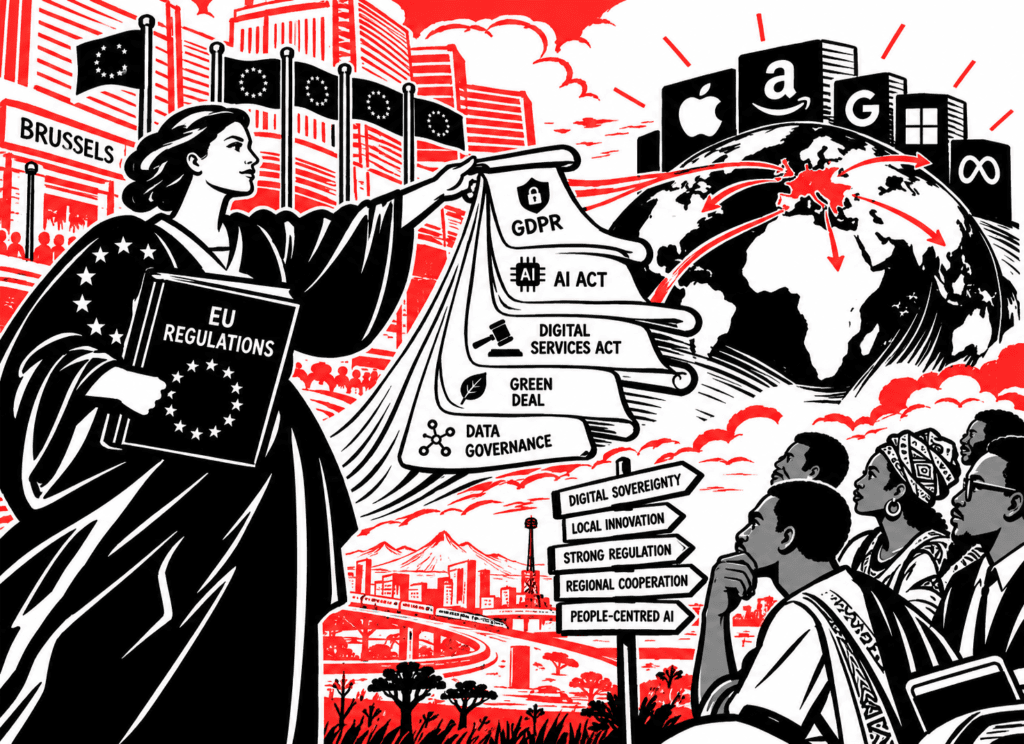
How Europe Became the World’s Technology Regulator — and What Africa Must Learn
For much of the twentieth century, technological power was concentrated in a few regions. Silicon Valley produced companies such as Microsoft, Apple, Google, Amazon, Meta, IBM, Oracle, SpaceX, Nvidia, and OpenAI. China, through its state-led industrial strategy and the rise of Shenzhen, fostered firms including Huawei, Tencent, ZTE, Alibaba, BYD, and ByteDance. However, when the question shifts from who builds technology to who writes the rules governing it, the answer today is neither Washington nor Beijing.
It is Brussels.
The European Union has quietly become the world’s most influential technology regulator. Washington builds many of the platforms, and Beijing drives their expansion at home, but Brussels has taken the lead in shaping the rules that govern them. A product manager in Bangalore, a compliance officer in Seoul, or a payments engineer in Cape Town or Nairobi increasingly designs with European regulation in mind; not only to reach the European market, but because one global standard is often cheaper and simpler than fifty local versions.
Anu Bradford of Columbia Law School gave this trend its name in a 2012 journal article and developed it further in her acclaimed 2020 book, The Brussels Effect: How the European Union Rules the World. The concept describes the European Union’s ability to shape global markets unilaterally; without negotiation, coercion, or even deliberate intent in every case.
Whoever writes the rules eventually shapes the innovation that follows.
The Rise of the Regulatory Superpower
The European Union grasped something many governments overlooked: in a digital economy, power comes not only from manufacturing products or owning platforms, but also from setting standards. Unlike earlier industrial revolutions, the digital economy depends on interoperable rules that shape how data is collected, how artificial intelligence is used, how platforms compete, how consumers are protected, how cybersecurity incidents are reported, how algorithms are assessed, how digital identities are verified, and how cloud providers manage information across borders.
Bradford identifies two ways this influence spreads. The de jure Brussels Effect occurs when multinational companies encourage their home governments to adopt EU-style rules, or when other jurisdictions directly borrow from EU law. Zambia, South Africa, India, Brazil, South Korea, Japan, and more than 120 countries worldwide have aligned their data-protection laws with the GDPR to varying degrees. The de facto Brussels Effect is quieter: companies often apply the EU’s stricter standards across their global operations because building one compliant product is cheaper than maintaining fifty jurisdiction-specific versions. Europe did not try to rival Silicon Valley by creating its own technology giants. It competed through law, exporting its rules far beyond its borders. That legal influence has also helped make standards such as ISO/IEC 27701 part of the global compliance landscape.
The Pattern Behind European Technology Laws
European technology laws rarely stand alone. Each measure builds deliberately on what came before, creating an increasingly coherent governance architecture rather than a patchwork of disconnected rules. This progression can be understood in five phases:
Phase 1 — Protect Individuals (2016–2018)
Europe’s regulatory rise began with the citizen, not the corporation. The General Data Protection Regulation (Regulation (EU) 2016/679) was adopted in April 2016 and became directly applicable across all member states on 25 May 2018, following a two-year transition period. The GDPR recast privacy from a matter of business preference into an enforceable fundamental right grounded in Articles 7 and 8 of the EU Charter of Fundamental Rights. Article 6 requires every processing activity to rest on one of six lawful bases: consent, contract, legal obligation, vital interests, public task, or legitimate interests. That test has since become standard language in privacy teams from Lagos to Lusaka. Before the GDPR, a business might ask, “Can we collect this data?” Afterwards, the practical question became, “On what lawful basis may we process it, and for how long?” Backed by fines of up to 4% of global annual turnover, that shift changed data-handling practices even for firms with no physical presence in Europe.
Phase 2 — Secure Digital Infrastructure (2016–2027)
Once data protection had matured, Europe turned to the resilience of the systems that process that data. The original NIS Directive of 2016 was replaced by the NIS2 Directive (Directive (EU) 2022/2555), which entered into force on 16 January 2023 and required national transposition by 17 October 2024, extending baseline cybersecurity and incident-reporting obligations to eighteen sectors, including energy, transport, health, and digital infrastructure. The financial sector received its own instrument: The Digital Operational Resilience Act (Regulation (EU) 2022/2554), which has applied since 17 January 2025 and now binds more than 22,000 banks, insurers, payment institutions, and their critical ICT vendors to five pillars of ICT risk management, incident reporting, resilience testing, third-party oversight, and information sharing, with fines of up to 2% of worldwide turnover for non-compliance. The Cyber Resilience Act (Regulation (EU) 2024/2847) followed in December 2024, extending “security by design” obligations to hardware and software products themselves, with core duties phasing in through December 2027. Together, these instruments reflect a settled European premise: cybersecurity is no longer an information-technology function but a form of national infrastructure protection, and banks, hospitals, telecom operators, and energy utilities now face binding, not merely advisory, resilience obligations.
Phase 3 — Regulate Digital Markets (2022–2024)
Europe then confronted the market power that a decade of platform growth had produced. The Digital Markets Act (Regulation (EU) 2022/1925) entered into force on 1 November 2022 and became applicable on 2 May 2023; the European Commission designated the first six “gatekeeper” companies, including Alphabet, Amazon, Apple, ByteDance, Meta, and Microsoft, in September 2023, with full compliance required by March 2024. Its companion, the Digital Services Act (Regulation (EU) 2022/2065), imposes tiered obligations on intermediaries according to size, with the largest platforms and search engines supervised directly by the European Commission since August 2023. Rather than break dominant firms apart through antitrust litigation, as is more common in the American tradition, Europe chose to regulate their behaviour directly: banning self-preferencing, mandating interoperability of messaging services, restricting targeted advertising to minors, and requiring rapid removal of illegal content.
Phase 4 — Build Trust in Artificial Intelligence (2021–2027)
As generative AI accelerated globally, Europe again moved first among major economies. First proposed by the European Commission in April 2021 and agreed by Parliament and Council in December 2023, the AI Act (Regulation (EU) 2024/1689) entered into force on 1 August 2024 as the world’s first comprehensive, horizontal AI statute. Rather than banning the technology outright, it adopts a four-tier, risk-based classification: minimal, limited, high, and unacceptable risk, with obligations scaled to the harm a given application could cause. Prohibitions on “unacceptable risk” systems and AI-literacy obligations took effect from 2 February 2025; transparency duties for general-purpose AI model providers followed in August 2025; and full application for high-risk systems is scheduled for August 2026, with the EU’s 2026 “AI Omnibus” negotiations proposing to push some high-risk deadlines to 2027–2028. Fines for non-compliance can reach €35 million or 7% of global annual turnover, whichever is higher; a ceiling designed to concentrate the minds of even the largest AI developers.
Phase 5 — Digital Sovereignty (2020–present)
Europe’s most recent phase reflects a recognition that technological dependence is also geopolitical dependence. The European Data Strategy (2020), the Data Governance Act (2022), and the Data Act (2023/2854, applicable from September 2025) together aim to create a functioning single market for data. The European Digital Identity Wallet, mandated under the revised eIDAS Regulation (Regulation EU No. 910/2014), requires member states to offer citizens a trusted digital identity by 2026. Gaia-X, a federated cloud infrastructure initiative launched by France and Germany in 2019, seeks to reduce reliance on non-European hyperscalers, while the European Chips Act (2023) commits over €43 billion in public and private investment to double the EU’s share of global semiconductor production by 2030. The objective here is no longer simply consumer or market protection; it is strategic autonomy: ensuring that the infrastructure underpinning European digital life remains, at minimum, subject to European jurisdiction.
The European Technology Governance Pyramid
Taken together, these five phases look less like separate statutes and more like one load-bearing structure. Each layer supports and strengthens the one beneath it. That coherence is precisely what makes Europe’s technology-governance model more consistent (and more exportable) than those of its major rivals.
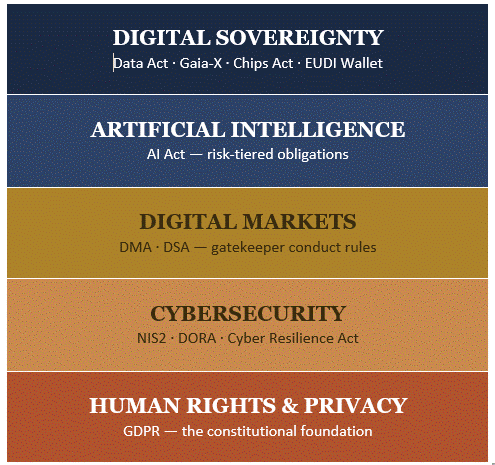
Figure 1. Each layer of European technology law presumes and reinforces the layer beneath it — a structural coherence that is difficult for any single-issue regulator to replicate.
The American Model: Innovation Before Regulation
The United States has followed a very different philosophy, shaped by decades of relatively light federal intervention in digital markets. That approach encouraged rapid innovation, deep venture-capital markets, and the entrepreneurial conditions that produced Apple, Google, Microsoft, Amazon, Meta, Nvidia, and OpenAI. Yet the absence of comprehensive federal privacy and AI laws has also left a fragmented landscape. California’s Consumer Privacy Act and California Privacy Rights Act sit alongside comparable laws in Virginia, Colorado, Connecticut, and more than a dozen other states, while federal protections remain sector-specific—HIPAA for health data, the Gramm-Leach-Bliley Act for financial data, and COPPA for children’s data—rather than general. AI governance has developed in much the same way, through executive orders, guidance from agencies such as NIST and CISA, and state legislation instead of one binding federal framework. America excels at creating technology; Europe excels at governing it. That gap has helped Brussels, rather than Washington, become the default rule-setter for companies operating across many jurisdictions.
China: State-Led Digital Governance
China offers a third model, combining close state oversight with an explicit industrial strategy. Its 2017 Cybersecurity Law, 2021 Data Security Law, and 2021 Personal Information Protection Law form a data-governance regime that, on paper, resembles the GDPR in some of its individual-rights provisions. It operates, however, within a system that also treats state access to data, domestic technology ecosystems, and national AI leadership as policy priorities. The United States emphasises market dynamism, Europe emphasises individual rights and European values, and China emphasises state coordination and strategic control. The contrast is a reminder that technology governance is never a neutral template; it reflects each jurisdiction’s underlying constitutional order.
Comparing the Three Models
| Dimension | European Union | United States | China |
| Regulatory posture | Regulation-first | Innovation-first | State-led innovation |
| Underlying value | Human rights | Market efficiency | National strategy |
| Legal instrument | Comprehensive statutes | Fragmented, sector-specific | Centralised, state-directed |
| Primary beneficiary | Consumer / citizen | Business and investor | The state |
| Strategic objective | Digital sovereignty | Global technology leadership | Technological self-reliance |
The Brussels Effect in Practice
The mechanism is straightforward. Large multinational companies cannot afford to maintain dozens of differently regulated product lines for dozens of markets, so they often default to the strictest applicable standard—which, in technology governance, is usually Europe’s. Cookie-consent banners, detailed privacy controls, AI-transparency documentation, cybersecurity incident-reporting templates, supplier risk-assessment questionnaires, and standard contractual data-protection clauses have spread far beyond the EU, often for commercial convenience rather than legal necessity. A consumer in Zambia or South Africa may therefore benefit from protections designed for European citizens simply because the global company serving both markets found it cheaper to build one compliant product than two.
Africa’s Missed Opportunity
Across much of Africa, the digital economy has been approached from the position of an importer rather than a rule-maker. African markets import cloud infrastructure, AI models, cybersecurity products, payment rails, and digital identity systems—and often import the frameworks intended to govern them as well. The result is a sequencing problem: regulation commonly arrives only after a technology is deeply embedded in national infrastructure, by which point the range of realistic policy choices has narrowed considerably.
What Africa Can Learn from Europe
Europe’s experience shows that governance can be a strategic asset, not merely a compliance burden. Africa does not need to copy the EU’s statutes. It can, however, build a coherent and carefully sequenced governance architecture that reflects the continent’s economic and institutional realities. Six priorities stand out:
1. Develop a Continental Technology Governance Framework
The African Union should move beyond declaratory instruments toward harmonised, enforceable frameworks spanning AI, cybersecurity, cloud governance (data localisation), digital identity, digital competition, and data governance. The Malabo Convention (The AU Convention on Cyber Security and Personal Data Protection, adopted in June 2014) finally entered into force in June 2023 after Mauritania became its fifteenth ratifying state, but as of this writing sixteen of the fifty-five AU member states have ratified it, and several of the continent’s largest digital economies, including South Africa, have yet to do so. The 2022 AU Data Policy Framework and the AfCFTA Protocol on Digital Trade, adopted by AU Heads of State in February 2024, offer complementary (though still unevenly implemented) building blocks.
2. Harmonise Data Protection
Although more than thirty African states have enacted national data protection laws, meaningful differences remain in scope, enforcement capacity, and cross-border transfer rules. Greater harmonisation (i.e., building on the Malabo Convention and the AU Data Policy Framework rather than displacing them) would reduce compliance costs for firms operating across borders, facilitate cross-border digital trade, strengthen regional digital markets, and directly support the operationalisation of the African Continental Free Trade Area.
3. Build African AI Governance
Rather than waiting for foreign AI regulations to harden into de facto global norms, Africa has already taken a first step: the AU’s Continental Artificial Intelligence Strategy, adopted in July 2024, sets out principles for AI development suited to the continent’s own priorities: multilingual AI for African languages, agricultural innovation, healthcare diagnostics, education, and financial inclusion. Translating that strategy into binding national and regional instruments, rather than leaving it as aspirational text, is the next test.
4. Strengthen Digital Sovereignty
African governments should prioritise sustained investment in regional cloud infrastructure, sovereign data centres, secure digital identity systems, continental payment infrastructure such as the Pan-African Payment and Settlement System (PAPPS), and trusted AI compute capacity. Reducing dependence on externally owned digital infrastructure enhances both operational resilience and negotiating leverage with foreign technology providers.
5. Invest in Regulatory Capacity
Governance is only as effective as the institutions that enforce it. Regulators, lawmakers, judges, cybersecurity agencies, and data protection authorities need sustained investment in technical expertise, independent budgets, and cross-border cooperation to keep pace with technological change. In practice, even the best-written statute becomes little more than a voluntary code if the regulator lacks the resources to enforce it.
6. Shape Global Standards
Africa should participate more actively, and earlier, in international standard-setting bodies such as the International Organisation for Standardisation (ISO), the International Telecommunication Union (ITU), and the technical forums that quietly shape emerging-technology norms years before those norms become binding law. Contributing to standards at the drafting stage allows African priorities to be reflected in the text, rather than merely accommodated after the fact.
Beyond Regulation: Governing for Growth
Africa should not treat technology regulation simply as a compliance obligation imposed from elsewhere. Good governance can build investor confidence, deepen consumer trust, improve cybersecurity, support regional integration under the AfCFTA, enable responsible AI adoption suited to local conditions, and provide the legal certainty that innovation needs. The aim is not to regulate innovation out of existence, but to create the conditions in which African innovation can grow responsibly and earn trust at home and abroad.
Conclusion
The twenty-first century will be shaped not only by those who invent new technologies, but also by those who set the rules under which they operate. The United States has demonstrated unmatched strength in innovation. China has shown the power of coordinated industrial and technology policy. Europe has shown that thoughtful, sequenced governance can shape global digital markets even without dominating technology production.
Africa now faces a real strategic choice. It can continue importing technologies, standards, and regulatory models designed elsewhere and shaped by interests that are not always its own. Or it can build a governance framework rooted in its own economic ambitions, legal traditions, and development priorities. Europe’s lesson is not that regulation must always come before innovation. It is that governance, when pursued strategically and coherently rather than reactively, becomes a form of geopolitical influence: those who write the rules increasingly shape the direction of global technology.
For Africa, catching up will take more than isolated laws passed in response to the latest crisis. It requires a long-term continental vision that brings digital rights, cybersecurity, competition policy, artificial intelligence, digital trade, and technological sovereignty into one coherent governance ecosystem. If the continent succeeds, it can move from passively receiving global digital norms to actively shaping the digital future—the same transition Europe has made over the past two decades.
References
African Union (2014) African Union Convention on Cyber Security and Personal Data Protection (Malabo Convention). Adopted 27 June 2014, Malabo, Equatorial Guinea. Entered into force 8 June 2023.
African Union (2022) AU Data Policy Framework. Endorsed by the AU Executive Council, February 2022. Addis Ababa: African Union Commission.
African Union (2024) AfCFTA Protocol on Digital Trade. Adopted by the 37th Ordinary Session of the AU Assembly of Heads of State and Government, 17–18 February 2024, Addis Ababa.
African Union (2024) Continental Artificial Intelligence Strategy. Adopted by the African Union, July 2024. Addis Ababa: African Union Commission.
Bradford, A. (2012) ‘The Brussels Effect’, Northwestern University Law Review, 107(1), pp. 1–68.
Bradford, A. (2020) The Brussels Effect: How the European Union Rules the World. New York: Oxford University Press.
Bradford, A. (2023) Digital Empires: The Global Battle to Regulate Technology. New York: Oxford University Press.
European Commission (2024) ‘AI Act enters into force’, News article, 1 August 2024. Brussels: European Commission.
European Parliament and Council (2016) Regulation (EU) 2016/679 (General Data Protection Regulation). Official Journal of the European Union, L119, 4 May 2016.
European Parliament and Council (2022) Directive (EU) 2022/2555 on measures for a high common level of cybersecurity across the Union (NIS2 Directive). Official Journal of the European Union, L333, 14 December 2022.
European Parliament and Council (2022) Regulation (EU) 2022/1925 on contestable and fair markets in the digital sector (Digital Markets Act). Official Journal of the European Union, L265, 12 October 2022.
European Parliament and Council (2022) Regulation (EU) 2022/2065 on a Single Market for Digital Services (Digital Services Act). Official Journal of the European Union, L277, 27 October 2022.
European Parliament and Council (2022) Regulation (EU) 2022/2554 on digital operational resilience for the financial sector (DORA). Official Journal of the European Union, L333, 14 December 2022.
European Parliament and Council (2023) Regulation (EU) 2023/2854 on harmonised rules on fair access to and use of data (Data Act). Official Journal of the European Union, 22 December 2023.
European Parliament and Council (2024) Regulation (EU) 2024/1689 laying down harmonised rules on artificial intelligence (AI Act). Official Journal of the European Union, 12 July 2024.
European Parliament and Council (2024) Regulation (EU) 2024/2847 on horizontal cybersecurity requirements for products with digital elements (Cyber Resilience Act). Official Journal of the European Union, 20 November 2024.
European Commission (2023) European Chips Act — Regulation (EU) 2023/1781. Official Journal of the European Union, September 2023.
Republic of Zambia (2021) Cybersecurity and Cybercrimes Act No. 2 of 2021. Lusaka: Government Printer.
Republic of Zambia (2021) Data Protection Act No. 3 of 2021. Lusaka: Government Printer.
UNIDIR Cyber Policy Portal (2025) ‘Ratifications to the African Union Convention on Cyber Security and Personal Data Protection’. Geneva: United Nations Institute for Disarmament Research.