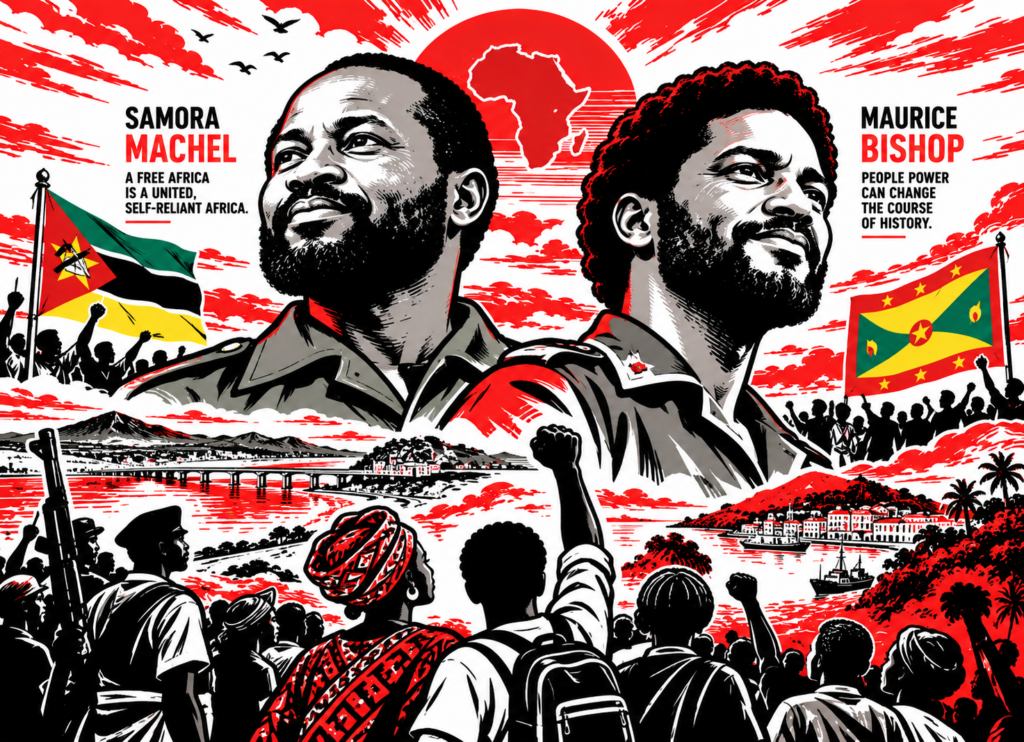
19th October 2026 is 40 years since Samora Machel died at Mbuzini and 43 years since Maurice Bishop was shot at Fort Rupert. One led a nation of millions across the Indian Ocean; the other, a Caribbean island of about 100,000 people. Both were young men who thought a small, poor, newly colonised country could determine its own destiny. Both were killed on the same day of the year, three years apart.
In South Africa today, government and family groups gather at the Samora Machel Monument in Mpumalanga to mark the 40th anniversary of the Mbuzini tragedy, under the theme of Samora Machel’s devotion to the people of Southern Africa (gov.za). In St George’s, Grenada, the anniversary is marked much more quietly and painfully.
The African Renaissance Review remembers them as a pair because their stories mirror the ones we are asking about today: payments, data, and digital infrastructure. What does it actually take for a small country to be sovereign? What destroys that sovereignty from the outside, and what destroys it from the inside?
Samora Machel: the nurse who became a nation-builder
Samora Moisés Machel was born in Chokwe, Gaza province, on 29 September 1933 and trained as a medical assistant before to being drawn into politics (SAHRIS). He joined FRELIMO in Tanzania in 1963, trained in Algeria, took command of the armed forces in 1968, and became the movement’s sole leader in 1970. He led Mozambique to independence from Portugal in 1975.
He was a man of urgency. Schools and clinics were being pushed into the rural areas which the colonial state had effectively ignored. His speeches were long, direct and very much aimed at his own people (his own officials), with corruption, laziness and arrogance among the new elite being as much a target as colonialism itself. He spoke of a ‘new man’ forged through work and discipline.
He pursued a very expensive foreign policy. Mozambique provided rear bases to the ZANU liberation fighters and subsequently became a haven for the ANC. The price of that was in blood and money, with Rhodesian and then South African raids and a full-blown destabilisation war being fought through RENAMO. Under that pressure, he signed the Nkomati non-aggression pact with Pretoria in 1984, which many of us found a very bitter compromise (SAHRIS).
On 19 October 1986, his Tu-134 (returning from the Frontline States summit in Zambia) flew into the Lebombo hills at Mbuzini (just inside South Africa), and he and 34 others perished (The Presidency). The South African inquiry blamed the crew; the Soviets put the blame on a false navigation beacon. The TRC later found the evidence inconclusive. Graça Machel has always maintained that her husband was assassinated, and the families have requested that the inquiry be reopened (Opinion Nigeria). Forty years on, the question is still open.
For the Zambians, it’s very much a home story. He died on his way back from our country, from the Frontline States meeting, where Zambia was absolutely at the heart of it.
Maurice Bishop: the lawyer of the small island
Maurice Rupert Bishop was born in Aruba to Grenadian parents on 29 May 1944 (Grenada Forward Ever campaign). A London-trained lawyer came home to co-found the New JEWEL Movement (E-lfare, Education and Liberation), whose ideology was very much in the Black Power mould and also very much in the Nyerere/Tanzania mouldzania mould.
On 13th March 1979, the movement got rid of Gairy’s increasingly repressive government in a virtually bloodless coup. The ensuing People’s Revolutionary Government ran a literacy campaign, expanded free health care and free secondary education, pushed for equal pay for women and with Cuban assistance opened the international airport at Point Salines. For many in the Caribbean and in Africa, Bishop’s “Forward ever, backwards never” was proof that a small state could speak for itself.
The revolution also had a more sinister aspect. Elections were suspended, the free press was suppressed and political detainees were held without trial. Those decisions effectively destroyed the institutions which might have subsequently protected Bishop.
In October 1983 a faction around his deputy Bernard Coard had him under house arrest. On 19th October the crowds freed him and marched on Fort Rupert (the army HQ). The soldiers opened fire, and Bishop, Education Minister Jacqueline Creft, Unison Whiteman and five others were executed by firing squad (Global Voices). Six days later, on the 25th October, the US invaded (Caribbean News Service).
The wound has never closed. The remains of Bishop and those who died with him have never been returned to their families and are still missing (Washington Post podcast). Grenadians commemorate 19th October every year with an empty grave.
What bound them?
Machel and Bishop were in the same political world really: the Non-Aligned Movement and the post-colonial Global South. They shared three convictions.
- Dignity before dependency. Both saw literacy, clinics, and the end of colonial humiliation as the first fruits of independence, not luxuries to be accrued later.
- Solidarity across the water. Mozambique bled for Zimbabwe and for South Africa’s freedom. Grenada saw itself as part of a Black Atlantic that included Africa, and neither thought liberation could be purely national.
- The right of the small to choose. Both were adamant that a poor country could choose its own partners and its own path, and that the bigger powers would punish it for doing so.
In fact, they shared a weakness. Each faced pressure from a powerful neighbour or superpower, and each was surrounded by comrades with guns as well as ideas. The external threat and the internal fissures worked in tandem. For Bishop, the fatal blow came from within his own party. For Machel, it was forty years of unanswered questions, all pointing outwards.
The two families are still waiting for answers on this date. In Mozambique and South Africa, the cause of the Mbuzini crash is still officially unresolved. In Grenada there is still no body to bury. Truth for both is still an open wound, and Africa and the Caribbean should be pressing for it together.
Machel and Bishop weren’t saints, and they wouldn’t have wanted to be remembered as such. They’d have wanted to be debated with, built up eventually on and eventually out of what we can do. The best thing we can do on this 19th October is answer it for questions, and answer it for institutions strong enough to outlast any one of us.
