
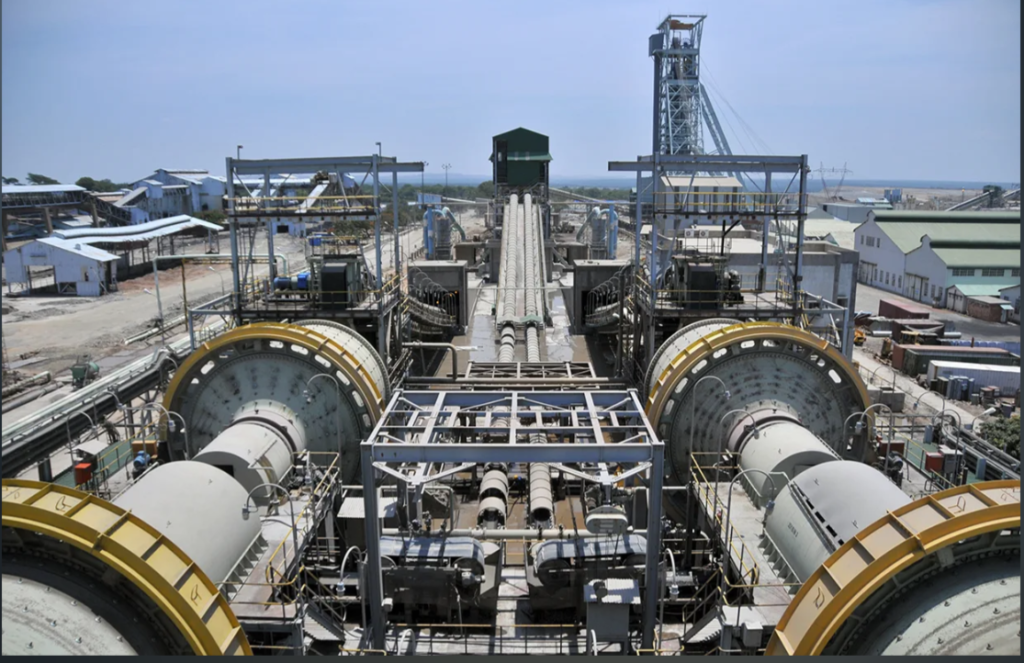
Introduction: The Copperbelt at a Historic Crossroads
For more than a century, Zambia’s economic story has been closely tied to one mineral: copper.
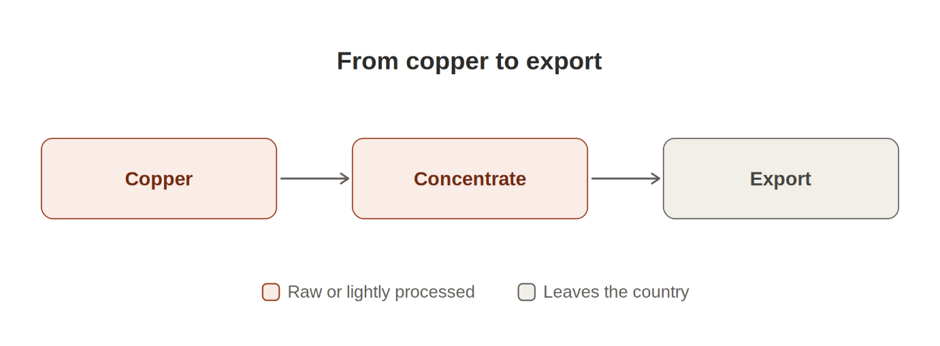
Since the 1930s, copper has built towns, attracted railways, generated foreign exchange, and connected Zambia to global markets. But it also created a structural vulnerability: the country has historically exported a mineral while importing much of the technology, machinery, and manufactured products associated with it. The same can be said even today.
The current global energy transition now presents Zambia with a different possibility.
Electric vehicles, battery storage, renewable-energy systems, electricity grids, digital gadgets (phones and laptops), and digital infrastructure are increasingly demanding for minerals such as copper, cobalt, lithium, nickel, and graphite. Electric vehicles accounted for more than 70% of global battery deployment in 2025, with EV battery deployment reaching about 1.2 TWh, which implies total battery deployment well above 1.5 TWh. The International Energy Agency (IEA) expects EV battery deployment to reach almost 3 TWh by 2030 under its Stated Policies Scenario (STEPS) [1].
This raises a fundamental question for Zambia:
Will the Copperbelt once again become primarily a source of raw materials, or can it become the industrial heart of Africa’s emerging battery economy?
By 2050, the answer could have profound implications for Zambia’s economic structure.
1. Checkmate: Zambia’s Piece Is Already on the Board
Zambia does not need to start from zero. In 2024, Zambia ranked as the world’s eighth-largest mined copper producer, accounting for approximately 3.6% of global production. Copper represented about 66% of Zambia’s goods exports, worth approximately US$7.5 billion. The mining and quarrying sector contributed 17.4% of GDP [2].
Copper’s importance is rapidly outgrowing its traditional reputation in wiring and construction. Today, it stands as the indispensable baseline metal of the clean-energy age.
Without copper, the green transition simply stops. Because copper forms the nerve centre of electric vehicles, charging stations, and battery packs, while providing the core wiring for wind turbines, solar installations, massive transformers, and modernised electrical grids. Even behind the digital curtain, copper quietly powers high-capacity data centres, telecom networks, and advanced industrial machinery.
This sheer indispensability is driving unprecedented demand. According to the International Energy Agency (IEA), total global copper consumption is set to climb from roughly 26.7 million tonnes in 2024 to 31.3 million tonnes by 2030, eventually reaching 34 million tonnes by 2040. Crucially, clean technology is the main engine behind this surge, with cleantech demand alone projected to jump from 7.7 million tonnes in 2024 to nearly 11 million tonnes by the decade’s end [4].
This means Zambia’s copper endowment is not simply an asset belonging to the mining industry. It could become an industrial platform.
2. Beyond The Battery Economy
When people hear “battery economy”, they often think about factories producing finished electric-car batteries. But that is only the final part of a much larger ecosystem.
A battery value chain can include:
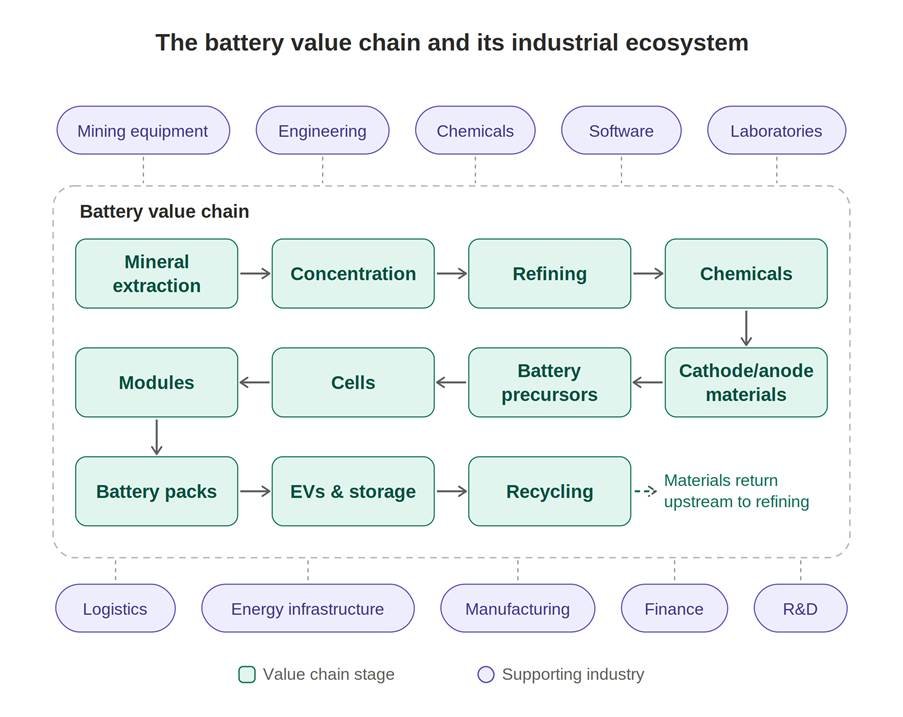
This distinction is crucial for Zambia. The country does not necessarily have to leap immediately from exporting copper to manufacturing millions of complete EV batteries.
There are many intermediate steps.
The strategic question should therefore be:
Which parts of the battery and electrification value chain can Zambia competitively capture by 2030, 2040 and 2050?
That is a much more realistic industrialisation question.
3. The Copperbelt’s Greatest Advantage May Be Regional, not National
One of Zambia’s biggest strategic advantages is its geographical relationship with the Democratic Republic of Congo. The DRC possesses enormous cobalt resources and is the world’s dominant source of mined cobalt, supplying more than 70% of global output in recent years [5]. Zambia, meanwhile, is a major copper producer and has its own cobalt production associated largely with copper mining; six Zambian operations were producing cobalt from copper in 2024 [6].
That dominance has also become a policy lever. After a 2025 export ban, Kinshasa moved to a quota system capping cobalt exports at 96,600 tonnes, less than half the country’s 2024 export volume, and the IEA expects the cobalt market to move into deficit from 2026 [7]. For Zambia, this is both a reminder of how exposed battery supply chains are to policy decisions in a single country and an argument for regional coordination.
This creates an unusual regional opportunity. So rather than asking if Zambia can build an entire battery industry on its own, the real question we need to start asking is:
Can Zambia and the DRC build an integrated Central African battery and electrification manufacturing ecosystem?
The two countries signed a cooperation agreement in Lusaka on 29 April 2022 aimed at developing an electric-battery and clean-energy value chain [8]. Later on, they agreed on a common governance framework, the DRC–Zambia Battery Council, that also covers the development of industrial zones in both countries [9]. Zambia’s Ministry of Commerce, Trade and Industry identified Ndola on the Copperbelt as a site for the initiative [10], and the two governments signed an agreement in March 2023 to establish special economic zones dedicated to battery precursors, batteries, and electric vehicles, which led to a pre-feasibility study [11]. Public information on the joint precursor project remains limited, and the location of the plant has been a point of disagreement between the two sides [12].
This is important because regional industrialisation can overcome some of the limitations of individual African economies.
Zambia may not possess every mineral required for a battery. The DRC may not possess every component, technology, or logistical capability required for a globally competitive battery industry.
But together, these countries can potentially construct a larger industrial ecosystem.
4. The Copperbelt Beyond Mining
Imagine the Copperbelt in 2050.
Instead of an industrial landscape defined almost entirely by open-pit mine shafts, noise, and raw concentrators, picture a bustling, high-tech manufacturing corridor stretching from the Copperbelt into Northwestern Province and across the border to Kolwezi.
In this future, raw copper and cobalt don’t leave the country on flatbed trucks just to be processed thousands of miles away. Instead, they flow directly into local precursor chemical plants and precision copper-foil factories. Right next door, workers produce heavy-duty transformers, electrical cables, and high-capacity battery packs, which feed assembly lines rolling out electric buses, two-wheelers, solar hardware, and charging units designed for African roads.
Supporting this entire ecosystem is a dense, self-sustaining industrial web: specialised mining-equipment plants, materials testing labs, battery recycling facilities, and technology startups, all linked to top-tier universities dedicated to energy science.
The transformation would be nothing short of profound: shifting the region’s identity from a vulnerable, raw-mineral supplier to Africa’s premier green-tech manufacturing hub.
5. Beyond Cobalt: A Multi-Mineral Strategy
I am tempted to describe Zambia’s battery opportunity primarily through cobalt. But that would be too narrow. The country’s copper advantage may ultimately prove even more important.
The energy transition requires enormous quantities of copper because electrification requires more electrical infrastructure. UN Trade and Development (UNCTAD) projects global copper demand to rise by more than 40% by 2040 [13]. The trade rules matter as much as the demand. UNCTAD notes that refined copper typically faces tariffs below 2%, but duties can rise to as much as 8% on finished products such as wires, tubes, and pipes, which discourages value-added exports from producing countries [13].
The implications are enormous. A future Zambian copper strategy should therefore consider industries such as:
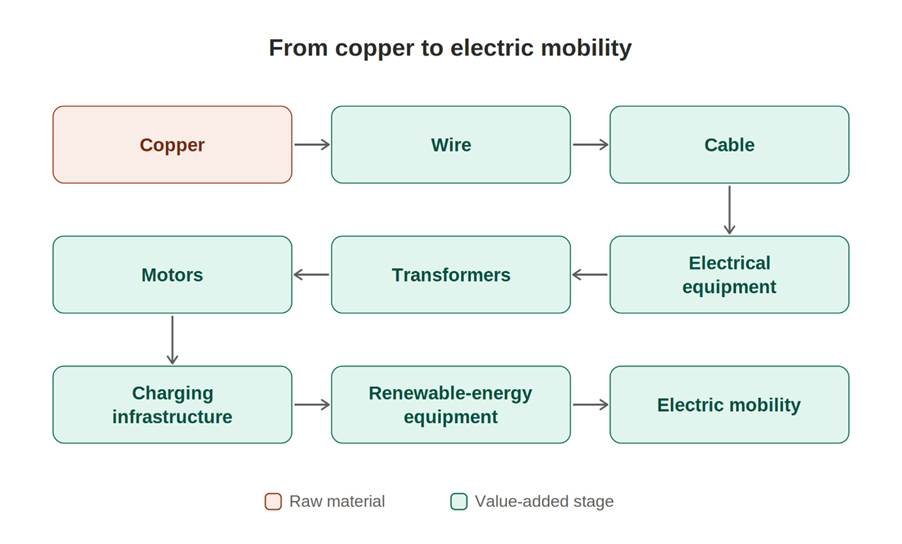
This is potentially a much broader industrial pathway than the current status:
6. A Strategy Already in Motion
This opportunity is not merely theoretical. Zambia’s current policy direction increasingly recognises the importance of critical minerals and value addition.
UNCTAD’s 2026 assessment of Zambia’s diversification opportunities identifies more than 400 products across 25 sectors that the country could potentially develop. This includes 73 products linked directly to energy-transition mineral value chains [14][15]. It estimates that a validated subset of opportunities could require about US$1.21 billion in investment and generate approximately 115,000 jobs across the economy [14].
The National Critical Minerals Strategy 2024–2028 identifies eleven minerals as critical to Zambia over the period. These include copper, cobalt, manganese, nickel, graphite, lithium, and rare earth elements [16]. The strategy addresses gaps such as insufficient geological data and sets out a plan for managing these minerals more effectively [17].
The World Bank has similarly argued that Zambia’s energy-transition mineral opportunity will depend not merely on extracting minerals but on reliable and cost-competitive electricity; transport and logistics; workforce development; environmental and social management; improved investment conditions; and greater value addition [18].
The direction is therefore increasingly clear, but the harder question is turning policy into execution.
7. Powering the Vision: Why Electricity Is the Make-or-Break Factor
There is one uncomfortable reality that Zambia cannot escape:
A battery economy cannot be built on an unreliable electricity system.
The 2024 drought and the most recent past have exposed this vulnerability dramatically. Hydropower accounts for more than three-quarters of Zambia’s installed generation capacity, and the drought reduced available power by roughly one-third. Mining alone accounts for about half of national electricity consumption [19].
Here lies the core dilemma. Zambia is striving to power the global energy transition, yet it can barely get enough electricity to process its own minerals. We can’t move forward until we fix that gap.
Looking toward 2050, any serious industrial strategy must reframe electricity: it’s no longer just a basic domestic utility but the vital engine of industrial growth.
To power heavy manufacturing and energy-intensive refining, Zambia cannot rely on a single energy source. It needs a resilient, multi-tiered grid—one that blends reliable hydropower with expanding solar and wind, backed by utility-scale battery storage, decentralised power generation, and modernised transmission lines.
Cross-border energy trading will be just as critical. Recent investments are already laying that groundwork: a $43 million World Bank grant approved in July 2026 is funding a crucial 47 km transmission segment on the Zambian side. Once complete, this will finish a 192 km, 400 kV interconnector with Malawi—bolstering regional grid stability and proving that energy security, much like the supply chains it powers, thrives on connection rather than isolation. [20]. Beyond keeping the lights on, expanding this grid plays a crucial role in powering local industries and driving development along the Lobito Corridor.
8. Redefining the Copperbelt: The Strategic Power of the Lobito Corridor
For decades, Zambia’s mineral economy has been constrained by distance from seaports. The development of the Lobito Corridor introduces another strategic possibility.
A functioning rail and logistics corridor connecting the Copperbelt and Katanga to Angola’s Atlantic port could reduce transport distances and create a new route for minerals, machinery, and manufactured products. The European Commission describes it as connecting the port of Lobito with Katanga in the DRC and the Copperbelt in Zambia and as the first open-access transcontinental rail link in Africa [21]. Further, the Corridor could also connect mineral-producing regions to wider African and international markets.
An important qualification is that Zambia’s own leg has yet to be built: the Zambia–Angola railway is a greenfield project, with roughly 515 km of new line planned inside Zambia between the border and Chingola [22]. Power is also a recognised constraint along the route, and the US Trade and Development Agency plans to fund a study on strengthening electricity networks serving mining operations and communities in the DRC and Zambia [23].
This creates an important concept for Zambia 2050:
The Copperbelt should not be developed as an isolated mining enclave.
It should become part of a regional industrial corridor.
9. The Ecosystem First: Building a Lasting Battery Industry in Zambia and Africa
An official ribbon-cutting for a new battery factory makes for a great photo opportunity, but a headline alone doesn’t build an industry.
To turn a single factory into a powerhouse capable of competing on the global stage, you need an entire supporting cast. That means uninterrupted power and smooth freight routes; heavy-duty industrial land and abundant water; world-class chemical engineers and rigorous testing labs; along with robust Intellectual Property (IP) protections, quick financiers, smart customs clearances, and reliable export channels. Without this dense web of suppliers, researchers, and specialised services, a factory remains an island.
That’s why Zambia’s real opportunity lies in building industrial clusters rather than betting on isolated plants. A factory that simply imports all its parts generates modest local value before shipping profits elsewhere. But surround that same plant with local suppliers, specialised technology hubs, and domestic service providers. This also has the potential to trigger a chain reaction by creating skilled jobs, fuelling innovation, and driving genuine, lasting economic transformation.
10. Building Zambia’s Human Capital for 2050
At its core, the battery revolution isn’t just about digging rocks out of the ground; it’s a high-tech knowledge economy built on top of physical materials.
While mining engineers get the ore out of the earth, keeping value in the country takes a vastly broader brain trust. Zambia will need a new generation of specialists: chemical and materials scientists to refine raw elements, electrical and mechanical engineers to build cell architectures, automation and robotics experts to run high-precision production lines, data analysts to monitor battery health, and environmental scientists to ensure the whole process is sustainable.
This means local universities and technical colleges must evolve in lockstep with the nation’s industrial ambitions. Specialized degree programmes such as Battery Engineering, Electromobility, Industrial Automation, and Energy Storage can no longer be treated as niche subjects reserved for institutions in Europe, Asia, or North America. If Zambia wants to capture real, long-term value from its resources rather than just exporting raw talent along with raw minerals, that expertise needs to be grown, nurtured, and produced right at home.
11. The Digital Layer Matters Just as Much
The Copperbelt of tomorrow won’t just be powered by heavy machinery and rich mineral veins—it will run on data.
Modern mining, refining, and manufacturing no longer rely solely on physical muscle; they depend on digital intelligence. The Next-generation facilities operate on a backbone of artificial intelligence, industrial IoT, robotics, autonomous equipment, predictive maintenance, and real-time analytics.
This shift opens up a massive parallel opportunity for Zambia: building a home-grown Mining and Energy Technology ecosystem right alongside its physical factories.
Off-the-shelf software developed in Silicon Valley or Europe often struggles with the realities of local African operations, from intermittent connectivity to extreme heat and specific geological conditions. But by nurturing local tech startups, software engineers, and data scientists, Zambia can design smart, battle-tested digital solutions tailored specifically to regional challenges. Instead of paying license fees to import foreign software, the Copperbelt could soon be exporting African-built industrial tech to mining corridors across the continent.
Therefore, the industrial question becomes:
Can Zambia move from extracting copper to extracting value from copper, and eventually to creating knowledge around copper?
That is the deeper meaning of economic transformation.
12. Africa Must Break the Cycle of Dependency
There is also a geopolitical dimension.
Africa has experienced centuries of commodity extraction in which valuable resources were exported while much of the higher-value processing, technology, and financing occurred elsewhere.
The energy transition could reproduce this pattern under a different name. Research on the African battery value chain finds that African countries currently supply mainly raw materials, while China leads in both manufacturing and innovation [27].
There is a real risk that the global clean-energy transition may simply swap one historic form of resource extraction for another by replacing reliance on crude oil with dependency on critical minerals like copper, cobalt, and lithium, without ever sparking true industrial development across Africa.
To avoid repeating the past, Africa’s mineral wealth must serve as the foundation for homegrown industrialisation.
This isn’t a call for isolation or a rejection of international business. Capitalising on this moment will require massive amounts of foreign direct investment, specialised technology, and global commercial expertise. But the goal must be genuine, balanced partnership rather than structural dependency.
When global investors (FDI) enter the market, the objective shouldn’t just be extracting raw materials for export. The deals should be structured to build up local supplier networks, elevate technical skills, expand research capabilities, and transfer proprietary know-how. By securing domestic ownership stakes and expanding manufacturing ecosystems, Zambia can convert short-term mineral demand into long-term, self-sustaining economic power.
13. Preparing Zambia for Technological Uncertainty
There is another reason why Zambia should not bet everything on one battery chemistry.
Battery technology is changing. Lithium-ion batteries currently dominate the market, but chemistries and technologies are evolving. LFP (Lithium Iron Phosphate) batteries have become increasingly important; the IEA notes that the rapid rise of LFP has moderated its outlook for cobalt demand to 2040 [4].
The IEA also expects recycling to become more important. It estimates that a successful scale-up of recycling could lower the need for new mining by 5–30% by 2040 in the STEPS [3], and that under today’s policy settings average recycling rates across key energy minerals could rise from around 10% to close to 20% by 2040 [24].
This means Zambia’s strategy must be technology-neutral but value-chain focused.
Instead of saying:
“Zambia will manufacture one particular type of battery.”
The strategy should say:
“Zambia will build the industrial, scientific and manufacturing capabilities required to participate in successive generations of energy-storage and electrification technologies.”
That is much more resilient.
14. Recycling: Zambia’s Second Copperbelt
By 2050, millions of electric vehicle batteries produced during today’s clean-energy boom will reach the end of their useful lives. That upcoming wave of retired tech isn’t just a waste challenge; it represents the birth of a massive new resource stream: urban minerals.
Instead of relying solely on heavy excavation, high-grade copper, cobalt, lithium, and nickel can be reclaimed directly from spent battery packs and discarded electronics. This means tomorrow’s mining won’t take place strictly underground; much of it will happen right on the surface.
Zambia has a major opportunity to position itself early across the entire circular value chain:
- Collection and Diagnostics: Establishing regional hubs to gather, inspect, and evaluate spent batteries.
- Second-Life Systems: Repurposing worn EV batteries into affordable stationary energy storage for homes and regional grids.
- Advanced Recycling and Recovery: Processing electronic waste and extracting high-purity, battery-grade metals locally.
Building a future-proof mineral economy doesn’t mean digging deeper holes forever. By developing urban mining capability today, Zambia can ensure that when the world’s first generation of electric vehicles retires, the valuable metals inside them flow right back into local factories.
15. Zambia’s 2050 Objectives
The objective should not simply be:
“Build a battery factory.”
The objective should be considerably more ambitious:
A Zambian Battery and Electrification Industrial Ecosystem
By 2030: Build the foundations
Between now and 2030, Zambia should focus on geological exploration and resource mapping; reliable power expansion/diversity; copper and cobalt value addition; industrial parks; battery-precursor development; building technical skills; research partnerships; regional agreements; transport corridors; and lastly, investment reform policies.
By 2040: Move deeper into manufacturing
By 2040, Zambia should aim to expand into battery components; battery materials; electrical equipment; charging infrastructure; electric buses; electric motorcycles and three-wheelers; energy-storage systems; renewable-energy equipment; and mining and industrial machinery.
By 2050: Become an integrated industrial hub
The long-term vision could encompass:
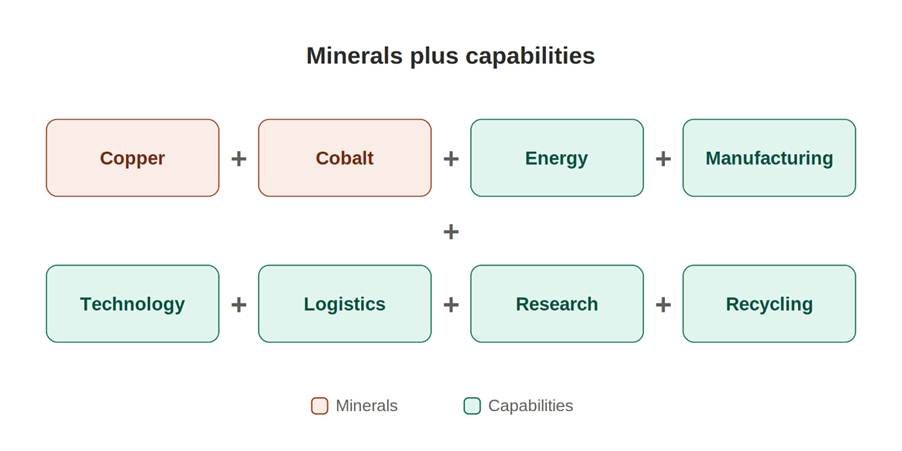
Thus, forming an integrated regional ecosystem.
16. The Copperbelt – A Laboratory for African Industrialisation
There is an even bigger opportunity that exists here.
The Copperbelt could become one of Africa’s most important experiments in resource-based industrialisation. If Zambia succeeds, the model could be applied elsewhere.
Africa has bauxite in Guinea; manganese in South Africa and Gabon; lithium in Zimbabwe and Namibia; cobalt in the DRC; graphite in Mozambique, Tanzania and Madagascar; copper in Zambia and the DRC; and platinum-group metals in Southern Africa.
So, the question is therefore bigger than just Zambia. This is about whether Africa can use its massive mineral resources to create an industrial capability. The African Development Bank has highlighted battery precursor production and electric two- and three-wheelers as opportunities for African industrialisation and argues that battery and electric-vehicle value chains should be a priority for resource-based industrialisation, with the African Continental Free Trade Area (AfCFTA) providing access to wider regional and continental markets [25][26].
17. Avoiding the “Resource curse 2.0”
There is a danger that the language of the green economy creates another commodity boom without structural transformation.
Imagine a scenario in which Zambia exports:
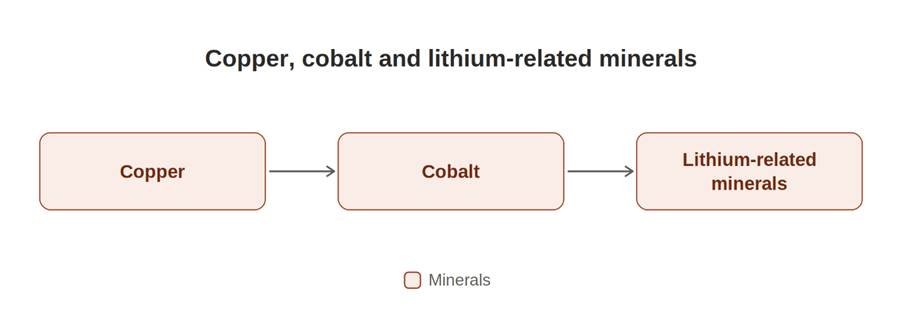
while importing:
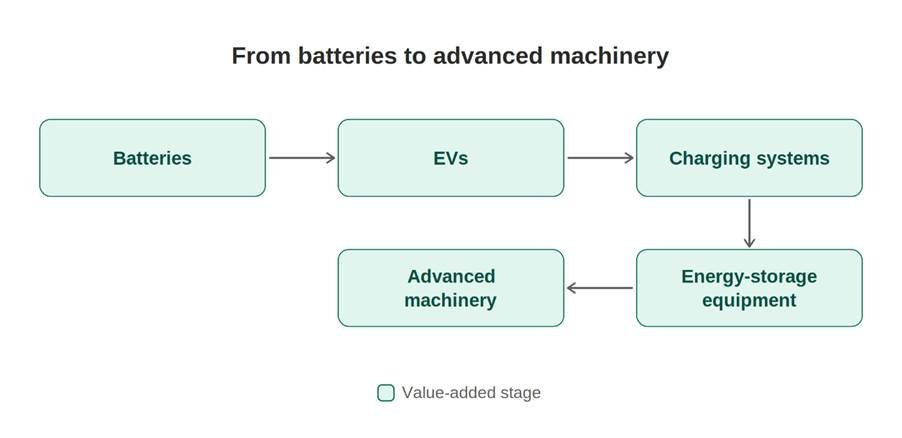
Zambia would still be stuck at the bottom of the value chain. The economy might look greener, but its underlying structure would remain much the same. Success, then, should not be judged simply by the tonnes of copper Zambia pulls from the ground.
A better measure would ask:
- whether more Zambians are gaining advanced technical skills;
- whether local businesses are breaking into global supply chains;
- how much of the manufacturing is taking place at home;
- whether Zambia is developing more of its own technology;
- how much more value Zambia earns from every tonne of mineral it exports;
- whether Zambian researchers and firms are producing patents and industrial innovations;
- whether homes and industries can count on reliable electricity;
- and how much of the value created across the chain stays in Africa.
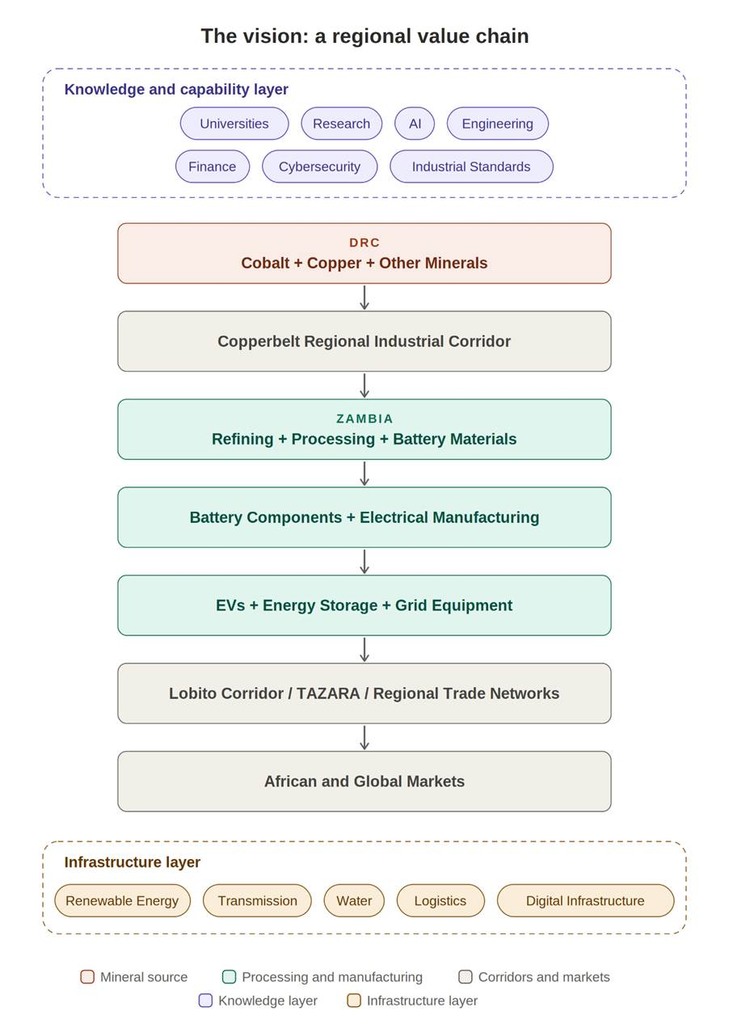
18. A possible Zambia 2050 industrial map
The vision could eventually look something like the following:
19. Zambia’s Question
The fundamental question facing Zambia is not:
“How much copper can we produce by 2050?”
It is:
“What can Zambia manufacture because it has copper?”
That question changes everything.
Copper can finance industrialisation.
Copper can support engineering.
Copper can support electrical manufacturing.
Copper can support battery and energy-storage industries.
Copper can support electric mobility.
Copper can support research.
Copper can support technology.
But only if Zambia deliberately builds the institutions and infrastructure that connect the mine to the factory, the factory to the laboratory, the laboratory to the market, and the market to Zambian enterprise.
Conclusion: From Copper Country to Energy-Technology Nation?
Zambia enters the energy transition with something many countries would like to possess: a globally significant copper industry located beside one of the world’s most important cobalt-producing regions. But mineral endowment is not the same thing as industrial power. The difference lies in what happens next. If Zambia continues primarily exporting minerals, the energy transition may produce another commodity cycle.
If Zambia uses its mineral endowment to build manufacturing, skills, infrastructure, research, technology and regional markets, the energy transition could become something much more significant:
a second industrialisation.
The Copperbelt of the twentieth century was built around copper extraction.
The Copperbelt of the twenty-first century could be built around electrification.
And the Copperbelt of 2050 could potentially become something even larger:
Africa’s industrial laboratory for the energy, mobility and battery economy.
The opportunity is no longer theoretical. The global market is growing, Zambia and the DRC have laid the groundwork for cooperation, and international institutions are pointing to practical ways of adding value locally. But Zambia cannot afford to wait. This window of opportunity will not stay open forever.
Across the world, other countries are already racing to attract the investment, technology and factories that will shape the next industrial era.
Zambia’s challenge is to turn the minerals beneath its soil into the industrial strength above it—to move beyond supplying raw materials and become a producer in its own right.
By 2050, the defining question may not be whether Zambia still has copper in the ground.
It will be whether the country used that copper to build an economy strong enough to thrive long after the metal stopped defining Zambia’s story.
Zambia 2050 should not be a vision of a bigger mining industry. It should be a vision of a more sophisticated economy built around mining, manufacturing, energy, technology, knowledge and African markets.
The Copperbelt has the minerals. The real challenge is building everything else.
References
[1] International Energy Agency (2026). Global EV Outlook 2026: Electric vehicle batteries. https://www.iea.org/reports/global-ev-outlook-2026/electric-vehicle-batteries
[2] U.S. Geological Survey, National Minerals Information Center. Zambia. https://www.usgs.gov/centers/national-minerals-information-center/zambia
[3] International Energy Agency (2025). Global Critical Minerals Outlook 2025: Overview of outlook for key minerals. https://www.iea.org/reports/global-critical-minerals-outlook-2025/overview-of-outlook-for-key-minerals
[4] International Energy Agency (2026). Global Critical Minerals Outlook 2026: Outlook. https://www.iea.org/reports/global-critical-minerals-outlook-2026/outlook
[5] Fastmarkets (2026). “Massive” discrepancy between DRC cobalt hydroxide exports, allocated quota: sources. https://www.fastmarkets.com/insights/discrepancy-between-drc-cobalt-hydroxide-exports-allocated-quota-massive/
[6] Energy Capital & Power. Zambia Unveils Critical Mineral Prospects and Milestones. https://energycapitalandpower.africa-newsroom.com/press/zambia-unveils-critical-mineral-prospects-and-milestones?lang=en
[7] ESI Africa (2026). Cobalt mining and the DRC effect (citing the IEA Global Critical Minerals Outlook). https://www.esi-africa.com/finance-and-policy/cobalt-mining-drc-effect/
[8] UN Economic Commission for Africa (29 April 2022). Zambia and DRC Sign Cooperation Agreement to manufacture electric batteries. https://www.uneca.org/stories/zambia-and-drc-sign-cooperation-agreement-to-manufacture-electric-batteries
[9] Ministry of Commerce, Trade and Industry, Zambia. Redefining Zambia’s industrialization path through the Electric Vehicle (EV) batteries Initiative. https://www.mcti.gov.zm/zbpup/?p=2641
[10] Parliament of Zambia (2023). Ministerial Statement on the Zambia–Congo DR Joint Initiative on Electric Battery. https://www.parliament.gov.zm/sites/default/files/images/publication_docs/Ministerial%20Statement%20-%20On%20Zambia-Congo%20DR%20Joint%20Initiative%20on%20Electric%20Battery.pdf
[11] Ministry of Commerce, Trade and Industry, Zambia (2023). Flag Off of Pre-Feasibility Study – Electric Vehicle Batteries. https://www.mcti.gov.zm/?p=6200
[12] Natural Resource Governance Institute (2024). The DRC-Zambia Battery Plant: Key Considerations for Governments in 2024. https://resourcegovernance.org/publications/drc-zambia-battery-plant-key-considerations-governments-2024
[13] UN Trade and Development (2025). Global Trade Update (May 2025): Focus on critical minerals – copper in the new green and digital economy. https://unctad.org/publication/global-trade-update-may-2025-critical-minerals-copper
[14] UN Trade and Development (2026). Rapid assessment of value addition and diversification within and beyond the critical energy transition minerals value chain: Zambia. https://unctad.org/publication/rapid-assessment-critical-energy-transition-minerals-value-chain-Zambia
[15] UN Trade and Development (17 February 2026). Launch of the rapid assessment for Zambia (Secretary-General’s statement). https://unctad.org/osgstatement/launch-rapid-assessment-zambia-value-addition-and-diversification-within-and-beyond
[16] British Geological Survey / NERC (2025). Critical minerals potential of Zambia: guide to the geology, occurrences, exploration and mineral production. https://nora.nerc.ac.uk/id/eprint/539541/
[17] DLA Piper Africa, Chibesakunda & Company. Understanding Zambia’s National Critical Minerals Strategy. https://www.dlapiperafrica.com/en/zambia/insights/2024/understanding-zambias-national-critical-minerals-strategy-key-implications-for-the-mining-sector
[18] World Bank (2025). Exploring How Zambia Can Leverage Energy Transition Minerals for Economic Transformation (Zambia Economic Update). https://www.worldbank.org/en/news/feature/2025/08/12/exploring-how-zambia-can-leverage-energy-transition-afe-minerals
[19] World Bank (2026). Powering Zambia’s Transformation: From Electricity Crisis to Catalyst for Growth and Jobs. https://www.worldbank.org/en/country/zambia/publication/powering-zambia-s-transformation-from-electricity-crisis-to-catalyst-for-growth-and-jobs
[20] World Bank (23 July 2026). World Bank Group Supports Zambia–Malawi Interconnector to Power Growth, Jobs, and Regional Energy Trade. https://www.worldbank.org/en/news/press-release/2026/07/23/world-bank-group-supports-zambia-malawi-interconnector-to-power-growth-jobs-and-re
[21] European Commission, Global Gateway. Connecting the Democratic Republic of the Congo, Zambia, and Angola to Global Markets through the Lobito Corridor. https://international-partnerships.ec.europa.eu/policies/global-gateway/connecting-democratic-republic-congo-zambia-and-angola-global-markets-through-lobito-corridor_en
[22] Lobito Corridor (2026). The Lobito Corridor in 2026: Complete Guide. https://www.lobitocorridor.com/articles/lobito-corridor-2026-complete-guide/
[23] Club of Mozambique. U.S. targets Lobito Corridor energy gap in African critical minerals drive (reporting a USTDA briefing). https://clubofmozambique.com/news/u-s-targets-lobito-corridor-energy-gap-in-african-critical-minerals-drive/
[24] International Energy Agency (2026). Global Critical Minerals Outlook 2026: Executive summary. https://www.iea.org/reports/global-critical-minerals-outlook-2026/executive-summary
[25] African Development Bank (2023). Rich in green minerals, African countries eye booming electric vehicle and clean energy market worth trillions of dollars. https://www.afdb.org/en/news-and-events/rich-green-minerals-african-countries-eye-booming-electric-vehicle-and-clean-energy-market-worth-trillions-dollars-65241
[26] African Development Bank. Approach Paper towards preparation of an African Green Minerals Strategy. https://www.afdb.org/sites/default/files/documents/publications/approach_paper_towards_preparation_of_an_african_green_minerals_strategy.pdf
[27] ECDPM. An African battery value chain to kickstart green industrialisation. https://ecdpm.org/work/african-battery-value-chain-kickstart-green-industrialisation