There’s a familiar conversation about AI in Africa. We often see it as an opportunity. It’s viewed as a leapfrog technology that allows a farmer in Chipata to price her maize based on tomorrow’s weather, not yesterday’s gossip. This view is real and deserves our focus.
However, there’s a quieter conversation happening behind closed doors. This discussion is crucial for security, just like any border dispute or coup. It centres on what occurs when systems that decide our money, elections, infrastructure, and jobs are not built, understood, or accountable here.
This isn’t an argument against AI. It’s about how AI has crossed a threshold that many African governments haven’t yet recognised. AI is now infrastructure, just like a power grid or a payment system. When a nation lacks control over its infrastructure, it becomes a vulnerability, not a convenience.
The African Union highlighted this in July 2024. It adopted its Continental AI Strategy in Accra, naming risks like cybersecurity, bias, privacy, and disinformation alongside the technology’s potential. What follows is an effort to take that warning seriously, sector by sector.
A DEPENDENCY WE DID NOT CHOOSE
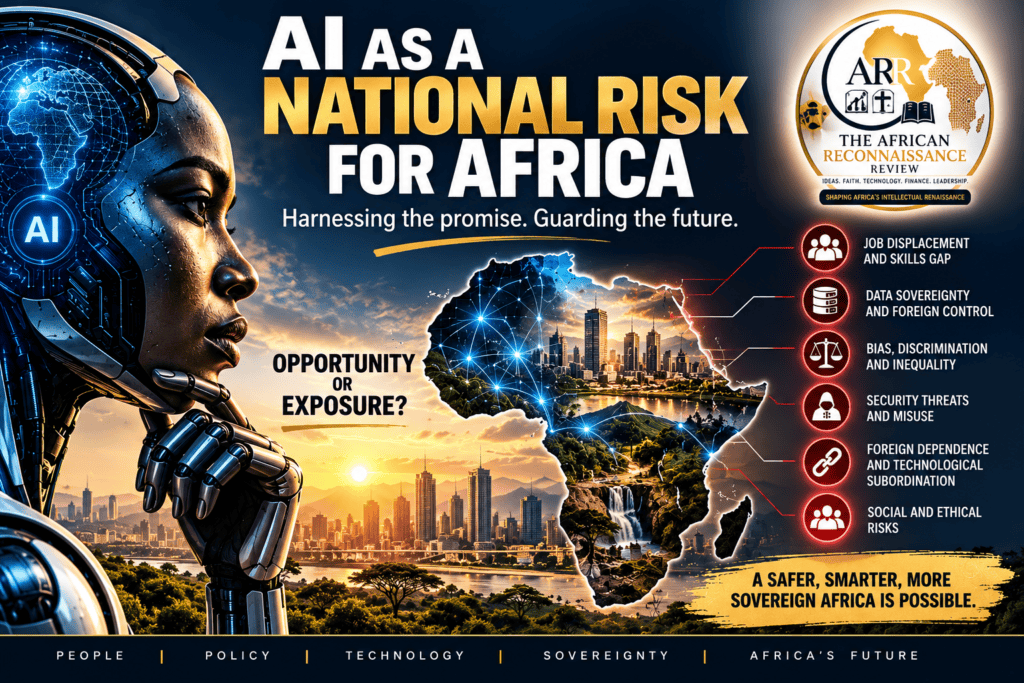
Let me start with the uncomfortable facts. Most foundation models, cloud infrastructure, and specialised chips for modern AI are not created or managed in Africa. The data our institutions produce, like banking transactions, health records, and biometric registers, often leaves the continent for processing. This has been part of the data localisation debate for a decade. However, the stakes have grown. Now, it’s not just about where data is stored. It’s also about which foreign company’s model controls how a bank, hospital, or border post uses it. A continent that outsources its reasoning infrastructure has outsourced a slice of its sovereignty, even without a formal agreement.
THE FINANCIAL AND CRITICAL-INFRASTRUCTURE EXPOSURE
For those of us working inside the critical national infrastructure, this is not theoretical. As AI models get embedded into fraud detection, credit scoring and transaction monitoring, they also become a new attack surface: model poisoning, adversarial inputs and AI-accelerated social engineering are no longer theoretical threats in security literature, they are live items on our risk registers. A national payment switch that leans on AI without the local capacity to audit, retrain or fail safely on that model has added a dependency it cannot fully see, let alone fully secure. The World Economic Forum’s own risk reporting has repeatedly placed AI-enabled disruption among the top global risks of the decade; and African financial infrastructure, still building its cyber-maturity, sits closer to the exposed end of that risk than the protected end.
A continent that outsources its reasoning infrastructure has outsourced a slice of its sovereignty.
DISINFORMATION ARRIVES AHEAD OF INSTITUTIONS
Next, consider the ballot box. Africa is mid-way through one of its busiest electoral cycles in a generation. Generative AI has made cheap to create convincing fabrication for the first time in history. Take for example, South Africa’s 2024 election saw a widely shared fabricated endorsement video. Researchers monitoring Ghana’s 2024 polls found deepfakes and a new tactic: politicians calling genuine footage as AI-generated to escape accountability. This was the case as well with Zambia’s recent August 2026 elections where we witnessed deepfakes flying around on social media. With more than 670 million internet users on the continent, most of them young and online, and with digital literacy still uneven, this is fertile ground for manipulation. A fragile institution struggles to counter this in real time. Disinformation research shows that synthetic content doesn’t need new grievances; it just needs to amplify existing ones.
JOBS, YOUTH, AND A DEVELOPMENT MODEL UNDER STRAIN
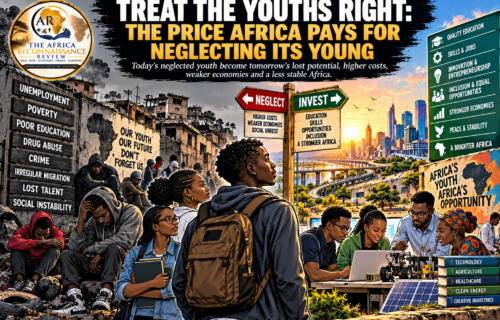
Africa’s development strategy over the last decade has focused on digital services and business-process outsourcing (BPO). This includes call centres, back-office, and data-entry jobs that helped young graduates in Lusaka, Nairobi, Accra, and Lagos enter the formal economy. However, generative AI targets this type of work first.
Industry analysis shows that up to 40 percent of tasks in Africa’s BPO sector are at risk of automation. The International Labour Organization’s global report indicates that while exposure in Africa is lower than in high-income countries, it still poses risks. Weak labour protections and safety nets mean that lower exposure doesn’t equal lower risk. A youth bulge without enough jobs is not just a statistic. Historically, it has often led to instability across the continent
BIAS, EXCLUSION, AND WHOSE INTELLIGENCE COUNTS
The current crop of large models are heavily trained on data from outside Africa. This includes different languages, assumptions, and social norms. When these models are used in African credit scoring, health triage, or hiring tools without careful thought, the issues become real. For example, they might misinterpret a Zambian applicant or provide poor diagnostics for a population they weren’t designed for. Technology that consistently fails to serve its users is not neutral. It represents a governance failure with national-security implications. Institutions that stop working for their citizens lose trust long before it becomes a crisis.
THE GOVERNANCE GAP IS THE REAL VULNERABILITY
None of this would be as dangerous if African nations had strong AI governance in place. Most do not. The AU’s Continental AI Strategy is a real milestone. It’s a rare example of the continent defining its own risk categories instead of following the EU’s. However, a strategy alone isn’t enough. It doesn’t create an inspectorate, a licensing system, or a national incident-response team. Until member states turn this ambition into funded institutions, Africa risks becoming, as some analysts say, a testing ground for AI systems. The harms of these systems may be found here instead of prevented.
WHAT THIS MEANS, CONCRETELY, FOR US
For a security or compliance professional sitting inside a bank, a regulator or a Fintech, the translation is direct. AI governance can no longer be a side conversation bolted onto an existing information security management system. It needs its own risk register, its own model-assurance function, and its own line into national cybersecurity and critical-infrastructure planning. For a policymaker, the translation is that the AU strategy needs domestic teeth: a Zambian, Kenyan or Zimbabwean AI act with an actual regulator behind it, not a document. And for the rest of us, the translation is simpler still: sovereignty in the twenty-first century is not only about land, currency or command of an army. It is about whether the systems reasoning on your behalf (about your money, your vote, your job) answer to you.
Africa doesn’t need to reject AI to stay safe from it. Instead, it should stop viewing AI as just a productivity tool. We must see it as what it is: critical infrastructure. This requires the same sovereignty, audit, and resilience we demand for a power grid or a central bank. The African Renaissance won’t come from someone else’s algorithm. It must be guided by our own judgment, informed by the machine but never controlled by it.
REFERENCES & FURTHER READING
African Union (2024). Continental Artificial Intelligence Strategy, adopted by the AU Executive Council, 45th Ordinary Session, Accra, Ghana, July 2024.
Future of Privacy Forum (2024). “The African Union’s Continental AI Strategy: Data Protection and Governance Laws Set to Play a Key Role in AI Regulation.”
World Economic Forum (2024). Global Risks Report 2024.
Institute for Security Studies / Konrad-Adenauer-Stiftung research on AI disinformation around African elections, cited via Times of Oman, 2024.
WITNESS Deepfakes Rapid Response Force (2025). “AI, Disinformation and the Battle for Truth: How Ghana’s 2024 Elections Exposed a New Age of Political Deception.”
GNET / International Centre for the Study of Radicalisation (2024–2025). Reporting on AI in African electoral misinformation and counter-terrorism contexts.
Genesis Analytics / Caribou / Mastercard Foundation. “Preparing for AI in the BPO and ITES Sector in Africa.”
International Labour Organization (2025). Generative AI and Jobs: global and regional exposure analysis, with the National Research Institute, Poland.
ODI (2025). “The AI Time Bomb: 2.5 Million Jobs at Risk — Is Kenya Ready?”
McKinsey & Company. “Leading, Not Lagging: Africa’s Generative AI Opportunity.”
Policy Center for the New South (2026). “Disinformation in the Age of AI in Africa: The Emergence of a New Risk Regime for Electoral Processes.”