
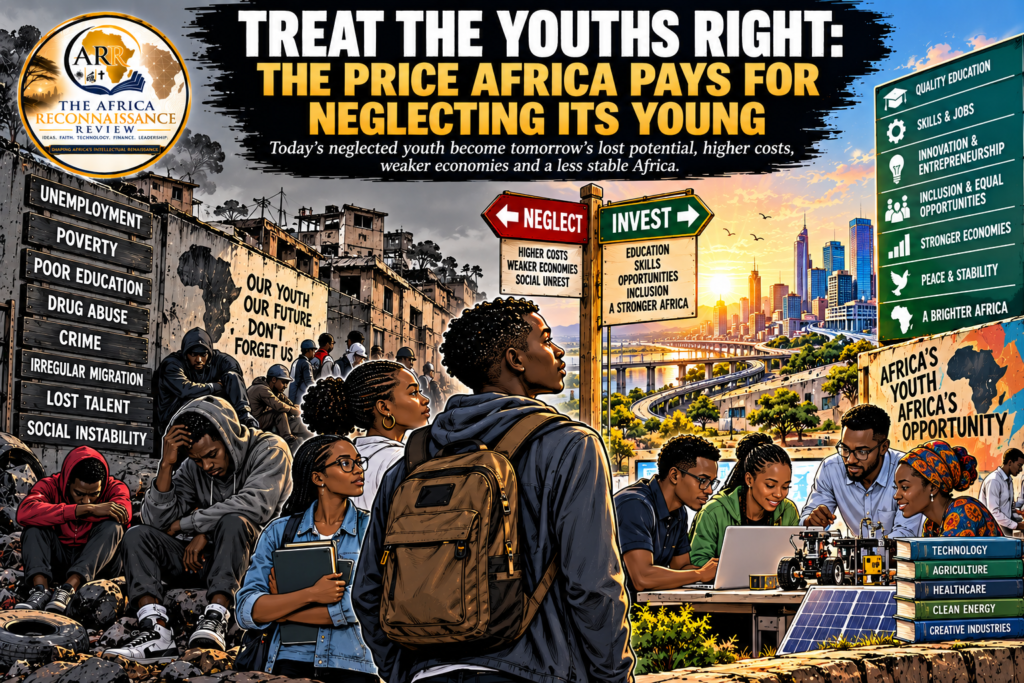
There is a warning buried in the old reggae records that Africa has never quite learnt to hear. Jimmy Cliff spent much of his career singing about dignity denied and patience running out, and in “Treat the Youths Right”, he issued an appeal that could have been written for any African capital today: nurture the young or watch the future you built on their backs collapse under its own neglect. Nearly half a century later, that request still lands, sharper now than when it was first sung, because the youth Cliff was singing about are no longer a demographic footnote in Africa. They are the majority, and they are angry.
Walk through any Zambian town, be it Luanshya, Kitwe, Ndola, Kabwe, or, for that matter, any capital from Lusaka to Nairobi, and the pattern repeats with disheartening consistency. Our continent, with the youngest population on earth, has somehow managed to build political systems that treat our youths as an afterthought. The politicians treat the youths as a voting bloc to be courted every five years and forgotten in between. The consequences of such neglect are no longer theoretical. They are visible in the unemployment queues, in the graveyards of abandoned campaign promises, and in the quiet absence of anyone willing to show a young person the way forward.
Let us start with the numbers, because they are stark enough without exaggeration. The World Bank and the African Development Bank both put the figure at roughly ten to twelve million young Africans entering the labour market every year, against an estimated three million new formal wage jobs created across the continent over the same period.¹ Zambia illustrates the gap bluntly at home: the government’s own National Action Plan for Improving and Strengthening the Skills Anticipation System found that, as of 2022, more than 3.3 million Zambian youth (about half the youth population) were classified as “not in education, employment, or training”. 2
The headline unemployment figures can actually understate this crisis. Zambia’s youth unemployment rate, as measured by the modelled ILO estimate the World Bank publishes, sits at around ten per cent (10%), a number that looks almost reassuring next to some of Zambia’s neighbours.³ But that statistic counts anyone who did even an hour of paid work in the reference week as employed, whether that was a formal salary or an afternoon spent selling airtime at a roadside booth. It is the NEET figure, and the everyday experience of graduates driving taxis or vending goods they are overqualified to sell, that captures the truer story: this is a crisis of underemployment and idle potential as much as one of joblessness in the strict statistical sense.
What makes this more than an economic statistic is the political silence around it. Governments campaign on job creation with the reliability of a season change, yet few ever build the industrial base, the credit systems, or the skills pipelines that would make those jobs materialise. Youth unemployment is treated as a communications problem that is managed through slogans such as “empowerment funds”, “youth enterprise schemes”, or “graduate internship programmes”, rather than a structural failure demanding structural investment. The young person filling out yet another application knows the difference between a policy and a press release, even if the politician announcing it hopes they don’t.
Nothing shatters trust between young Africans and their leaders quite like a broken promise. It has become a familiar routine: election season rolls around, candidates roll out glossy youth manifestos, town halls fill to capacity, and hashtags go viral. But once the voting ends and real governance begins, those grand pledges quietly dissolve into unfunded budget lines and forgotten committees.
Zambia’s own recent history supplies the pattern in miniature. Government has rolled out a succession of flagship schemes aimed at young people, such as the Youth Empowerment Fund administered through the Ministry of Youth, Sport and Arts; loans and grants through the Citizens Economic Empowerment Commission (CEEC); and sector-specific initiatives such as the fuel-tanker, bus, and earth-moving-equipment empowerment schemes launched in 2014. Independent reporting on these programmes in late 2025 pointed to the weaknesses that have dogged similar schemes across the continent: poor implementation, weak accountability, and youth-run projects that collapse once the initial capital is exhausted.⁴ A similar pattern shows up in the youth and community allocation of the Constituency Development Fund (CDF). A special audit covering the year ending December 2023, analysed by Transparency International Zambia, revealed a striking reality: 53% of the total CDF money across all ten provinces sat completely unspent. In fact, eight out of ten provinces failed to spend even 50% of their allocated funds.⁵ Money set aside for young people, in other words, quite often simply sits unused or unaccounted for.
This is not simply disappointing; it is corrosive. Every unspent fund and every abandoned scheme teaches a generation that political language is decorative rather than binding, that their vote buys attention but not accountability. If you multiply that pattern across the continent’s five-decade experiment with electoral democracy, it becomes easier to understand why so many young Africans now approach politics with the practised cynicism of people who have been fooled before and refuse to be fooled twice or simply stop voting at all.
I think the third failure is quieter than the other two but arguably more damaging in the long run: the near-total absence of structured mentorship between Africa’s political and institutional leadership and the generation meant to succeed it. In much of the West, however imperfectly, there exist pathways, such as internships, apprenticeships, party youth wings that actually feed talent upward, and professional associations that pair the experienced with the emerging. In many African political systems, power is protected rather than passed on. The leaders who came of age in liberation movements decades ago still occupy the same seats, often surrounded by loyalists rather than successors. These leaders have little visible appetite for cultivating the next generation of thinkers, technocrats, or public servants.
This absence of mentorship is felt in professional life too. Young professionals across technical and public-sector fields often enter their careers well trained on paper, yet with few senior figures willing to invest the time that judgement, networks, and institutional fluency require. Where skills transfer happens at all, it tends to be informal and uneven, that is, normally shaped by the goodwill of individual mentors rather than any deliberate national strategy. A generation raised on online courses and open-access certification has taught itself remarkably well, but self-taught competence is no substitute for the wisdom that only comes from someone further along the road choosing to walk beside you.
If you put these three failures together (no jobs, no credible promises, no guidance), the result is predictable, even if African political establishments keep acting surprised by it. The most visible consequence is migration. The Afrobarometer’s most recent continental survey, covering thirty-eight countries, found that fifty-five per cent (50%) of Africans aged eighteen to thirty-five have considered emigrating, with the search for work and escape from economic hardship cited as the dominant reasons.⁶ That number is more than double the share among those over fifty-five. The most educated and most urban youth are consistently the most likely to weigh an exit, which is precisely the brain-drain pattern the continent can least afford.⁶ Over the last 4 years, I have personally witnessed family members and friends who have emigrated to either the USA, Australia or Europe.
If migration is not possible or not chosen, disillusionment often channels into protest. Kenya’s 2024–2025 Gen Z-led demonstrations against the Finance Bill and the state’s often violent response to them left more than sixty people dead and showed how quickly economic grievance over jobs, taxation, and corruption can escalate into direct confrontation with government.⁷ In September and October 2025, comparable youth-led protests in Madagascar over chronic water and power shortages widened into demands for constitutional reform and ended with President Andry Rajoelina leaving office.⁸ Zambia has not been immune to the same undercurrent: a youth-led movement organised under the banner “Fix Zesco” attempted to protest the utility’s handling of load-shedding and its lack of transparency in 2024, though the demonstration itself was blocked by police.⁹ A similar situation unfolded in The Gambia in September 2026, where a 48-hour blackout triggered intense, youth-led protests. None of these movements began as ideological uprisings. Each began with young people who had simply run out of patience with promises that were never kept by the politicians.
Jimmy Cliff’s plea was never complicated: give the young something real to hold onto, and they will build rather than burn. Translated into policy, that means African governments should start treating job creation as an industrial strategy rather than campaign rhetoric. It means actually building up our manufacturing, tech, and agro-processing sectors to absorb a young workforce, not just paying lip service to the idea. It means building accountability directly into political promises so that manifestos serve as tools to hold leaders responsible or accountable, not just election-season entertainment. It ensures that funds earmarked for young people are actually spent on them. Most importantly, it requires a dedicated, well-funded commitment to mentorship: pairing experienced leaders with emerging talent in government and business alike so leadership is passed down, rather than merely defended. None of this is beyond Africa’s means. What has been missing is not capacity but will; the political will to see young people as partners in nation-building rather than problems to be managed until the next election season. Cliff’s youths are singing something similar today, in different rhythms and on different platforms, but the message has not changed: treat them right, or watch them walk away to another country, to another cause, or simply into a silence that no government should mistake for peace.
Just like the Bembas say: Imiti iyikula empanga.
References
- World Bank, “Africa,” World Bank Group regional overview (2026); African Development Bank Group, Jobs for Youth in Africa: Strategy for Creating 25 Million Jobs and Equipping 50 Million Youth 2016–2025 (2016).
- Zambia Ministry of Labour and Social Security, National Action Plan for Improving and Strengthening the Labour Market Information and Skills Anticipation System (2023–2027), cited in Afrobarometer Dispatch No. 937, “Zambian Youth See Their Country as Moving in the Wrong Direction” (20 January 2025).
- World Bank, World Development Indicators: “Unemployment, Youth Total (% of Total Labour Force Ages 15–24) (Modelled ILO Estimate) – Zambia.”
- “Beyond Funding: Why Youth Empowerment Programs Underperform in Zambia”, Lusaka Times (26 December 2025).
- Transparency International Zambia, analysis of the Auditor General’s Special Audit Report on the Constituency Development Fund for the year ended 31 December 2023, as reported in The Zambian Observer (6 March 2025).
- Afrobarometer, “Africans Support Free Movement, but Remain Divided on Immigration,” African Insights Report (2026).
- Georgetown Journal of International Affairs, “The Gen-Z Uprising in Kenya: Digital Dissent and the Struggle for a New Civic Order” (18 May 2026); Al Jazeera, “Kenya Braces for Return of Gen Z Protests – How Did They Begin?” (24 June 2026).
- AllAfrica, “Is Gen Z Reshaping Africa’s Political Landscape?” (16 October 2025).
- CIVICUS Monitor, “Zambia: Peaceful Assembly & Expression Under Threat” (2024).