
How Nigeria’s Esorae Group is building a wellness business around the way people rest, live, move, eat and learn, and what its model can and cannot tell us about Africa’s emerging wellness economy.
Importing goods has been a common trend in Sub-Saharan Africa’s consumer markets for decades. Towels, beddings, packaged food, and gym equipment have been imported through sea freight charged in dollars and sold to the emerging middle-class of urban residents.
A new wave of entrepreneurs has emerged, seeking to revolutionise things by building local manufacturing facilities, controlling their supply chains, and demonstrating that it is possible to manufacture high-quality products locally rather than importing them from other places.
Esorae Group in Nigeria is one example of such organisations. Ewaen Sorae established the company in 2010 as a luxury towel and bedding retailer, and it has since evolved into a group with operations in home-goods manufacturing, real estate, sports, foods, and education.
The moment’s importance cannot be overlooked. The Global Wellness Institute (GWI) estimated the wellness industry in Sub-Saharan Africa at about $94 billion in 2025. This means Nigeria accounts for about $8.8 billion of the market, making it the fifth-largest wellness market in Sub-Saharan Africa.
The opportunity is real, but so are the constraints. Esorae’s story highlights both.
At the heart of the group’s story is what economists call reverse brain drain: educated professionals returning to their home countries from developed nations where they built flourishing careers.
Sorae studied accounting at the University of Benin and later completed his master’s degree at the University of Bedfordshire. He later worked for five years at Provident Financial Group in the UK, where he specialised in consumer credit and business development. He said he was just a step away from British citizenship when he decided to move back to Nigeria in 2010.
The idea to start a business came up a year earlier. When he visited Nigeria in 2009, he found it difficult to get quality towels. This may seem like a minor issue, but, according to him, it highlighted a larger problem in Nigeria: the country’s growing hotel business and wealthy households still relied heavily on imports for their linen.
Sorae cited the japa wave as the biggest challenge to local business growth. Japa refers to skilled Nigerians who are leaving the country in pursuit of a better life abroad. He said this is one of the biggest hurdles for any business that wants to flourish locally.
The decision to come back was the reverse. It is a business that has a history that goes beyond its commercial aspects.
From Retailer to Manufacturer
When you think of E’Sorae, it is natural to assume its journey began as a manufacturing firm. The truth is rather different. E’Sorae Luxury began as a retailer of high-end towels and bathrobes based in Lagos, selling through retail shops and on its website. Within a decade, it grew from two offerings to over eighty products. Only after building its reputation and understanding customer needs did the brand decide to start manufacturing.
This is a significant point, as it highlights how industry capacity is built in African marketplaces. Only once the retailer has learnt about the consumer and proven demand does manufacturing follow, replacing foreign goods with local products.
Sorae mentions the same strategy in relation to its approach. As one of the country’s major consumers of duvets and blankets, Esorae increased its local production capacity to reduce foreign exchange outflows. The firm produces around 700,000 products per year, including duvets, blankets, toppers, and protectors. It also claims to be serving in excess of 700 hotels in its 2024 coverage. Although the figures have not been independently verified, they give us an idea of the firm’s overall trend.
A retailer learns the customer and proves demand; a manufacturer turns that knowledge into import substitution. Esorae did both, in that order.
An Ecosystem Built Around Daily Life
Esorae stands out from a typical conglomerate because an underlying concept unites all its activities. Rather than treating well-being as a single product line, like a gym subscription or healthy food products, the organisation views well-being as a concept shaped by daily routines such as sleeping, living, exercising, eating, and studying.
The following table describes what we can confirm about each area in the ecosystem.
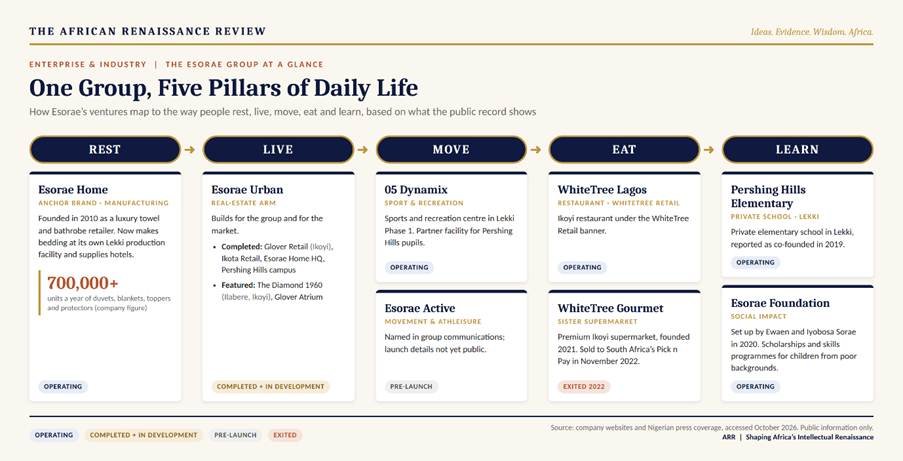
Source: company websites and Nigerian press coverage, accessed October 2026. Status reflects public information only.
Rest: Esorae Home
The home brand remains the anchor. Its premium bedding built the customer trust every other venture draws on. Recent touches, such as free in-store consultations with a sleep specialist, show the brand moving from selling products towards selling an outcome: better sleep.
Live: Esorae Urban
The real-estate arm builds on a simple premise: that buildings can support or undermine mental and physical health. Its marketing leans heavily on biophilic design, using natural light, ventilation and greenery as part of the product. Completed projects include Glover Retail in Ikoyi, Ikota Retail, the Esorae Home headquarters and the Pershing Hills school campus. Its featured residential projects, The Diamond 1960 in Ilabere, Ikoyi, and Glover Atrium, are positioned as full-floor, light-filled homes. Notably, Esorae Urban also built the group’s own factory and school, which keeps construction capability inside the group.
Move and Eat: 05 Dynamix, Esorae Active and WhiteTree
05 Dynamix, a sports and recreation centre in Lekki Phase 1, gives the movement pillar a physical home and doubles as the sports facility for Pershing Hills pupils. Esorae Active, an athleisure and movement line, is named in group communications but has not yet launched publicly. On the food side, WhiteTree Lagos operates as a restaurant in Ikoyi under the WhiteTree Retail banner.
Learn: Pershing Hills and the Esorae Foundation
Pershing Hills Elementary in Lekki, reported as co-founded in 2019, emphasises experiential learning, sport and financial literacy. Alongside it, the Esorae Foundation, set up by Ewaen and Iyobosa Sorae in 2020, funds scholarships and skills programmes for children from poor backgrounds. Linking the foundation to the group’s businesses, so that trained beneficiaries can find work within them, is one of the more thoughtful features of the model.
The WhiteTree Exit: What It Proves, and What It Does Not
The group’s most cited validation is a sale. In November 2022, South Africa’s Pick n Pay acquired WhiteTree Gourmet, a premium supermarket in Ikoyi that Sorae had founded only a year earlier under his WhiteTree Retail company. Nigerian press reports said Pick n Pay approached Sorae as it expanded its Lagos footprint, and that the store served over 5,000 customers in its first six months.
The deal shows that Sorae can build a retail asset attractive enough for a multinational to buy, and to do so quickly. That is a meaningful signal in a market where foreign retailers have more often exited than entered. However, it should not be overstated. The deal terms were never disclosed; it involved a single young store rather than a scaled chain, and the buyer was the one taking the market-entry risk. It is best read as proof of execution and of exit discipline, not as a valuation of the wider group.
Family Capital and Governance
Behind the operating companies is the OpesVenit Family Office, established by Ewaen Sorae and his wife, Iyobosa Sorae, an investment specialist who serves as its chief executive.
OpesVenit holds the group’s real-estate arm and invests across education, health, retail, technology and property. The partnership combines Ewaen Sorae’s retail and marketing instincts with a more finance-led approach to capital allocation and risk management.
Family offices can provide patient capital, which is particularly valuable in sectors such as manufacturing and property, where returns often take time. At the same time, they can concentrate decision-making within a small circle.
As Esorae grows, outside lenders, partners and investors will pay close attention to the boundary between the family office and the operating companies. Independent oversight and clear governance structures will become increasingly important.it.
Lessons Beyond Lagos
For entrepreneurs within Africa, the most useful lesson is not Esorae’s luxury positioning. It is the order in which the business was built.
Start with a focused product in a market you understand. Learn what customers need and earn their trust. Once demand has been proven, move backwards into production.
Then look for ways each business can strengthen the others. In Esorae’s case, the factory supplies hotels, the property company builds the factory and school, the school uses the sports centre, and the foundation helps develop a future pool of skilled workers.
The second lesson is patience. Manufacturing and property both require long-term capital that can withstand currency swings and slow returns.
Many African markets favour short-term trading over long-term investing. Companies that can tap into patient money from families, institutions, or development sources will be better positioned to create sustainable productive capacity. Those that are more open to returning this money will have a better chance of becoming sustainable institutions.
Conclusion
Esorae Group does not yet have the industrial strength that some of its most positive reports suggest.
But what it does have may prove even more useful in the long run: a real example of how a Nigerian founder recognised an unmet need, built a retail brand around it, and then manufactured a solution. It then grew on the principle that well-being depends on where, how, and when people sleep, move, live, eat, and learn.
The true test of its future lies in these questions: Can it grow beyond its current clientele? Is it prepared to cope with the country’s currency problems? Is its corporate governance transparent enough to build trust independent of the founding family?
If Esorae can overcome these obstacles, it can serve as a role model for African businesses.
.