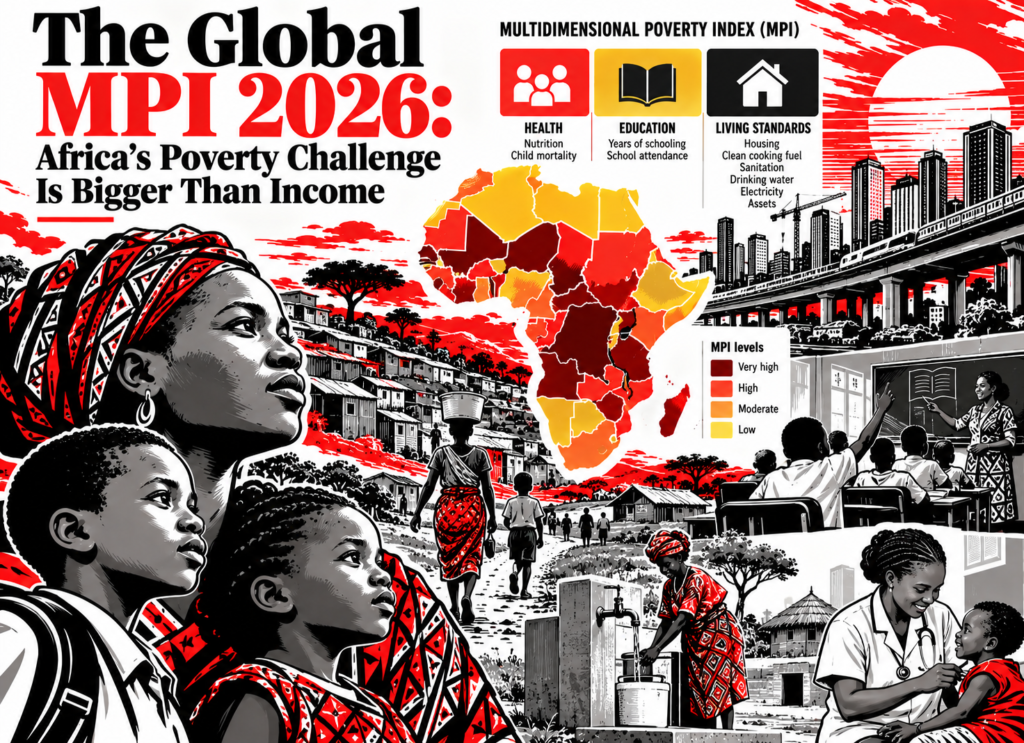
Global multidimensional poverty has risen for the first time since the index began in 2010. For Africa, and in particular for Zambia, the question is why economic progress so often fails to translate into the conditions in which the average person actually lives.
The 2026 update of the global Multidimensional Poverty Index (MPI) (published 12th October by the UNDP and OPHI) shows that 1.2 billion people across 108 countries are living in multidimensional poverty. That is 18.9% of the 6.3 billion people covered, and 51.5 million more than the previous like-for-like update.
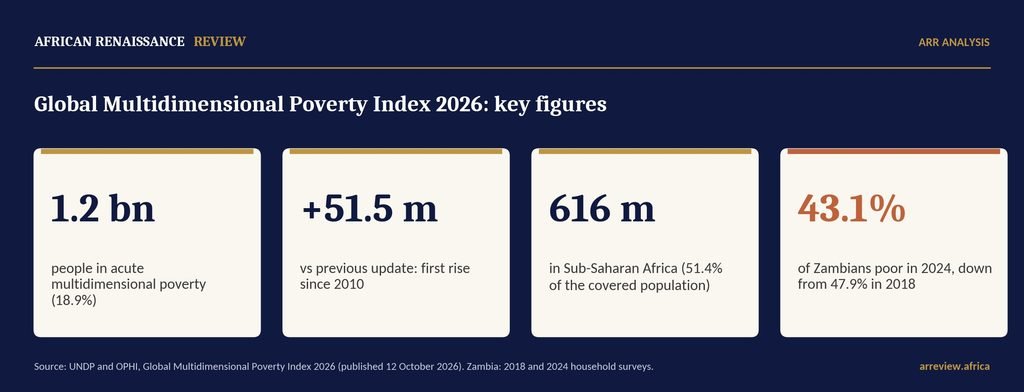
The headline needs careful reading. About 15.8 million of that increase came simply from updated population estimates in 95 countries where no new survey data were available. The rest reflects changes in poverty rates, demographic shifts and differences between survey rounds. The rise is real, but it is partly a story of populations growing faster than deprivation is falling.
That’s exactly why the index is so important for Africa. Poverty is not simply a question of household income. It’s about whether the children in that household go to school, whether the family are eating adequately, whether the community has access to clean water, whether the home has electricity and whether people are living in conditions that are conducive to human dignity.
Africa carries the heaviest burden.
Sub-Saharan Africa is at the heart of the global picture. Some 616 million people in the region (51.4% of the region’s population) are multidimensionally poor, and their average intensity of deprivation (52.6%) is the highest of any region. Globally there are some 617 million poor children, and 83% of them live in rural areas.
These deprivations don’t come in isolation. A child who is undernourished, who lives a long way from a school that is actually functioning and who has no reliable electricity is facing one problem rather than three. Poor nutrition impairs learning; poor schooling limits future employment opportunities; and poor infrastructure limits what a household or small business can actually earn.
For Africa the challenge is not simply to grow national economies. It is to ensure that growth translates into a change in the conditions of people’s actual lives.
What the index measures
The global MPI tracks overlapping deprivations across three equally weighted dimensions and ten indicators.
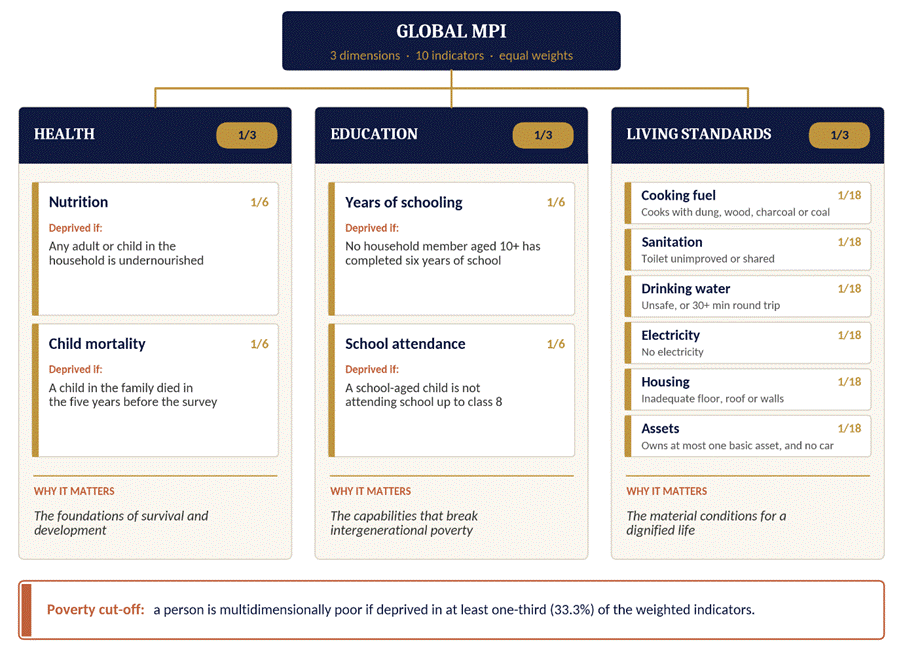
Figure 1. Structure of the global MPI.
A person is classified as multidimensionally poor if their household is deprived in at least one third of the weighted indicators. The index is a combination of the incidence of poverty (how many people are poor) and the intensity of poverty (how deprived the poor are on average).
Two countries can have the same level of poverty, and yet in one the poor will be multi-deprived. They will need different responses.
Zambia: a falling rate, a rising number
Zambia is one of only 13 countries with new survey data in the 2026 update, and its result embodies the central paradox of this report. The share of Zambians in multidimensional poverty declined considerably between 2018 and 2024, but population growth was so rapid that the number of people in poverty actually increased. The UNDP reports the same pattern in Angola.
Zambia, 2018 vs 2024: fewer poor, but more people on the edge
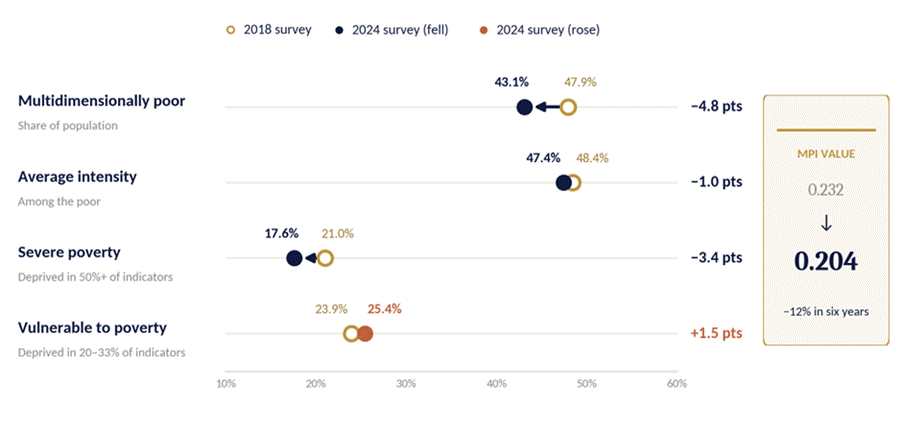
Figure 2. Zambia, 2018 and 2024. Sources: UNDP MPI 2025 country briefing; Global MPI 2026 Statistical Update.
In 2024 some 9.18m Zambians were multidimensionally poor. The improvements are real in that there are fewer poor people and fewer severely poor people. The proportion of people just above the line has, however, increased to a quarter of the population. One drought, one illness or one price shock and a large number of them would be pushed back.
A falling percentage can co-exist with increasing pressure on schools, clinics, water systems and social protection.
The composition points to where policy should be targeted. Deprivations in the area of living standards (electricity, water, sanitation, cooking fuel, housing and assets) account for 54.8% of multidimensional poverty in Zambia, health at 22.7% and education at 22.5%. Zambia’s own 2022 Living Conditions Monitoring Survey puts income poverty at 60.0% against the national poverty line which is a useful reminder that income poverty and multidimensional poverty are two different (though overlapping) measures of hardship.
Zambia should therefore be tracking both the poverty rate and the absolute number of the poor and planning public services for the number of people it will have rather than the number it currently has.
Why growth alone is not enough
Growth is vital in that it creates jobs, expands the tax base and funds public services. However, it does not automatically eradicate multidimensional poverty.
When opportunities are concentrated in a few cities or sectors, rural communities remain cut off. When work is insecure, income gains don’t translate into lasting improvements in nutrition, schooling, or housing. When services fail to keep up with population growth (as Zambia’s figures clearly show), prosperity and deprivation can go hand in hand.
Four priorities deserve particular attention from African governments:
- Invest in human capital: Early childhood nutrition, maternal and child health, school attendance, learning outcomes and skills.
- Close the rural infrastructure gap: Reliable electricity, safe water, sanitation, roads and digital connectivity.
- Create productive employment: Link industrialisation, agriculture, local manufacturing and enterprise to decent jobs and household incomes.
- Spend for results: Assess public expenditure based on tangible improvements in people’s lives rather than budget figures or the number of projects launched.
Poverty reduction should be a measured outcome of economic policy rather than an assumed by-product of growth.
Climate change multiplies deprivation.
The previous edition of the index (the 2025 report) found 887 million multidimensionally poor people living in areas exposed to at least one of the four climate hazards (extreme heat, flooding, drought and air pollution). Some 651 million were exposed to two or more.
Zambia is very much aware of this risk. Its economy and indeed many people’s livelihoods are predicated on rain-fed agriculture and hydropower, so a single drought can have the effect of a collapse in harvests, a spike in food prices and power cuts which in turn will impact schools, clinics and businesses. The most deprived households will have the least to fall back on. The previous El Niño-induced drought during the 2023/2024 farming season devastated Zambia’s agriculture and energy sectors. It destroyed nearly 1 million hectares of maize, caused the lowest rainfall since 1981, and prompted a national disaster declaration in February 2024. It further affected over 9 million people across 84 districts.
Poverty policy must therefore incorporate climate adaptation: resilient infrastructure, water security, agricultural productivity and social protection that can scale up in the event of a shock. Climate and poverty are one agenda, not two.
Rapid progress is possible, including in Africa.
The 2026 findings are not just a tale of failure. Of the 89 countries with comparable trend data, 33 halved their MPI over the course of under 15 years, and six of those were in Sub-Saharan Africa. Eswatini reduced the share of its population in multidimensional poverty from 38.7% to 8.0% over the course of about 15 years.
These cases clearly demonstrate that large reductions are possible. They don’t in any way prove that any one particular policy can be simply transplanted wholesale. The institutions, the demographics, the economic structure and the pattern of deprivation will all be different.
The key lesson is methodology. Find the most prevalent deprivations, the groups where deprivations overlap the most and the interventions which have the potential to improve multiple outcomes at the same time. For Zambia the new 2024 data make that form of targeting far more achievable than it has been for some years.
From measuring poverty to ending it
The 2026 MPI is first and foremost a test of accountability. If poverty is multidimensional, then national success cannot be measured by GDP growth, inflation, debt ratios and employment rates alone. Those are all important indicators, but they must be balanced by evidence of improved health, education, living standards and resilience.
Governments should publish accessible poverty dashboards, strengthen their statistical systems, assess their social programmes, and report progress both nationally and by province. Parliament, civil society, researchers and the media should be able to see whether policy is actually reducing deprivation. Development partners should be held to the same standard with their financing judged on the basis of tangible, durable gains in national capability.
The clock is short. SDG target 1.2 is to halve by 2030 the proportion of people living in poverty in all its dimensions according to national definitions. The challenge is not merely to measure poverty better. It is about using the evidence to change what keeps people poor.
Conclusion
The 2026 index is asking Africa to rethink what development success actually means. An increasing economy matters, but its value lies in people’s lives. Can children learn without hunger? Do families have safe water and reliable power? Can rural communities get to a working clinic? Can young people find decent work? Can households survive a drought, an illness or a price shock without falling deeper into poverty?
These aren’t side issues at all. They are the core indicators of development.
Zambia’s latest data show both sides of the equation: genuine progress on the poverty rate and a growing number of people still in poverty. Africa needs growth that creates livelihoods, institutions that deliver services and policies that address the range of overlapping disadvantages simultaneously rather than in isolation.
Africa’s progress should ultimately be judged not just on the wealth its economies generate but on how much deprivation they can eradicate.
Sources
- UNDP, “Global multidimensional poverty rises for first time since 2010”.
- UNDP Human Development Report Office, 2026 Global Multidimensional Poverty Index.
- UNDP and OPHI, Global Multidimensional Poverty Index 2026: Statistical Update.
- UNDP, Multidimensional Poverty Index 2025 briefing note: Zambia.
- OPHI, “2026 update of the Global MPI sends important signals on poverty reduction”.