Why does flying within Africa cost so much, and what could make it cheaper and more reliable?
Imagine an Africa where flying is affordable.
Imagine a young entrepreneur in Lusaka trying to get to a client meeting in Nairobi to discuss a possible e-payment wallet launch. A family saving for a holiday in Accra, a Zambian student travelling to Witwatersrand University in South Africa, or a shop owner looking to meet suppliers in Kigali.
Now imagine each of them finding a reasonable ticket, a flight that departs on time, and an easy border to cross. That is roughly what the continent’s integration plans assume. For many travellers, that is not what they find yet.
When flying within Africa is expensive, the cost goes beyond the seat price. Deals don’t happen, conferences are missed, and tourists stick to one country instead of two. Families also see each other less often than they want. A ticket between two African capitals can be too expensive for many. The lack of direct routes also often forces travellers through faraway hubs. For example, if you’re travelling from Lusaka’s Kenneth Kaunda International Airport to West African destinations such as Lagos or Accra, you can forget about direct flights and should expect a stopover. Because of the peculiarities of African air routes, you’ll most likely fly east through East Africa or south through South Africa. This adds hours and costs to what should be a simple journey.
An integrated African economy relies on affordable movement for people across the continent.
Why Flying in Africa Costs So Much
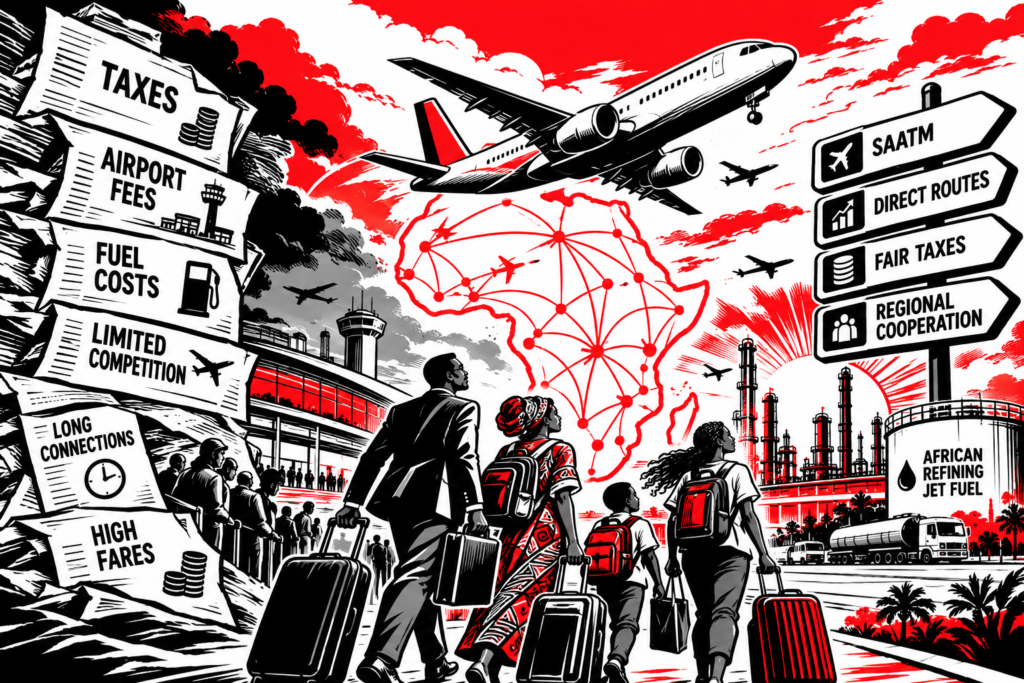
There is no single culprit. Normally, high fares come from several linked issues: taxes and charges, fuel costs, regulations, thin route networks, and the cost of keeping aircraft in the air.
1. Taxes and charges
Taxes and charges are the most visible part of the problem. In September 2024, the African Airlines Association (AFRAA) reported that passengers on international flights from Africa paid an average of 3.5 in taxes, fees, and charges. This added up to around US$68. The comparable averages were US$32 in Europe and US$34 in the Middle East.
The continental figure shows big differences:
- West and Central Africa averaged over US$100 per international departure.
- North Africa averaged around US$25.
While sixty-eight dollars may not sound like much against the price of a ticket, it adds up quickly for a family of four. Governments and airports must fund safety, security, and infrastructure. So the real question isn’t whether charges should exist. It is whether they are proportionate, transparent, and linked to the services they pay for. AFRAA believes many African countries charge more than needed to cover operating costs. They see aviation as a way to generate general revenue.
IATA made a similar point in April 2026, estimating that taxes and charges in Africa are about 15% above the global average. The organisation urged governments to stop increasing fees, such as passenger data (API-PNR) charges. It also called on West African states to follow the December 2025 ECOWAS decision. This decision aims to abolish aviation taxes and reduce certain charges by 25%. A sensible starting point for any government is to look at the combined effect of all levies, not just each one alone.
2. Fuel
Fuel is one of an airline’s highest operating costs, and in Africa it costs more than elsewhere. IATA estimated in late 2025 that African carriers paid about 17% more for fuel than the global average.
The reasons include:
- Limited competition among suppliers
- Costly logistics
- Fragmented supply chains
- Small purchasing volumes
Cheaper fuel would not automatically mean cheaper tickets. It would let airlines lower fares, add routes, or stay financially healthy. We also think that competitive supply deals, better storage and distribution, and clear airport pricing would all help.
3. Can African refining help?
For decades, many African oil producers exported crude and imported the refined products made from it, including jet fuel. That left them exposed to shipping costs, supply disruptions and currency swings.
Nigeria’s Dangote Petroleum Refinery began operations in January 2024. It has a capacity of 650,000 barrels per day. This development is changing the landscape. Nigeria had no jet fuel imports from June 2025 to June 2026. In April 2026, the Middle East conflict disrupted supply routes. S&P Global data revealed that Dangote became the world’s largest single exporter of jet fuel.
However, much of that fuel leaves the continent. A BusinessDay analysis from October 2026 found that around 87% of the refinery’s aviation fuel was exported in August 2026. Kpler shipment data indicates that Europe is now its biggest jet fuel market. Refiners sell where margins are the highest, and in 2026 those margins were often in Europe. Exports to other African countries are up. However, a major refinery on the continent does not guarantee cheaper fuel for African airlines, at least for now.
With more refining capacity in Africa, the Jet A-1 market could grow stronger. This means shorter supply routes. It also reduces reliance on distant suppliers and boosts competition among fuel providers. Investment in storage, pipelines, ports, and airport fuel systems would matter as much as refining itself. Landlocked countries such as Zambia, Botswana, etc., can benefit from regional cooperation. They can access supplies through coastal neighbours and get better prices.
For Zambia, the practical question is whether expanding refining capacity across the continent will translate into lower jet fuel prices at Kenneth Kaunda International Airport and regional hubs. Several factors will determine the outcome. These include regional transport logistics, import arrangements, and storage infrastructure. Tax structures, exchange rate changes, and competition among local suppliers also play a role.
Producing fuel in Africa does not make it cheap. Refineries buy crude oil at international prices. They cover their own operating costs. Then, they sell products in markets that use global benchmarks for pricing. Local production boosts availability, but it can’t protect prices from global market shifts or currency changes.
The refining capacity works best in competitive fuel markets with efficient distribution.
Governments can help by:
- Reviewing airport fuel-supply plans.
- Ensuring fair access to storage and refuelling.
- Publishing pricing details.
Energy, transport, trade, and tourism are all connected. Choices made in one area affect the others.
4. Fragmented markets and limited competition
Africa has 54 countries. Each country has its own aviation rules. Many bilateral agreements also determine who can fly where and how often. These arrangements exist for good reasons. However, they can make it hard for airlines to operate across borders.
When new entrants can’t join, or services are scarce, passengers face high fares and inconvenient schedules. This can create a cycle: high fares reduce passenger numbers. Then, low volumes drive up the cost per seat. Limited service makes flying even less appealing.
Opening markets can help, provided safety oversight stays strong and access is genuinely open, not just open on paper.
5. Too few direct connections
A continent can have plenty of airports without having a working network. IATA’s late-2025 outlook showed that only 19% of intra-African routes had direct flights. Travellers often connect through a hub. Sometimes, this hub is outside the region where they begin and end their journey. Each extra leg can mean a higher fare, a longer day, a missed connection, or an unplanned night in a hotel.
Not every route can support direct flights. Demand, aircraft availability, and operating costs all matter. But where demand exists, regulation should not stand in the way.
6. Older aircraft and expensive maintenance
Maintenance, spare parts, insurance, and financing all cost African airlines more. In July 2025, an IATA analysis looked at 11 African airlines, excluding Ethiopian Airlines. It found their average cost per available tonne-kilometre in 2024 was nearly 140 US cents. This is about twice the global average. The same analysis found that, on average, African carriers’ aircraft were five years older than the global norm.
Older aircraft are not unsafe if they are properly maintained. They do burn more fuel and need more maintenance. This makes reliable and economical operations harder.
Easier access to aircraft finance, local MRO centres, and nearby parts would lower the need to buy these services from abroad. This change won’t compromise safety.
What Could Make Flying More Affordable?
1. Review taxes and harmonise charges
Governments could begin by reviewing all taxes, fees, and charges on air travel. They should also show passengers how their ticket price is divided. This includes the fare, government taxes, airport charges, and other levies.
The test for each charge checks if it matches the cost of a real service. It also assesses whether, alongside other charges, it discourages travel and investment. Charges that don’t meet that test might be lowered or dropped. New fees could need proper discussion first. Nearby countries might also align their charges to simplify things. Safety and infrastructure would still need funding.
2. Make the Single African Air Transport Market work.
The African Union started the Single African Air Transport Market (SAATM) in January 2018. This initiative aims to implement the 1999 Yamoussoukro Decision. That decision allows open access to Africa’s air transport markets. At least 35 AU member states, including Zambia, have signed a solemn commitment to implement it. Signing is the easier part.
But full implementation means:
- Revising bilateral agreements.
- Granting traffic rights as agreed.
- Removing limits on routes and frequencies.
- Having a reliable way to settle disputes.
Airlines that meet safety and licensing rules should be allowed to compete fairly.
The potential gains are real, but they should be read carefully. A 2025 study by Cristea, Abate, and Benitez in Economics of Transportation looked at 71 African country pairs from 2011 to 2019. They found that liberalising air service agreements, either partially or fully, reduced fares and boosted passenger numbers. This change brought consumer benefits, including a 38% drop in airfares. That is an average estimate from one study, not a promise for every route. The earlier World Bank paper found no evidence that more airlines operated between countries after liberalisation. This shows that opening a market isn’t the same as creating competition.
3. Encourage competition without weakening safety.
More airlines don’t always mean cheaper tickets. If liberalisation is poorly designed, dominant carriers can retain much of their market power. Lowering barriers for qualified regional carriers and enforcing clear competition rules both matter.
National carriers can contribute to connectivity, employment, and development. Their future depends on sound management and the value they offer passengers. Whether an airline flies a national flag matters less than whether it connects people safely and reliably at a price the market can sustain.
4. Strengthen regional hubs and secondary airports
A good network reaches beyond the largest cities. Regional hubs can gather demand and enhance connections. When they have enough traffic, secondary airports can link farming areas, tourist spots, mining towns, and growing commercial centres to bigger markets.
Any expansion needs credible demand forecasts. The priorities are often less noticeable than new terminals. They include:
- Runways and navigation aids
- Efficient ground handling
- Modern air traffic management
- Reliable power
- Digital passenger processing
Zambia’s opportunity lies in enhancing Lusaka’s role as a regional gateway. This means connecting the Copperbelt, Livingstone, and Mfuwe. It will also link these areas to nearby countries. This will require cooperation among government, airlines, airports, tourism operators, and private investors.
5. Lower the cost of fuel, finance and maintenance
Aviation works best as a connected industry, not just a transport service. Regional cooperation could improve how jet fuel is bought, stored and distributed. Airlines could explore joint procurement where it is commercially and legally feasible. Lenders can create financing options for regional carriers. Investors can also support maintenance facilities and parts distribution.
Governments and development finance institutions can help reduce the cost of financing modern, fuel-efficient aircraft for skilled operators. Public money should support measurable gains in efficiency, connectivity, and reliability. It shouldn’t be an open-ended subsidy for airlines that can’t make it on their own.
6. Treat reliability as seriously as price.
A cheap ticket is not worth much if the flight is often late, cancelled or poorly connected. Reliability stems from good fleet planning, skilled staff, and proper maintenance. It also relies on good airport infrastructure, efficient air traffic management, and solid passenger protections.
Publishing data on on-time performance, cancellations, baggage handling, and complaints helps passengers compare airlines. It also helps regulators hold them accountable. Safety is not negotiable. Lower fares should come from greater efficiency. They shouldn’t come from cutting maintenance, regulatory independence, or training.
7. Make borders easier to cross.
Aviation reform won’t go far if travellers still deal with visa requirements, slow border checks, and mixed rules. IATA noted in April 2026 that nearly half of intra-African travel still requires a visa.
Wider visa-free and visa-on-arrival options, improved e-visa systems, and coordinated border procedures would help the African Continental Free Trade Area (AfCFTA) achieve its goals. This includes business travel, professional services, tourism, time-sensitive cargo, and regional supply chains.
Who Pays for Expensive Air Travel?
Every pricey ticket raises a big question: who suffers when travelling between African countries is hard and expensive? Entrepreneurs who cannot afford to visit new markets leave business relationships undeveloped. Expensive destinations lose visitors. This means fewer jobs for those areas—professionals who cannot travel share less knowledge.
The burden is also uneven. Wealthier travellers can handle high fares. But students, small-business owners, and regular families often get priced out.
None of this means flying should be cheap at any cost. Airlines must cover costs, invest in safety, and earn a sustainable return. Some remote or low-demand routes may need special public support. This matters if governments consider these routes essential.
The key difference is between a fare that reflects the real cost of service and one inflated by unnecessary taxes, weak regulation, or rules that distort the market.
Seen this way, affordable flying becomes less about passenger comfort and more about economic opportunity.
A Continent That Can Move Itself
How well Africa connects its markets, people, and ideas will shape much of its future. Roads and railways are essential, and shipping carries most international trade. Air travel does what others can’t. It connects distant cities fast. It supports urgent business and reunites people over long distances.
Cheaper flights alone won’t solve Africa’s development challenges, and lower fares don’t guarantee growth. Benefits come from investing in many areas, like the following:
- Infrastructure
- Skills
- Tourism
- Trade facilitation
- Effective regulation
These investments help boost overall growth. Still, the opportunity is significant. The African Union already has a framework for a more integrated air transport market. The challenge is turning that framework into something passengers and businesses can actually feel.
Imagine a student in Lusaka attending a conference in Accra without saving for months. An entrepreneur in Kampala meeting customers in Lagos. Tourists can visit multiple African countries in one trip. They can do this without flights between them draining their budget.
Imagine airlines competing on price, service, and reliability. Airports operate smoothly, and governments see aviation as a way to grow, not just a source of fees.
An African renaissance means movement: people, ideas, and businesses are on the move. Flying across Africa should not be a privilege reserved for the few.
Editorial Sources
- African Airlines Association (AFRAA). 2024 Taxes and Charges Study Review (data collected September 2024). https://www.afraa.org/2024-afraa-taxes-and-charges-study-review/
- International Air Transport Association (IATA). Press release calling on African governments to prioritise aviation, Focus Africa conference, 29 April 2026. https://www.iata.org/en/pressroom/2026-releases/2026-04-29-01/
- IATA. Cost disadvantage of African airlines, Chart of the Week, 31 July 2025. https://www.iata.org/en/iata-repository/publications/economic-reports/cost-disadvantage-of-african-airlines
- IATA. 2026 industry outlook for Africa (fuel costs, route connectivity), as reported by IT-Online. https://it-online.co.za/?p=309402
- African Union. Single African Air Transport Market (SAATM). https://au.int/en/saatm
- Cristea, A. D., Abate, M. and Benitez, D. A. (2025). Towards a competitive air transport market in Africa: The role of bilateral air service agreements liberalization. Economics of Transportation, 42. https://ideas.repec.org/a/eee/ecotra/v42y2025ics2212012225000206.html
- Cristea, A., Abate, M. and Benitez, D. A. (2022). Toward a Competitive Air Transport Market in Africa. World Bank Policy Research Working Paper 10204. https://openknowledge.worldbank.org/entities/publication/32a9cbda-1be6-5dd2-a137-f9dc91cc9482
- United Nations Economic Commission for Africa. Liberalization of access to air transport markets in Africa: benefits, progress, challenges and way forward. https://www.uneca.org/liberalization-of-access-to-air-transport-markets-in-africa-benefits%2C-progress%2C-challenges-and
- U.S. Energy Information Administration (EIA). Country Analysis Brief: Nigeria, November 2025. https://www.eia.gov/international/content/analysis/countries_long/Nigeria/Nigeria-2025.pdf
- BusinessDay analysis of Dangote jet fuel exports, as reported by Parrot Nigeria, 14 October 2026. https://parrotnigeria.com/2026/10/14/dangote-exports-87-of-aviation-fuel-output-as-nigeria-records-zero-imports/
- S&P Global data on Dangote jet fuel exports, as reported by Arise News, 2026. https://www.arise.tv/dangote-refinery-becomes-worlds-largest-jet-fuel-exporter-in-april/
- Kpler shipment data on Dangote jet fuel exports, as reported by Tribune Online, 2026. https://tribuneonlineng.com/dangote-refinerys-jet-fuel-exports-rise-sharply-as-world-bank-imf-face-criticism-over-east-africa-refinery-debate/
Editorial note: Figures were checked against the sources listed above as of October 2026. Jet fuel market data in particular changes quickly and should be refreshed if publication is delayed.