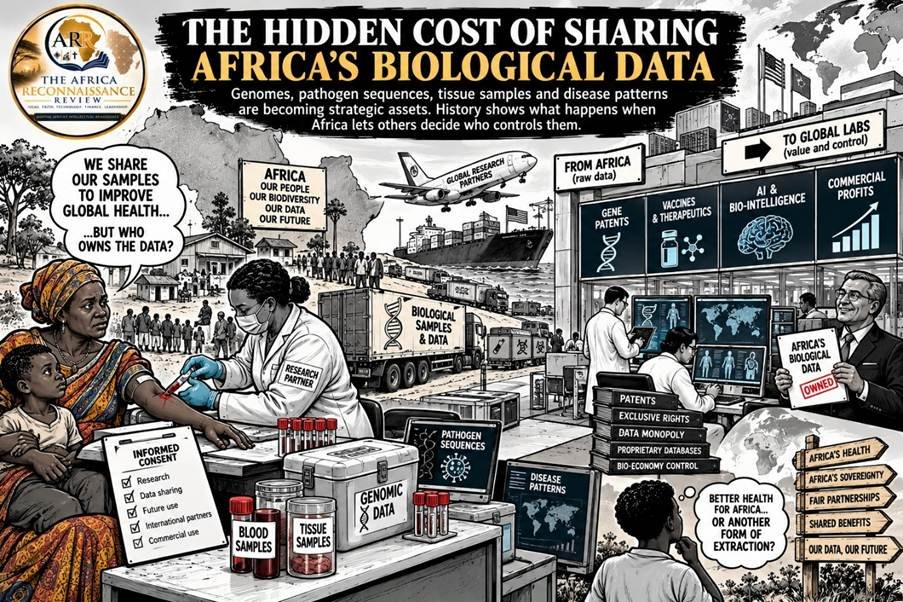
Genomes, pathogen sequences, tissue samples and disease patterns are becoming strategic assets. History shows what happens when Africa lets others decide who controls them.
Guest Contributor · 7 October 2026
It is something worth pausing over that Zambia has just achieved. On 5th October 2026, Health Minister Professor Roma Chilengi (in an interview on ZNBC Sunday) announced that Zambia would sign its five-year health memorandum of understanding with the United States on Thursday, provided that a clause concerning the sharing of disease specimens is deleted.
The money is substantial: the US provides US$1.5 billion over five years, and Zambia commits US$2.1 billion of its own.1 Yet the minister’s headline was not the money. It was that no specimen will leave the country under the agreement, and that data-sharing is limited to monitoring and evaluating US-funded programmes.1,2
I should mention that that was not a small concession to win. The earlier draft committed the two countries to negotiate the sharing of samples and genetic sequence data on epidemic-prone pathogens within five days of detection.4 According to the Associated Press, the US has already signed agreements with at least nine African nations that include such commitments, and says it may pass the data and specimens to up to ten unnamed American non-government entities to develop diagnostics and treatments.3 Zimbabwe walked away from a proposed US$367 million agreement in February over similar concerns.5 Kenya, the first country to sign under the new model, took a different route: in December 2025 its High Court suspended the data-sharing provisions of a US$1.6 billion pact after a consumer group argued that, once transferred abroad, Kenyans’ health data could no longer be recalled or overseen by Kenyan regulators. The deal proceeded only in June 2026, after the Court of Appeal lifted that order.22
For decades Africa has exported copper, cobalt, cocoa and coffee. Increasingly, another resource is leaving the continent, quietly and in refrigerated boxes: biological information. Right now, it is not the time to question only who owns Africa’s minerals? Instead, we should extend the question also to who controls Africa’s biological information? History offers some uncomfortable answers.
Seven risks hiding in a sample
While I am a researcher and writer rather than a clinician or biomedical scientist, the risks outlined here are well-documented in peer-reviewed academic literature.
1. Genomes identify communities, not just individuals.
Consider the Havasupai, a small Native American tribe living at the foot of the Grand Canyon. In the early 1990s, tribe members gave blood to Arizona State University researchers for what they understood to be a study of type 2 diabetes. They later discovered that their samples had also been used to study schizophrenia, inbreeding and ancient population migration. Such subjects were never agreed upon by the tribe and were regarded as offensive. After years of litigation, the university settled in April 2010, paying US$700,000 to 41 tribe members and returning the samples.6
Notice what happened. No individual’s name was published, and none needed to be. The harm fell on the community as a whole: outsiders had characterised its collective identity without permission. That is the essence of genomic profiling. A dataset collected for one benign purpose can be repurposed to describe, and potentially stigmatise, an entire people. It is not hard to imagine the same thing happening to a small Zambian community whose samples sit in a foreign laboratory, studied under questions its members never heard, let alone accepted.
Nor should we take comfort in the word “anonymised.” In 2013, researchers showed they could identify nearly 50 people who had contributed DNA to public research projects, using only Y-chromosome markers, free genealogy websites and basic details such as age and state of residence.7,8 Every year databases grow, and that task gets easier, and small, close-knit populations are the most exposed. A password can be changed. A genome cannot, and you share part of it with every relative you have.
2. Disease data is also national security data.
Surveillance data tells us where diseases occur, who is affected and how outbreaks spread. That is exactly what public health needs. But Southern Africa learnt in November 2021 that disease data also carries consequences far beyond the clinic.
When South African scientists identified the variant later named Omicron and promptly shared their findings, the reward was a wave of travel bans. Pretoria’s Department of International Relations and Cooperation said the bans amounted to punishing South Africa for its advanced genomic sequencing and its ability to detect new variants quickly.9 Neighbouring states, Zambia among them, were caught in the restrictions too, on the eve of the region’s December travel season.10 Transparency protected the world, while the countries that were transparent paid the economic price.
There is a second lesson. The same granular surveillance that pinpoints an outbreak can also show where clinics are thin, where borders are porous, how people move, and where a health system would buckle under pressure. In any language, that is strategic intelligence. It does not mean health data should be classified by default. It does mean governments should know exactly who holds such data and what they may do with it.
3. Pathogen information is bargaining power, and dual-use.
In early 2007, Indonesia, then the country hardest hit by H5N1 bird flu, stopped sharing virus samples with the World Health Organization’s global influenza network. Its complaint was simple. Samples it had shared were passed to pharmaceutical companies that developed and patented vaccines Indonesia could not afford.11 Much of the world called the move reckless. Yet the standoff produced the WHO Pandemic Influenza Preparedness Framework, agreed in May 2011, which linked virus sharing to benefit-sharing.11 The message for Africa is plain: pathogen samples are leverage as well as science.
But pathogen information also raises serious security questions. In 2011, researchers in the Netherlands and the United States developed H5N1 viruses that could spread through the air between ferrets. Concerned that the findings might be misused for bioterrorism, the US National Science Advisory Board for Biosecurity initially recommended withholding key details from publication. In March 2012, after reviewing revised manuscripts, it changed its position and supported publication.12 If even the world’s leading scientific institutions struggled with where to draw the line, African governments have every right to ask difficult questions before allowing their pathogen material to enter foreign laboratories.
None of this makes every pathogen sequence a weapons blueprint, and routine genomic surveillance is not inherently a bioweapons risk. The principle is proportionality: the more sensitive the material, the stronger the access and security controls should be.
4. Specimens outlive the agreements that move them.
A spreadsheet can be copied. A specimen can be re-studied for decades as technology improves. Blood drawn today may yield a new diagnostic, vaccine or AI training set in 2050, long after the officials who approved its export have left office.
West Africa knows this better than anyone. During the 2014–16 Ebola epidemic, WHO data obtained by Le Monde (French paper) indicated close to 269,000 samples were taken across Guinea, Liberia and Sierra Leone.13 Many were destroyed, but thousands were shipped abroad, more than 10,000 of them to the United Kingdom, according to a 2019 Telegraph investigation. Liberia’s stored samples were moved to a high-security laboratory in the United States in 2016.14 Scientists from the three countries reported that they could not access the samples for their own research. Survivors interviewed said no one had asked for their consent, and patents had been filed using West African material.14
Such occurrences ignited a wider global debate about who controls biological samples and who ultimately benefits from them. Western institutions maintained that transferring the samples was necessary because they had the secure facilities, storage capacity and expertise needed to develop medicines and vaccines. Many West African researchers and health officials, however, saw a troubling imbalance: foreign organisations were able to build knowledge and commercial value from African genetic material, while the communities that provided it were not always properly consulted or given a fair share of the benefits.
Now contrast what came later. Sierra Leone completed a secure national biobank in 2022 and, with WHO support, has consolidated its remaining Ebola samples there under national control.15 Recall, too, that the Havasupai got their blood back only after two decades and a lawsuit.6 The lesson is that the terms of a specimen’s afterlife must be written down before it leaves: who stores it, who may access it, whether it may be passed on or commercialised, who owns derivatives and intellectual property, and when it is returned or destroyed. Afterwards, the leverage is gone.
5. Who benefits from the value created?
African samples can feed medicines, vaccines, diagnostics, genomic databases and AI models whose intellectual property is owned abroad. Some call this biological colonialism, a successor to physical extraction and to what is now termed digital colonialism. The label can be debated. The policy question cannot be: does the population that contributed the resource share fairly in the value created from it? Indonesia’s vaccines and West Africa’s Ebola patents suggest the answer has too often been no.
6. Convergence raises the stakes.
Genomics, AI, geographic and demographic data, health records and behavioural data are increasingly combinable. Together they could produce population profiles of unprecedented detail, raising hard questions about discrimination and surveillance. The Havasupai case happened with 1990s tools. Governance should anticipate what today’s tools make possible rather than react to it afterwards.
7. Dependency is a sovereignty problem.
When samples routinely leave because the sequencers, databases and computing power sit abroad, Africa depends on others to understand its own biological environment. Africa provides the samples; others build the knowledge infrastructure. South Africa’s Omicron detection shows the alternative: home-grown sequencing capacity that puts an African laboratory at the front of a global response. International cooperation should build such laboratories, biobanks, bioinformatics capacity and biotechnology firms across the continent, not permanently substitute for them.
Govern by risk, not by reflex
I should also mention that none of this is an argument against cooperation. Pathogens cross borders, and so must knowledge. But cooperation should not mean “send us the samples and we will decide what happens to them.” A better principle should be: share knowledge, build capacity, protect sovereignty, share benefits. In practice that means classifying health and biological information by risk.
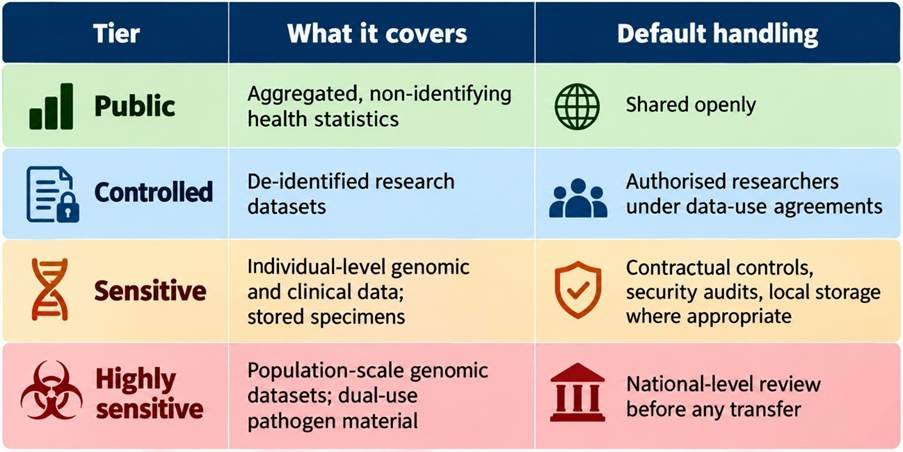
Any agreement that moves Zambian biological data or specimens should settle, in writing and before collection:
- Purpose limitation, informed consent and rules on secondary use
- Retention periods for both data and specimens
- Cross-border and onward transfers, and access rights
- Cybersecurity standards and breach notification
- Data localisation where justified
- Intellectual property, commercialisation and benefit-sharing
- Return or destruction of specimens
- Independent oversight with audit rights
Bilateral deals are not the only route. WHO member states are still negotiating a multilateral Pathogen Access and Benefit-Sharing (PABS) annex to the Pandemic Agreement adopted in May 2025. It failed to conclude by the May 2026 World Health Assembly, and talks now run toward May 2027.16,17 Bilateral agreements negotiated in that gap can lock in terms that a multilateral system would have made fairer. African negotiators should push to finish PABS and keep bilateral commitments consistent with it.
The strategic lesson for Zambia
Zambia does not start from zero; its task is to consolidate and modernise. The National Health Research Act No. 2 of 2013 already regulates biological material for health research, including its export, ownership, material transfer agreements, biobanks, data management and intellectual property.18 The National Health Research (Material Transfer) Regulations, 2018 require approval and a material transfer agreement before biological material is exported for research.19 The Data Protection Act of 2021 adds rules for sensitive personal data and cross-border transfers.20
What is missing is a single framework that treats population-scale biological and genomic data as a strategic national asset, and that applies to government-to-government agreements as firmly as to individual research projects. A National Biological and Genomic Data Governance Framework could unify these instruments around one principle:
Zambian biological specimens, genomic information and population-level health datasets are strategic national assets. Their collection, transfer, storage, processing and secondary use must be governed by Zambian law and by internationally recognised ethical and security principles.
The framework should also fix a known weakness. Researchers have noted that the 2013 Act’s bar on broad consent for future, unspecified research can deter legitimate genomic studies that depend on storage and reuse.21 Sovereignty should not become a reason for science to go elsewhere. The aim is tiered, accountable consent, not blanket refusal.
The revised US agreement is a useful precedent. Zambia negotiated, held its line on specimens, intellectual property and benefit-sharing, and still secured the funding.2 That outcome should be codified, so it does not depend on the resolve of each negotiating team. Civil society’s call to publish the final text before signing is consistent with that goal.2 Kenya shows the cost of skipping that step: its deal, challenged for lack of public participation and for conflicting with the country’s data protection law, spent six months tied up in litigation.22
Conclusion
Africa’s sovereignty debate is entering a new phase. The first struggle was over land, then minerals, then data. The fourth frontier is biological sovereignty.
The most valuable resource leaving Africa may not be something that can be weighed or loaded onto a ship. It may be a genome, a pathogen sequence, a tissue sample or a population health dataset, much like the Ebola blood that still sits in laboratories far from the patients who gave it.
Should Africa share? When sharing saves lives and advances science, yes. The harder question is: under whose rules, for what purpose, for how long, with what safeguards, and who ultimately benefits?
Health cooperation without sovereignty can become dependency. Biological data without governance can become a new form of extraction. This week, Zambia showed that the terms can be renegotiated. Africa should not wait until its biological resources become strategically valuable to decide who controls them.
References
[1] Reuters. Zambia to sign $1.5 billion US health pact after resolving differences over data-sharing. Reuters (republished by CNBC Africa), 6 October 2026. Available at: https://www.cnbcafrica.com/2026/zambia-to-sign-1-5-billion-us-health-pact-after-resolving-differences-over-data-sharing (accessed 6 October 2026).
[2] Musokotwane, M.. Zambia Ready To Sign US$1.5 Billion US Health Deal After Specimen-Sharing Clause Is Dropped. Lusaka Times, 6 October 2026. Available at: https://www.lusakatimes.com/2026/10/06/zambia-ready-to-sign-us1-5-billion-us-health-deal-after-specimen-sharing-clause-is-dropped/ (accessed 6 October 2026).
[3] Associated Press. Zambia says it will sign $3.6B US health deal after stripping patient data clauses. ABC News, 6 October 2026. Available at: https://abcnews.com/Health/wireStory/zambia-sign-36-billion-us-health-deal-after-137027258 (accessed 6 October 2026).
[4] The Rio Times. Zambia’s US Health Deal: Specimen Clause Dropped From US$1.5 Billion Pact. The Rio Times, October 2026. Available at: https://www.riotimesonline.com/zambia-us-health-deal-specimen-clause-2026/ (accessed 6 October 2026).
[5] Al Jazeera. US’s new scramble for Africa is biomedical imperialism (Opinion). Al Jazeera, 13 March 2026. Available at: https://www.aljazeera.com/opinions/2026/3/13/uss-new-scramble-for-africa-is-biomedical-imperialism (accessed 6 October 2026).
[6] Mello, M.M. and Wolf, L.E.. The Havasupai Indian Tribe Case — Lessons for Research Involving Stored Biologic Samples. New England Journal of Medicine, 2010, 363, pp. 204–207. DOI: 10.1056/NEJMp1005203. Available at: https://www.nejm.org/doi/full/10.1056/NEJMp1005203 (accessed 6 October 2026).
[7] Gymrek, M., McGuire, A.L., Golan, D., Halperin, E. and Erlich, Y.. Identifying Personal Genomes by Surname Inference. Science, 18 January 2013, 339(6117), pp. 321–324. DOI: 10.1126/science.1229566. Available at: https://pubmed.ncbi.nlm.nih.gov/23329047/ (accessed 6 October 2026).
[8] Whitehead Institute for Biomedical Research. Scientists expose new vulnerabilities in the security of personal genetic information. News release, Cambridge, MA, 17 January 2013. Available at: https://wi.mit.edu/news/scientists-expose-new-vulnerabilities-security-personal-genetic-information (accessed 6 October 2026).
[9] BusinessTech. Government engaging countries that have banned travel to South Africa. BusinessTech, 27 November 2021. Available at: https://businesstech.co.za/news/?p=542114 (accessed 7 October 2026).
[10] Press Trust of India. S Africa slams countries imposing travel bans on fears of Omicron, calls it “knee-jerk reaction”. Morung Express, 28 November 2021. Available at: https://morungexpress.com/s-africa-slams-countries-imposing-travel-bans-on-fears-of-omicron-calls-it-knee-jerk-reaction (accessed 6 October 2026).
[11] Kamradt-Scott, A. and Lee, K.. The 2011 Pandemic Influenza Preparedness Framework: Global Health Secured or a Missed Opportunity? Political Studies, 2011, 59(4), pp. 831–847. DOI: 10.1111/j.1467-9248.2011.00926.x. Available at: https://researchonline.lshtm.ac.uk/2628863 (accessed 6 October 2026).
[12] CIDRAP News. NSABB reverses recommendation on H5N1 studies. Center for Infectious Disease Research and Policy, University of Minnesota, 30 March 2012. Available at: https://www.cidrap.umn.edu/cidrap/content/influenza/avianflu/news/mar3012nsabb.html (accessed 6 October 2026).
[13] Assemblée nationale (France). Question écrite n° 16912: Sang contaminé par Ebola (citing WHO data obtained by Le Monde). 15th legislature. Available at: https://www.assemblee-nationale.fr/dyn/15/questions/QANR5L15QE16912.pdf (accessed 6 October 2026).
[14] Freudenthal, E.. Ebola’s lost blood: row over samples flown out of Africa as ‘big pharma’ set to cash in. The Telegraph, 6 February 2019 (republished by Yahoo News). Available at: https://news.yahoo.com/ebola-apos-lost-blood-row-150000131.html (accessed 6 October 2026).
[15] WHO Regional Office for Africa. Hope secured: safely moving Ebola samples in Sierra Leone. WHO AFRO, Freetown. Available at: https://www.afro.who.int/fr/node/19974 (accessed 7 October 2026).
[16] World Health Organization. WHO Member States agree to extend negotiations on key annex to the Pandemic Agreement. WHO news release, Geneva, 28 March 2026. Available at: https://www.who.int/news/item/28-03-2026-who-member-states-agree-to-extend-negotiations-on-key-annex-to-the-pandemic-agreement (accessed 6 October 2026).
[17] Konrad-Adenauer-Stiftung, Multilateral Dialogue Geneva. PABS Annex to the WHO Pandemic Agreement: Member States extend negotiations into 2027. Geneva Telegram, May 2026. Available at: https://www.kas.de/en/web/multilateraler-dialog-genf/geneva-telegram/detail/-/content/pabs-annex-zum-who-pandemieabkommen-who-mitgliedstaaten-verlaengern-verhandlungen-bis-2027 (accessed 6 October 2026).
[18] Republic of Zambia. The National Health Research Act, No. 2 of 2013. Date of assent 21 March 2013. National Assembly of Zambia. Available at: https://www.parliament.gov.zm/node/3078 (accessed 6 October 2026).
[19] Republic of Zambia. The National Health Research (Material Transfer) Regulations, 2018. Statutory Instrument No. 92 of 2018. Government Gazette, 7 December 2018. ZambiaLII. Available at: https://zambialii.org/akn/zm/act/si/2018/92 (accessed 6 October 2026).
[20] Republic of Zambia. The Data Protection Act, No. 3 of 2021. National Assembly of Zambia.
[21] AAS Open Research. Policy makers, regulators and researchers’ perspectives on genomics research and the capacity of the National Health Research Act of 2013 to regulate genomics research in Zambia [version 1; peer review: 2 approved with reservations]. AAS Open Research, 2020, 3:32. DOI: 10.12688/aasopenres.13092.1. Available at: https://doi.org/10.12688/aasopenres.13092.1 (accessed 6 October 2026).
[22] Reuters. Kenyan court suspends health pact with US to hear data privacy case. Reuters, 11 December 2025. Available at: https://www.reuters.com/business/healthcare-pharmaceuticals/kenyan-court-suspends-health-pact-with-us-hear-data-privacy-case-2025-12-11/ (accessed 6 October 2026).