By Septimius Severus | 06 October 2026 | ARR Perspective
Zambia’s next mobility question
For decades, Zambia has relied mainly on roads to keep the country moving. They connect towns, carry copper and farm produce, and allow people to travel from one province to another. But we are reaching a point where simply building more roads and putting more vehicles on them can no longer be our main answer to mobility.
The bigger question is this: how can a growing country move millions of people efficiently, affordably, and sustainably without letting its cities and highways become permanently congested?
Another generation of cars and buses cannot be the whole answer. Zambia needs to seriously consider a modern railway along its main economic spine from Nakonde through the Copperbelt and Lusaka to Livingstone, linked to regional networks and integrated with public transport in our cities.
This is not an argument for an underground railway across the entire country; that would be unnecessary and far too expensive. It is a case for a modern, reliable, high-capacity railway electrified where traffic levels justify the investment, alongside proper metro or rapid-transit systems in major urban centres, especially Lusaka and the Copperbelt. Planning for that transition should begin now.
1. Engine On: Zambia’s Motor Revolution
In September 2026, RTSA chief executive Amon Mweemba said Zambia’s vehicle population had climbed to about 1.1 million, up from roughly 700,000 two years earlier.1 Earlier RTSA reports tell the same broad story. The 2020 status report counted 853,909 registered vehicles,2 while the 2023 report recorded more than 960,000 in 2022 before inactive vehicles were removed and the cumulative figure fell to 823,680.3 The figures are not measured on exactly the same basis, so they should be compared with care. Even so, the overall direction is clear.
RTSA’s 2023 report made the same point plainly: as urbanisation and motorisation grow, investment in public transport becomes critical.3 Every new vehicle needs road space, parking, fuel and maintenance. It also puts pressure on junctions, main roads, and already limited urban land.
This is the heart of the matter: Zambia does not have a car problem; it has a mobility-system problem. People buy cars because they need dependable ways to move. Workers must get to their jobs, students to campuses, families to clinics and traders to markets. Manufacturers also need reliable logistics. For many people, a private car is simply a practical response to an inadequate mass-transit system. Telling them to drive less will not solve the problem. The country must offer a credible alternative.
2. Moving people collectively
There is a basic economic difference between moving people one vehicle at a time and moving them together. A car or minibus carries only a handful of passengers; one train can carry a thousand or more. Rail also produces lower emissions per passenger and per tonne of freight than almost any form of road or air transport.5 The World Bank therefore describes rail as a climate-smart, efficient way to move both people and goods.4
The World Bank also offers an important warning. In many developing countries, rail has lost passengers and freight because services are slow, costly or unreliable, pushing people towards other options.4 That is why the first phase of any Zambian strategy must focus on making the railway dependable.
Think about the tens of thousands of people who travel into Lusaka each day. When most of them come by private car, the city must absorb thousands of separate vehicles, and find space for them on the road and at their destinations. Parking is already scarce in the CBD and in growing office districts such as Rhodes Park, Northmead, Longacres, Mass Media, Arcades and Manda Hill. If a meaningful share of commuters travelled by rail, a few high-capacity trains could carry the same number of people. The goal is not to eliminate cars. It is to make the car a choice rather than a necessity. That is what separates a car-dependent city from a modern, well-connected one.
3. Lusaka’s Blueprint Already Knew This Problem
Zambia has seen this challenge coming for some time. Between 2007 and 2009, the Government worked with the Japan International Cooperation Agency (JICA) on a comprehensive urban-development master plan for Lusaka, covering transport, water and sewerage.6 Adopted in 2010, the plan linked urban expansion to road congestion and weak public transport. Its long-term proposals included an urban railway of roughly 50 kilometres beyond 2030.
Lusaka has since grown far beyond what planners anticipated. JICA says population growth and development beyond the city boundary have moved much faster than expected. The city’s population is now estimated at 3.18 million (i.e., around sixteen times what it was ninety years ago).6 A newer Greater Lusaka Regional Development Plan, prepared with JICA support and looking ahead to 2045, covers Lusaka as well as Chongwe, Chilanga, Kafue and Chibombo. It proposes three ring roads, radial corridors, Bus Rapid Transit (BRT), new sub-centres and measures to guide urban expansion, with BRT trials among the priority projects before 2030.7
That work matters, but it also prompts a wider question: should Zambia continue to think about urban mobility mainly through roads and buses, or is it time to make rail one of the foundations of Greater Lusaka? BRT and rail do not have to compete. BRT is quicker and cheaper to build and may be the best first step on some routes. But whichever mode comes first, Zambia should identify and protect future rail corridors now, before development closes them off.
4. The Lusaka Metro Belongs Inside A National Railway Strategy
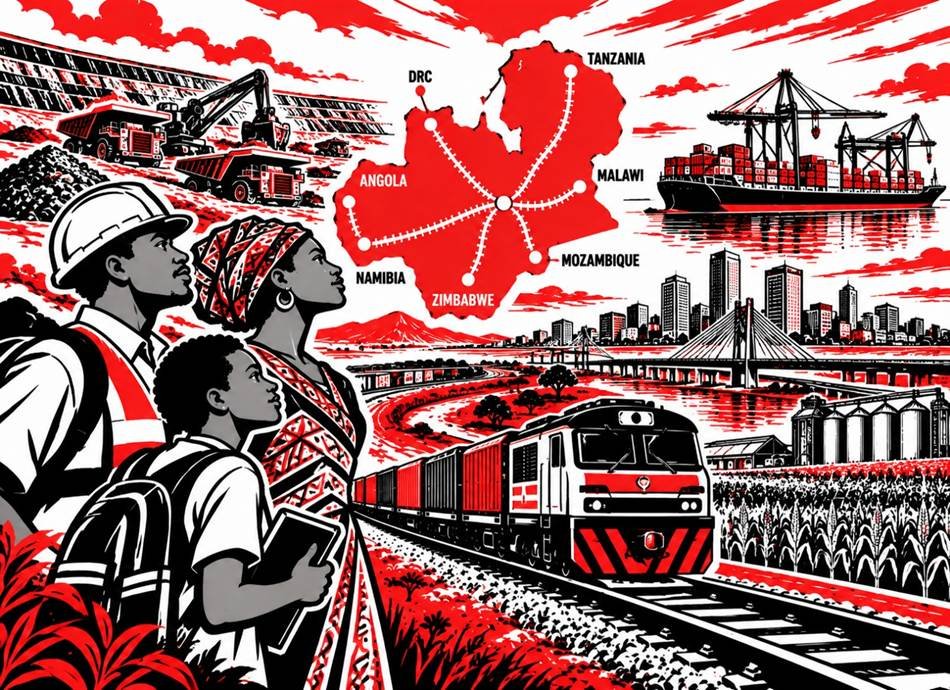
I am not an engineer, but one point seems clear: a Lusaka metro should not stand alone. It should form the urban part of a wider national railway strategy, and Zambia’s geography already suggests what that network could look like. The Tanzania–Zambia Railway (TAZARA) runs from Dar es Salaam to Kapiri Mposhi through Nakonde, Mpika and Serenje.8 At Kapiri Mposhi, it meets the Zambia Railways line running south through Kabwe, Lusaka and Kafue to Livingstone, while the Copperbelt line branches from the same junction. The government is already working with Chinese partners on an interconnector between the two systems and a dry port at Kapiri Mposhi.9
On a map, the corridor runs from Nakonde in the north to Livingstone in the south, passing through Mpika, Serenje, Kapiri Mposhi, Kabwe, Lusaka and Kafue. It also connects with the Copperbelt, Northwestern Province and other major economic centres. This is not a railway imagined from scratch. Much of the route already exists, although its northern and southern sections are being rebuilt under different financing and operating arrangements. The real task is to make those sections work as one passenger-and-freight system, with Lusaka as the main passenger interchange.
Within Greater Lusaka, an urban rapid-transit system could link the city centre to the airport corridor, connect outlying areas like Kafue, Chilanga, Chongwe, and Chibombo, and tie together key industrial zones, universities, and commercial hubs. It would also serve major residential areas (including Chelstone/Salama Park, Chilenje/Kabwata, and Makeni/Chilanga), ensuring direct access to the central business district.
Under this model, the national rail line acts as the intercity backbone, supported by a Lusaka metro for intra-city transit. Buses and minibuses handle feeder routes to and from rail hubs, while dedicated walking and cycling infrastructure completes the first- and last-mile connectivity. The rail should not push buses aside. Trains, buses, taxis, walking and cycling should work as parts of one connected system.
5. Does Zambia Really Need an Underground Railway?
This is where the national conversation needs to stay practical. An underground railway is not automatically the right answer. Tunnelling is extremely expensive, and surface or elevated rail is usually far more economical where land is available and development is less dense. Zambia should not begin by assuming that every section must go underground. Instead, it should ask where tunnelling would deliver enough mobility and economic value to justify the cost.
In Lusaka’s busiest areas, short underground sections might keep trains clear of surface traffic and remove dangerous conflicts with roads. Elsewhere, trains could run at ground level or on elevated structures. A future system could therefore use a practical mix of underground, elevated and surface rail, as many large cities do. The aim should be better mobility, not prestige.
6. Lessons from Africa: Johannesburg and Dakar
Zambia does not have to look only to Europe or Asia for lessons. South Africa’s Gautrain changed how people move between Johannesburg, Pretoria and OR Tambo International Airport. In its first six years, it carried close to 80 million passenger trips,10 and by its sixteenth anniversary in June 2026, that total had passed 216 million.11 The Gautrain Management Agency also estimates that property development around its stations has helped create about 245,000 jobs.12 In other words, stations can become economic centres, and rail can support development well beyond the tracks themselves.
Those achievements should be read alongside two cautions. First, the Gautrain was initially expected to carry between 90,000 and 110,000 trips a day, but by 2016 it was carrying about 62,000.13 Second, Dakar’s Train Express Régional, a 36-kilometre first phase that opened in December 2021 with more than US$200 million mobilised by the African Development Bank Group14 was designed to carry 115,000 passengers a day. In its first weeks, it averaged 30,000 to 40,000 against a first-year target of 75,000.15 These examples do not weaken the case for rail. They show why demand forecasts must be realistic, feeder services must be ready from the start, and fares must remain affordable.
The lesson is not that Zambia should copy the Gautrain or the TER. It is that rail infrastructure can reshape the geography of an economy, provided it is planned around real demand.
7. China: Where The Rail Is Treated As National Infrastructure
China offers an example on a much larger scale. Its Ministry of Transport reports that urban rail systems carried about 32.24 billion passenger trips in 2024 across 325 lines in 54 cities, with a combined operating length of about 10,946 kilometres.16 Those numbers are difficult to picture from a Zambian perspective, and the point is not that Zambia should try to become China. The useful question is what China understood about mobility as national infrastructure, and how Zambia might apply that principle at its own scale.
The lesson is simple: mobility is part of the infrastructure of economic development. Factories need workers, and workers need a reliable way to reach them. The cities need connections, markets need customers, universities need students, and hospitals need staff and patients. When journeys become faster and more predictable, people can reach more opportunities and businesses can serve larger markets. In time, the economic map of a country begins to change.
8. Europe: The Rail Remains Relevant in Advanced Economies
Europe’s railways did not become obsolete when cars, motorways and air travel became widespread. In 2022, the European Union had about 202,000 kilometres of railway, roughly 57 per cent of it electrified.17, 18 The European Commission reports that rail carried about 8.1 per cent of intra-EU passenger transport and 16.6 per cent of freight that year, while producing only 0.3 per cent of transport-related greenhouse-gas emissions.17
Zambia does not need to copy Europe’s network. The more useful lesson is that rail does not become irrelevant as countries grow richer and more people own cars. So the question is not, “Why do we need trains when people can own cars?” It is: “Why should people have to depend on cars when efficient mass transport is possible?”
9. Built for People, Built for Business
Zambia is more than a collection of cities. It is also a country of mines, farms, factories, border posts, logistics hubs and trading corridors. That gives rail two important jobs. As passenger transport, it can connect cities, towns and employment centres. As freight transport, it can move copper, farm produce, industrial goods, fuel and other bulk commodities more efficiently. Both functions should be planned together, while recognising that passenger and freight services have different operating needs.
That work is already beginning on three fronts.
TAZARA. On 29 September 2025, Zambia, Tanzania and China signed a US$1.4 billion revitalisation agreement. Under a long-term concession, China Civil Engineering Construction Corporation will rehabilitate more than 1,800 kilometres of track between New Kapiri Mposhi and Dar es Salaam, while also supplying new locomotives, coaches and wagons.19 The project was formally launched in Lusaka on 20 November 2025.8
Zambia Railways. The Industrial Development Corporation estimates that rehabilitation needs about US$1.75 billion. The existing line runs at only 15 to 20 km/h, and the plan is to reach at least 100 km/h for freight and 120 km/h for passengers.20 Parliament was told in 2024 that recapitalising the roughly 1,300-kilometre network, including signalling and rolling stock, would cost about US$2.19 billion. The estimates differ in scope and date, but they agree on the scale of the task. In December 2025, the Government released K100 million, complementing more than €50 million from the European Union’s Railway Sector Support Programme for track, signalling and telecommunications.21
The Lobito Corridor. In August 2026, the African Development Bank Group approved a US$255 million loan and a US$10 million grant for Zambia’s participation in the corridor, including about 550 kilometres of new railway in Zambia towards Angola.22 Later phases could take financing up to US$500 million.23
Zambia is already entering a new era of railway investment. Yet these projects have different financiers, concession arrangements and operators. Without a national plan, they could remain separate corridors rather than become a connected network. The opportunity is therefore bigger than rehabilitation alone. Zambia should decide what kind of railway system it wants for the next fifty years, and make today’s projects serve that vision.
10. From Colonial Railway to Modern Mobility Network
There is also a deeper history to confront. Much of Africa’s rail infrastructure was built around colonial priorities: moving minerals and agricultural produce from the interior to ports. It was an extraction and export network. Even TAZARA, financed by China and built in the 1970s as a symbol of post-colonial development,8 was conceived mainly as a freight corridor.
A modern African railway must be more than a simple transit route; it must serve as an engine of opportunity. It should connect workers to jobs, students to universities, farmers to markets, and manufacturers to suppliers. By linking businesses with customers, tourists with destinations, and communities with essential healthcare, rail infrastructure can bridge the gap between cities and unite Zambia with regional markets.
The railway of the twenty-first century should not merely be a freight railway. It should be a national development platform.
11. Nakonde–Copperbelt–Lusaka–Livingstone: An Economic Spine
Consider the strategic geography that underpins this network:
- Nakonde serves as the eastern gateway, anchoring Zambia’s connection to Tanzania and the broader East African transport network.
- The Copperbelt remains the nation’s industrial and mining heartland, extending westward through Northwestern Province to join the Lobito Corridor into Angola.
- Lusaka acts as the core hub—a bustling political, financial, educational, and rapidly growing technology centre.
- Livingstone stands as the primary tourism hub and a vital southern gateway into Zimbabwe, Botswana, Namibia, and neighbouring regional markets.
Linking these places with modern rail would do more than create another transport route. It could give Zambia a national economic spine. Someone in the north could board a dependable train to Lusaka or Livingstone instead of relying only on a long-distance bus or private car. Businesses could plan around predictable freight schedules. Tourists could move more easily between destinations, regional trade could become more connected, and Lusaka could develop into a genuine hub where different modes of transport meet.
12. Why Zambia Must Build for Purpose, Not Precedent
There is an understandable temptation to treat a large infrastructure project as proof of ambition. But mega-projects can easily become political monuments instead of services that people can rely on and the economy can sustain. Before construction begins, a modern railway must pass a series of demanding tests. Zambia should establish the following:
- Passenger-demand forecasts and freight-demand forecasts, tested against the forecasting failures noted above;
- Detailed route feasibility studies and cost-benefit analysis;
- Environmental and social impact assessments, and land acquisition requirements;
- Station development plans and integration with buses and taxis;
- Fare affordability;
- Operations and maintenance financing, not only construction financing;
- Rolling-stock, power and electrification requirements;
- Safety and signalling systems;
- Track gauge and interoperability with TAZARA, Zambia Railways, the Lobito Corridor and regional networks;
- Long-term institutional governance.
The country should also resist the temptation to build the entire network at once. A phased approach that is tied to an annual budget is more realistic. Japan keeps major infrastructure projects and rail corridors moving by planning for them over many years and funding them steadily through each annual budget. Special accounts, public corporations and dedicated revenue streams ensure that money continues to flow from one year to the next, rather than leaving long-term projects at the mercy of changing budget priorities.
13. A Possible Phased Strategy
| Phase | Focus | Test of success |
| Phase 1: Fix the existing railway | Rehabilitate track, modernise signalling, improve bridges and drainage, acquire reliable rolling stock, upgrade stations, set modern safety standards and publish dependable timetables. | A modern but unreliable train will not transform mobility. Reliability comes first. |
| Phase 2: Lusaka rapid transit | Begin with the highest-demand corridors. A feasibility study decides, section by section, between surface rail, elevated rail, underground metro, commuter rail or BRT. | Maximum passenger movement at sustainable cost. |
| Phase 3: National passenger railway | Introduce modern intercity services linking the principal economic centres. | Frequency, reliability, safety, affordability and journey time. |
| Phase 4: Electrification | Electrify where traffic volumes and economic analysis justify it, reducing diesel dependence and operating emissions as the power mix cleans up. | Lower whole-life operating cost, not electrification for its own sake. |
| Phase 5: Transit-oriented development | Around selected stations, encourage offices, shops, housing, hotels, universities, markets, public services and logistics facilities. | Railway investment becomes urban-development investment. |
14. Rail, Distance, and the Future Shape of Lusaka
Poor transport changes how people experience distance. When connections are slow and uncertain, cities begin to feel like isolated islands: Livingstone feels far from Lusaka, Lusaka feels far from the Copperbelt, and the Copperbelt feels far from Nakonde. A reliable railway makes those distances feel smaller. Predictable travel allows businesses to work across wider areas, gives people more freedom over where they live and work, helps universities attract students from farther away and expands the markets available to producers. That is why transport infrastructure can have such a strong economic effect.
Rail can also reshape Lusaka itself. More roads encourage more outward development. More outward development creates longer journeys, longer journeys create greater dependence on vehicles, and vehicle dependence produces more congestion. It becomes a cycle. Rail offers another model: transit-oriented corridors around stations, with higher-density development concentrated at transport nodes so that people can live, work and reach services close to a station. That aligns with the aim of the Greater Lusaka planning process to manage urban expansion and build a more integrated metropolitan region.7
15. It’s Not Trains vs. Cars – It’s Building an Integrated Transit System
It is tempting to view this as an attack on car ownership, but that misses the point. Cars will always be essential in Zambia for families, businesses, emergency services, rural communities and areas where rail simply is not practical.
The real goal is integration: cars, buses, rail, walking, and cycling working together. A modern transport system is built on options.
A commuter in Lusaka should be able to say, “Today, I’ll take the train.”
A business owner should be able to decide, “We’ll send this freight by rail.”
And a family should be free to choose, “We’ll drive today—it makes the most sense for this trip.”
True mobility isn’t about eliminating choices; it’s about expanding them.
16. Build for the Zambia That is Coming
Infrastructure is built for generations. A railway designed today could still be carrying passengers and freight in 2050, while a Lusaka metro planned now could still be serving the city in 2070. We cannot therefore base these decisions only on today’s traffic. We must ask: what will Zambia’s cities need when the population, economy and number of vehicles are all much larger?
If Zambia waits until Lusaka is completely gridlocked before beginning serious railway planning, the cost will be considerably higher. Land corridors will already be occupied, property acquisition will be expensive, construction will be more disruptive, and congestion will already have imposed high economic costs. The lesson from many cities is straightforward: transport infrastructure should precede demand wherever long-term urban growth is predictable.
The African Renaissance is not only cultural, political or technological. It also depends on the infrastructure that enables people to go about their daily lives and businesses to operate. A continent cannot industrialise effectively when people and cargo take too long to move. Africa’s future cities will need transport systems designed for the demands of this century, not continued dependence on infrastructure inherited from the last. For Zambia, that means planning a modern railway connecting Nakonde, the Copperbelt, Lusaka and Livingstone, alongside a metro or rapid-transit system that responds to Lusaka’s immediate mobility challenges. Together, they could become the mobility platform for the country Zambia is working to build.
References
[1] News Diggers (Zambia), “We’re struggling to mitigate accidents due to increased traffic – RTSA”, 10 September 2026. https://diggers.news/local/2026/09/10/were-struggling-to-mitigate-accidents-due-to-increased-traffic-rtsa/
[2] Road Transport and Safety Agency (RTSA), 2020 Road Transport and Safety Status Report, 2021. https://www.rtsa.org.zm/wp-content/uploads/2021/09/RTSA-2020-Annual-Road-Transport-and-Safety-Status-Report-v3-23.03.2021-Printed-1.pdf
[3] Road Transport and Safety Agency (RTSA), 2023 Road Transport and Safety Status Report.
[4] World Bank, “Railways” (transport topic brief). https://www.worldbank.org/en/topic/transport/brief/railways
[5] World Bank Transport Blog, “Decarbonizing transport: Shifting people and goods onto railways”, March 2024. https://blogs.worldbank.org/en/transport/decarbonizing-transport-shifting-people-and-goods-railways
[6] Japan International Cooperation Agency (JICA), “Zambia and JICA Partner to Develop Comprehensive Regional Development Plan for Lusaka City”, 2023. https://www.jica.go.jp/english/overseas/zambia/information/topics/2023/1519361_16921.html
[7] JICA, “Transforming Greater Lusaka: Achievements of the Comprehensive Regional Development Plan”, 2026. https://www.jica.go.jp/english/overseas/zambia/information/topics/2025/1579278_59730.html
[8] Railway Gazette International, “China-backed Tazara revitalisation officially launched”, 4 December 2025. https://www.railwaygazette.com/infrastructure/2025/12/04/china-backed-tazara-revitalisation-officially-launched/
[9] Lusaka Times, “Government plans modern dry port, TAZARA revitalization”, 12 January 2026. https://www.lusakatimes.com/2026/01/12/government-plans-modern-dry-port-tazara-revitalization/
[10] Global Infrastructure Hub, PPP Contract Management, “Gautrain Rapid Rail Link” case study. https://managingppp.gihub.org/case-studies/gautrain-rapid-rail-link/
[11] SAnews, “Gautrain marks 16 years of service: Over 216 million passenger trips and counting”, 9 June 2026. https://www.sanews.gov.za/south-africa/gautrain-marks-16-years-service-over-216-million-passenger-trips-and-counting
[12] SAnews, “Gautrain marks 14 years of operations”, January 2025. https://www.sanews.gov.za/south-africa/gautrain-marks-14-years-operations
[13] Engineering News, “Gautrain plus”, 29 July 2016. https://www.engineeringnews.co.za/article/gautrain-plus-2016-07-29
[14] African Development Bank Group, “The Dakar TER, an express train to development in Senegal”, December 2022. https://www.afdb.org/en/success-stories/dakar-ter-express-train-development-senegal-52985
[15] African Business, “Riding the €1bn Dakar Regional Express to Senegal’s future”, April 2022. https://african.business/2022/04/technology-information/riding-the-e1bn-dakar-regional-express-to-senegals-future
[16] Ministry of Transport of China, as reported by the State Council Information Office, “China’s urban rail transit trips up 9.5 pct in 2024”, 30 January 2025. https://english.www.gov.cn/archive/statistics/202501/30/content_WS679b5f38c6d0868f4e8ef492.html
[17] European Commission, Ninth monitoring report on the development of the rail market, COM(2025) 439, 30 July 2025. https://eur-lex.europa.eu/legal-content/EN/TXT/?uri=celex:52025DC0439
[18] Eurostat, “Electrified railway lines increased by 31% since 1990”, 13 March 2024. https://ec.europa.eu/eurostat/web/products-eurostat-news/w/ddn-20240313-1
[19] Ministry of Transport and Logistics (Zambia), “TAZARA: New Life, New Hope”. https://www.motl.gov.zm/?p=8035
[20] Railways Africa, “Zambia Railways Would Require Seven Years to Construct New Railway Line”, 24 October 2025. https://www.railwaysafrica.com/news/zambia-railways-would-require-seven-years-to-construct-new-railway-line
[21] TechAfrica News, “Zambia Injects K100 Million to Modernise Railways and Boost Economy”, 12 December 2025. https://techafricanews.com/2025/12/12/zambia-injects-k100-million-to-modernise-railways-and-boost-economy/
[22] African Development Bank Group, “Zambia: African Development Bank Group approves $255m loan and $10m grant to advance the Lobito Economic Corridor”, 6 August 2026. https://www.afdb.org/en/news-and-events/zambia-african-development-bank-group-approves-255m-loan-and-10m-grant-advance-lobito-economic-corridor-96069
[23] Railway Gazette International, “Financing backs Zambia’s participation in the Lobito Corridor programme”, 17 August 2026. https://www.railwaygazette.com/zambia/2026/08/17/financing-backs-zambias-participation-in-the-lobito-corridor-programme/