Can Zambia save its forests without making the poorest people pay the price?
Zambia is blessed with forests. For generations, these woodlands have given us food, energy, building materials, medicines, income and farmland. They also regulate water systems, store carbon, support biodiversity and sustain millions of livelihoods.
Every day, trucks loaded with charcoal pass through our streets; take a short walk, and you will see charcoal being sold along the roadside. But those forests are under pressure. We often describe deforestation as an environmental crisis, and it is. However, in Zambia, it is also a crisis of poverty, energy and economic survival.
That distinction matters.
When a rural household in Mpongwe or Shang’ombo cuts down a tree for charcoal, firewood or land to grow food, simply telling them to stop does not answer the real question. It may simply shift the burden of conservation onto those who are already struggling economically.
The real question for Zambia is therefore not merely, ‘How do we stop deforestation?’
How do we make forests worth more standing than they are when they are cut down?
One uncomfortable truth about environmental policy is that poverty can push people into choices that damage the environment. A family in Chawama looking for food or income today may not be able to prioritise a forest whose benefits feel distant and uncertain. This matters deeply in Zambia.
According to the World Bank’s Zambia Poverty and Equity Assessment, 64.3 per cent of Zambians lived on less than US$2.15 a day in 2022, based on the then-current international poverty line. This figure is crucial for context.
Therefore, when we talk about deforestation, we are also talking about people with limited economic choices. For many families, forests are a vital economic resource. Trees become charcoal. Forest products become income. Forest land becomes farmland. Firewood becomes household energy. In that sense, the forest is part of the household economy. That does not make unsustainable use harmless. It simply shows why enforcement alone will not solve the problem.
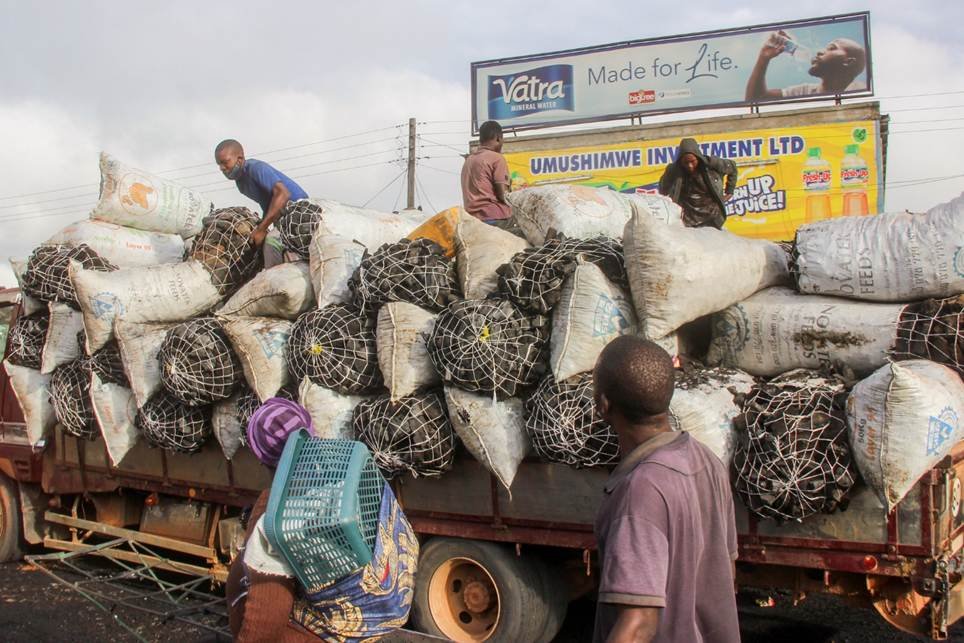
Bulk charcoal transport in Zambia. Source: Global Press Journal / Forests Suffer as Illegal Charcoal Dealing Surges
The Charcoal Economy
Few issues highlight Zambia’s deforestation challenge as clearly as charcoal. In Zambia, charcoal is an environmental problem, an energy source, a household expense, a rural income source, an urban necessity, and a commercial value chain.
The World Bank’s assessment found that charcoal production drives forest degradation. The producers often act out of poverty, unemployment, and limited options. The demand for charcoal is closely tied to urban energy needs. Thus, Zambia’s charcoal issue cannot be solved only in the forest.
Part of the solution lies in Lusaka, the Copperbelt, Central Province, and other urban areas where charcoal is consumed. If urban households rely on charcoal because they lack alternatives, there will be a continued market incentive for production elsewhere. The forest and the city are linked by this economic chain.
Urban energy demand creates rural income opportunities. Rural charcoal production creates forest degradation.
That is why Zambia needs an end-to-end solution. FAO’s analysis of agriculture-charcoal interactions reached a similar conclusion: reducing deforestation and forest degradation requires action on both the supply and demand sides.
It is easy to assume people use charcoal simply because they prefer it. The evidence suggests otherwise. Zambia has made progress on electricity access, but clean cooking remains a major gap. World Bank data shows that in 2023, only about 9.2 per cent of the population had access to clean cooking fuels and technologies. In rural areas, access was roughly 2.3 per cent.
According to the Zambia National Energy Compact, most households relied on firewood and charcoal for cooking and heating, based on the 2023 National Energy Access Survey. Only a small minority used clean energy sources. That changes the conversation.
A person cooking with charcoal is not always making an environmental choice.
A family buying charcoal might not be considering climate issues.
A charcoal producer may not be acting against the environment.
They may simply be using the energy options available to them. So, if Zambia wants to reduce deforestation linked to charcoal, it must offer alternatives that make sense in real household budgets.
There is a lesson here for environmental policy. Conservation rules without viable alternatives can quickly lose public support. Imagine telling a rural community in Kawambwa not to cut trees. At the same time, this community may face limited electricity, few employment opportunities, low agricultural productivity, weak market access, limited capital and few alternative income sources.
The policy may be environmentally sound, but economically incomplete. A sustainable conservation model must answer a practical question: what replaces the income or energy that people lose when forest use is restricted?
This is where Zambia’s Forests Act, 2015, matters. The law supports community forests and opens space for local people to participate in sustainable forest management. Its underlying principle is important: people who rely on forests should not be seen only as threats. They can also be guardians.
The most important shift Zambia could make is to stop viewing forests only as areas to be protected.
They should also be treated as productive natural capital.
A standing forest has economic value. It stores carbon, protects watersheds, supports agriculture and biodiversity, provides non-timber products and can strengthen tourism. Forests can also generate income through credible carbon and climate-finance mechanisms. The real challenge is making sure those benefits reach the communities that carry the cost of conservation.
In July 2026, the FAO reported growing interest in forest-carbon initiatives in Zambia. It noted the importance of understanding how these projects affect local communities that live in and manage forests. This work focuses on community well-being, forest governance, and how climate finance can support community forestry. This is a significant development.
However, carbon finance must not become another system in which communities provide resources while outsiders take most of the benefits. If communities are to protect forests for global climate benefits, there must be transparent and fair benefit-sharing.
These efforts have shown promise. In Eastern Province, for example, integrated approaches combining forest conservation, climate-smart agriculture, sustainable charcoal production, and improved cooking technologies have been applied.
In 2024, the World Bank approved an emissions reduction purchase agreement, creating an opportunity for communities in Eastern Province to receive up to US$30 million in results-based payments. The programme aims to reduce emissions by about three million tonnes of CO₂ equivalent between 2024 and 2029. Importantly, the project does not rely on forest protection alone.
The project uses climate-smart agriculture, sustainable forest management, fuel-efficient cookstoves, and sustainable charcoal production. This strategy is important because it recognises that environmental outcomes and household economic outcomes cannot always be separated.
The same programme reports that climate-smart agriculture has raised the yields of selected crops by more than 32 percent and that more than 72,000 hectares of forest have been placed under sustainable management. This points towards a more practical philosophy:
Protect the forest by improving the economics of the people living around it.
Agriculture Cannot Be Ignored
Attention often goes to charcoal, but agriculture is another major contributor to deforestation.
Farmers require land. A growing population requires more food. Inefficient agriculture encourages farmers to look for more land.
This creates another vicious cycle:
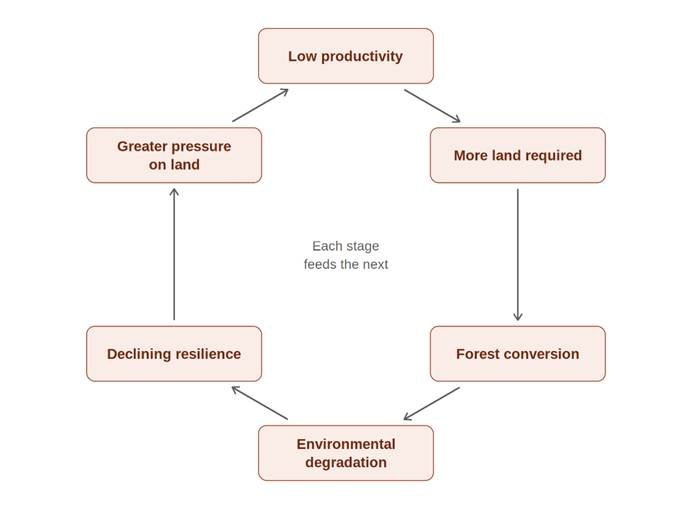
Breaking that cycle requires agricultural change. Farmers need to produce more from the land they already have, without being pushed further into forests. That means better farming practices, soil management, agroforestry, irrigation, climate-smart agriculture, extension services, market access, storage, value addition and rural infrastructure.
The World Bank’s 2026 climate-resilience work in Zambia highlights smart agriculture, irrigation and mechanisation. These approaches can raise productivity and resilience while reducing pressure on forests. They also create opportunities for climate and carbon finance. In practice, this connects environmental policy with development policy: when a farmer earns more from productive land, clearing more forest becomes less attractive.
Planting Trees Is Not Enough
Zambia has rightly embraced tree planting and restoration. But planting trees cannot substitute for dealing with the economic forces behind forest loss. A country can plant millions of seedlings while still losing mature forests faster than it can replace them. There is also an ecological difference between planting trees and restoring forests.
A plantation, a woodlot, and a mature miombo woodland are not interchangeable ecosystems.
Zambia therefore needs both forest conservation and forest restoration.
The first prevents further loss. The second repairs degraded landscapes. Both require long-term management.
Zambia’s deforestation issue is also an energy issue. Many households rely on firewood and charcoal, making it hard to ease pressure on forests. Expanding electricity access is not just about economic growth; it can also help conserve forests.
The World Bank notes that better access to modern energy can reduce reliance on firewood and charcoal while supporting economic development. The 2025 ASCENT Zambia project, funded by a US$200 million World Bank IDA grant, aims to provide reliable, sustainable energy to more than one million people in five years. Even so, electricity alone will not fix everything.
Zambia needs a clean-cooking strategy that includes electricity, LPG, improved biomass, and other suitable solutions. The goal should not be to dictate what households must use. Instead, it should be to ensure cleaner options are available, reliable, and affordable.
How Can Zambia Respond to Such Crisis?
A credible national response could be built around seven priorities.
1. Treat deforestation as an economic problem
Forest policy should be directly connected to poverty reduction, agriculture, and energy policy. The Forestry Department cannot solve deforestation by itself.
2. Make clean cooking affordable
Cleaner cooking alternatives need to compete economically with charcoal. That means addressing equipment costs, fuel availability, distribution and consumer financing.
3. Expand community forestry
The Forests Act already provides a legal foundation for community forestry. The challenge is implementation. Communities need meaningful rights, capacity, transparent governance and tangible economic benefits.
4. Make agriculture more productive
Climate-smart agriculture and agroforestry should be expanded so that food production can increase without a proportional expansion of cultivated land.
5. Develop sustainable forest enterprises
Communities should be empowered to generate legitimate income from forests without destroying them. Opportunities such as honey, mushrooms, fruits, medicinal products, sustainable timber, ecotourism and other forest-based enterprises can form part of diversified rural economies.
6. Make carbon finance accountable
Carbon markets can potentially provide additional resources for conservation. But Zambia should insist on transparent contracts, community participation, clear benefit-sharing, independent verification, grievance mechanisms, disclosure of project economics, and protection of community rights.
7. Improve enforcement—but target the value chain
Illegal forest exploitation should be addressed. But again, enforcement should not focus only on the person holding an axe. It should also examine the commercial networks, transport systems, markets and buyers that create the economic demand.
The Responsibility Question
It is tempting to ask: who is destroying our forests? But a better question may be: what economic system makes deforestation profitable, or even necessary?
That question helps us engage the issue more honestly. The charcoal producer is part of the story, but so are urban energy systems, weak alternatives, market demand, transport networks and the wider economy that makes forest clearing worthwhile.
Yes, the issue includes farmers who clear forests to plant crops. Yes, illegal timber harvesting is part of the problem, along with weak enforcement and strong demand for certain types of wood from particular market segments.
In other words, deforestation is not caused by one group alone.
It is a system. And systems require systemic solutions.
The Poor Are Not the Price of Green
This may be one of the most important principles Zambia can bring into its environmental policy.
After all, how can we ask people in poverty to conserve an asset if doing so means giving up income, energy or land? If we want communities to care for forests, conservation must also make economic sense for them.
- A farmer should be able to earn more through sustainable agriculture than by clearing new forests.
- Households should be able to cook without spending more than they can afford.
- Communities should be able to earn legitimate income from standing forests.
A young person should be able to get a job without having to resort to destructive forms of forest exploitation.
A community that protects its forests for carbon benefits should receive a fair share of the value generated.
It is an argument for socially sustainable environmental protection.
The Bigger Opportunity
Our forests are not obstacles to development. If we manage them well, they can become part of Zambia’s national development strategy. The World Bank’s recent work on climate resilience points in this direction by linking rural livelihoods, forest protection and climate and carbon finance to the country’s broader growth agenda.
That is the direction Zambia should explore.
The country’s natural capital can support:
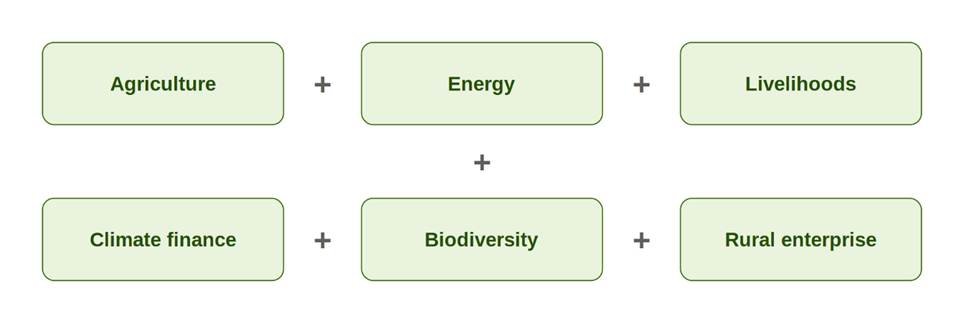
The challenge is designing institutions that can connect these sectors.
Zambia does not have to choose between protecting forests and protecting poor people.
But it does have to reject the idea that conservation can succeed without changing the economic conditions around forest use. Zambia already has important foundations: forestry legislation, climate commitments, community forestry initiatives and emerging carbon-finance programmes.
The next challenge is implementation.
Zambia needs to move from a model where forests are protected mainly through restrictions and enforcement to one where communities have a real economic stake in keeping forests standing.
The objective should be simple:
Make the standing forest more valuable to the Zambian household than the tree that has been cut down.
That is the real test of Zambia’s forest policy. Because if conservation makes poor people poorer, it will eventually face resistance. But if conservation creates livelihoods, energy security, productive agriculture and community wealth, the forest can become something very different.
It would no longer be merely something Zambia is trying to save.
Something Zambians have an economic reason to protect.
And perhaps that is where the country’s real forest solution begins.
References
1. Food and Agriculture Organization of the United Nations (FAO). Forestry – Zambia: Forest and Farm Facility (FFF) country profile.
2. Food and Agriculture Organization of the United Nations (FAO). Zambia – Integrated Land Use Assessment Phase II (ILUA II), 2011–2016.
3. Food and Agriculture Organization of the United Nations (FAO). Agriculture-Charcoal Interactions as Determinants of Deforestation Rates: Implications for REDD+ Design in Zambia. Policy Brief No. 6, 2015.
4. Food and Agriculture Organization of the United Nations (FAO) / UN-REDD Programme. Forest baseline surveys and REDD+ readiness reporting for Zambia.
5. World Bank. Zambia Poverty and Equity Assessment: Turning Things Around After a Lost Decade. Washington, DC, February 2025 (data year 2022).
6. World Bank. Zambia Clean Cooking Market Assessment. Washington, DC.
7. World Bank. Forest Tenure Assessment in Zambia. Washington, DC.
8. World Bank. Zambia Country Climate and Development Report (CCDR). Washington, DC, 2 April 2026.
9. World Bank. World Bank Approves Agreement to Cut Carbon Emissions in Zambia’s Eastern Province. Press release, 21 May 2024.
10. World Bank. Over One Million Zambians to be Connected to Electricity by 2030 Under New Energy Access Project. Press release, 28 July 2025.
11. United Nations Framework Convention on Climate Change (UNFCCC). Report on the Technical Assessment of the Proposed Forest Reference Emission Level of Zambia.
12. Republic of Zambia. Forests Act No. 4 of 2015. Laws of Zambia.
13. UN-REDD Programme (FAO/UNDP/UNEP). Zambia Validates New Study on Forest Carbon Projects and Community Forestry. 16 July 2026. Note: the workshop reviewed the study’s draft findings; the full study and its outputs (a Policy Note and Community Decision-Making Checklist) are due for release later in 2026.
14. Sedano, F., Mizu-Siampale, A., Duncanson, L. & Liang, M. Influence of Charcoal Production on Forest Degradation in Zambia: A Remote Sensing Perspective. 2022.